

Nitrate Supplements for Running: Your Evidence-Based Guide
Nitrate supplementation can meaningfully improve running performance for recreational and moderately trained athletes when dosed and timed correctly. An umbrella review of 20 systematic reviews with meta-analyses confirms that nitrate improves time-to-exhaustion and some endurance outcomes, with the strongest evidence pointing to a minimum effective dose of approximately 6 mmol per day and greater benefits from chronic supplementation lasting more than three days. For most runners, that translates to a single 300–500 mg beetroot shot taken 2–3 hours before a key workout.
Here is what to do right now:
- Try a single dose today. Take a concentrated beetroot juice shot providing approximately 300–500 mg (roughly 6–8 mmol) of inorganic nitrate about 2–3 hours before your next hard session.
- Practice in training first. Never debut a new supplement on race day. Test GI tolerance and timing across at least two or three training runs before committing to a race-week protocol.
- Skip the mouthwash. Antibacterial mouthwash before or after dosing can block the oral conversion that makes nitrate work. More on that mechanism below.
Key Takeaways
Nitrate supplementation improves running performance for most recreational athletes when taken at 6–8 mmol (approximately 372–496 mg) as a liquid shot 2–3 hours before exercise, with additional gains from a 4–6 day pre-race loading block.
| Point | Details |
|---|---|
| Effective dose range | Target 6–8 mmol (372–496 mg) of inorganic nitrate per session for most runners. |
| Timing is critical | Peak plasma nitrite occurs 2–3 hours post-ingestion; dose accordingly and avoid antibacterial mouthwash. |
| Who benefits most | Recreational and moderately trained runners see the strongest gains; elite athletes show smaller or mixed effects. |
| Safety check | Avoid nitrate supplements if you have hypotension, take antihypertensives or PDE5 inhibitors, or have a kidney-stone history. |
| RacepackSingapore | Stocks GU Energy Gels, HIGH5 ZERO+ electrolytes, and Garmin GPS watches for a complete race-week kit with next-day delivery in Singapore. |
This article is general information, not a substitute for advice from a qualified doctor. Consult a qualified healthcare professional about your own circumstances before acting on anything here.
Table of Contents
- How does nitrate become nitric oxide in your body?
- What does the research actually show for runners?
- Exactly how much nitrate should you take, and when?
- How to schedule nitrate use across training and race week
- Who should avoid nitrates, and what are the side effects?
- How to pick a nitrate product in Singapore
- Sources
- FAQ
How does nitrate become nitric oxide in your body?
Dietary nitrate increases nitric oxide (NO) availability through a two-step conversion: nitrate is first reduced to nitrite by bacteria on the tongue, then nitrite is converted to NO in the bloodstream and tissues. This is called the nitrate→nitrite→NO pathway, and it is the primary mechanism behind every performance benefit you will read about in the research.
Timing matters because of how long each conversion step takes. After you swallow a beetroot shot, peak plasma nitrite occurs roughly 2–3 hours after ingestion, which is why the standard pre-exercise window is 2–3 hours. Dosing too early or too late means you miss the physiological window when NO availability is highest.
Key mechanism insight: Nitric oxide supports vasodilation (widening of blood vessels), reduces the oxygen cost of submaximal exercise, and may improve mitochondrial efficiency. For runners, the most practically relevant effect is a lower oxygen demand at a given pace, which translates to better running economy and delayed fatigue.
The expert consensus derived via the modified Delphi technique confirms this pathway as the primary ergogenic mechanism and recommends acute doses in the 8–16 mmol range with the final dose taken 2–4 hours before exercise. For most recreational runners, the lower end of that range (6–8 mmol) produces measurable benefits with fewer GI concerns.
Why your oral microbiome is the gatekeeper
The first conversion step, nitrate to nitrite, depends entirely on nitrate-reducing bacteria living on the surface of your tongue. Antibacterial mouthwash, antiseptic toothpaste, or a recent antibiotic course can wipe out these bacteria and blunt the ergogenic effect. This is also why capsule forms of nitrate supplements are often less effective than liquid shots: capsules bypass the oral cavity and skip the tongue-bacteria conversion step entirely.
The practical rule is simple. Avoid antibacterial mouthwash for at least two hours before and after taking your beetroot shot. Brush with regular (non-antibacterial) toothpaste if you need to, and choose a liquid or shot format over capsules whenever possible.
Sports-science guidance from the Gatorade Sports Science Institute also notes that approximately 6–8 mmol nitrate consumed 2–3 hours pre-exercise consistently reduces the oxygen cost of submaximal exercise and lowers resting systolic blood pressure across multiple studies, reinforcing both the mechanism and the practical dose window.
What does the research actually show for runners?
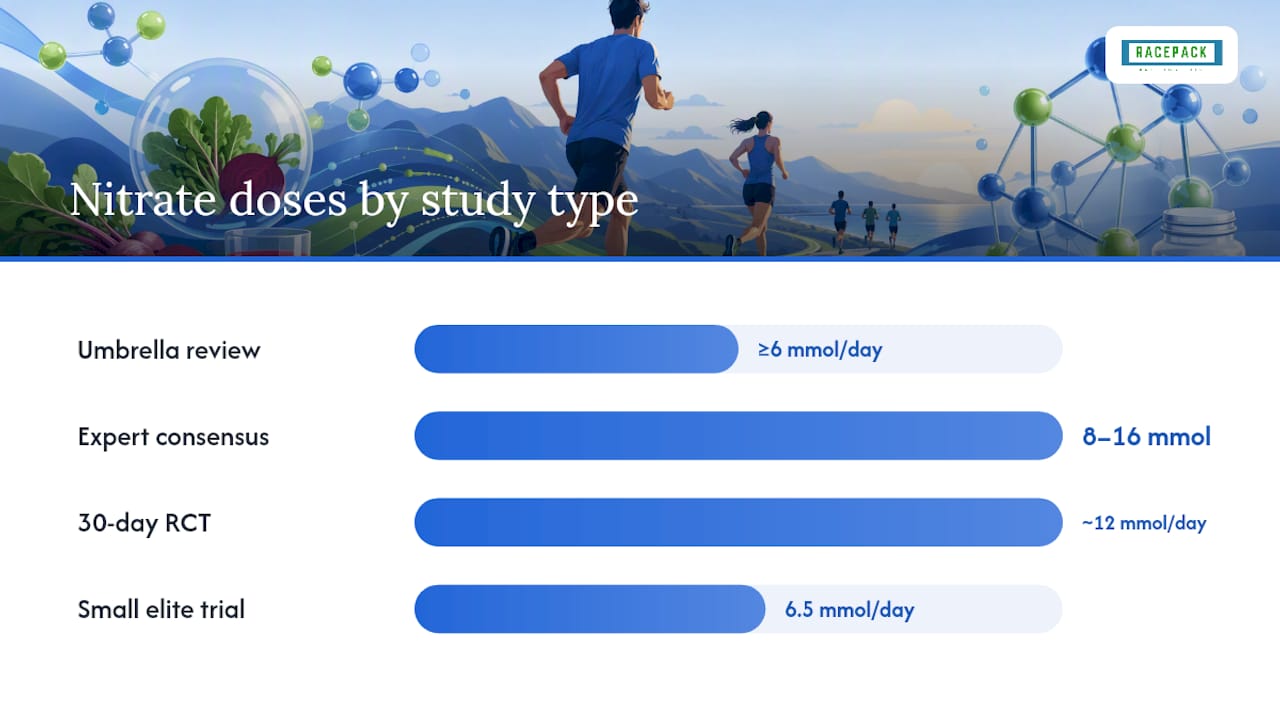
Evidence shows consistent improvements in time-to-exhaustion and some measures of running economy, with average gains typically in the low single-digit percent range for trained runners and larger effects for less-trained individuals. The table below summarizes key study types, populations, doses, and outcomes.
| Study type | Population | Nitrate dose | Duration/timing | Main outcome |
|---|---|---|---|---|
| Umbrella review (20 meta-analyses) | Mixed (recreational to trained) | ≥6 mmol/day | Acute and chronic (>3 days) | Improved time-to-exhaustion; mixed on time-trial |
| Expert consensus (Delphi) | Mixed | 8–16 mmol acute | 2–4 h pre-exercise | Supports vasodilation, running economy, reduced O₂ cost |
| RCT (30-day, recreational runners) | Recreational runners | ~12 mmol/day | 30 days combined with training | Improved 10-km time-trial; lower blood lactate |
| Small elite runner trial (15 days) | Elite runners | 6.5 mmol/day | 15 days | Likely improved time-to-exhaustion; no change in VO₂max |
A 30-day randomized trial in recreational runners found that daily inorganic nitrate supplementation combined with a structured running program improved 10-km time-trial performance and lowered exercise lactate compared with training alone. That is a meaningful real-world result for runners building toward a goal race.
What the evidence consistently supports:
- Improved time-to-exhaustion at submaximal intensities
- Reduced oxygen cost during submaximal running (better running economy)
- Lower blood lactate at matched workloads in recreational runners
- Modest improvements in time-trial performance for recreational and moderately trained athletes
- Some evidence for improved peak power output in short, intense efforts
What the evidence does NOT support:
- Improvements in VO₂max (maximum aerobic capacity)
- Meaningful strength gains
- Reliable time-trial benefits in elite athletes with high habitual dietary nitrate intake
Where the evidence gets complicated
A 15-day trial in elite runners using 6.5 mmol/day produced likely improvements in time-to-exhaustion and perceived exertion but no meaningful change in running economy or VO₂max. This is a recurring pattern in the literature: the closer an athlete is to their physiological ceiling, the smaller the marginal benefit from nitrate. Responder variability is real, and factors like training status, habitual dietary nitrate intake, and body mass all influence how much benefit you get. If you already eat a high-vegetable diet rich in leafy greens and beets, your baseline nitrite levels may already be elevated, which narrows the gap nitrate supplementation can close.
Exactly how much nitrate should you take, and when?
The practical target for most runners is 6–8 mmol of nitrate (approximately 372–496 mg) taken 2–3 hours before exercise. For goal races, a 4–6 day loading block at 300–500 mg per day can add a small but meaningful additional benefit on top of the acute dose.
The conversion to remember: approximately 62 mg of inorganic nitrate equals 1 mmol. Use this when reading product labels that list nitrate in milligrams rather than millimoles.
Acute dosing (single pre-session dose):
- Best for: key workouts, tune-up races, and race day
- Dose: 6–8 mmol (372–496 mg) taken 2–3 hours before the start
- Form: concentrated beetroot juice shot or liquid concentrate
Chronic loading (multi-day protocol):
- Best for: goal races where you want maximum benefit
- Protocol: 300–500 mg/day for 4–6 days leading into race day, with the final dose 2–3 hours before the start
- The expert consensus notes that doses above approximately 10–12 mmol rarely add further benefit and increase GI risk, so more is not better beyond that ceiling.
Pro Tip: Test your exact dose and timing in at least two training sessions before race week. GI tolerance varies significantly between runners, and discovering that a double-shot causes stomach cramps is information you want before the start line, not during.
How to schedule nitrate use across training and race week
Use nitrate for one to two prioritized hard workouts per week and for a 4–6 day pre-race loading block when targeting a goal race. Routine daily use outside of hard sessions is generally not necessary and adds cost without proportional benefit.
Step-by-step protocol for trialing nitrate in training:
- Week 1, Session 1: Take a single 6 mmol (approximately 372 mg) beetroot shot 2.5 hours before a tempo run or interval session. Note any GI symptoms, timing convenience, and perceived effort.
- Week 1, Session 2: Repeat with the same dose and timing. If GI tolerance is good, note whether perceived effort at target pace feels different.
- Week 2: If tolerated well, trial the 8 mmol dose (approximately 496 mg) before a longer hard session. This is your race-day dose candidate.
- Race-week loading block: Begin 4–6 days out from your goal race. Take your confirmed dose daily, with the final dose 2–3 hours before the race start.
- Race morning: Stick to the exact timing you practiced. Do not experiment with a new product or dose on race day.
Runner’s pre-race checklist:
- Confirm your dose and timing the night before (set an alarm if needed)
- Avoid antibacterial mouthwash from the evening before through race morning
- Stagger caffeine: take your beetroot shot first (2–3 hours out), then add caffeine 45–60 minutes before the start to avoid GI distress while capturing additive performance benefits
- Keep your shot refrigerated if possible; Singapore’s heat accelerates spoilage in opened products
- Pack your shot in a MyProtein Supplement Storage Box for organized, travel-ready race-day logistics
Singapore-specific notes: Most major Singapore races start between 5:00 AM and 6:30 AM. If your race starts at 5:30 AM, your beetroot shot goes down at approximately 2:30–3:00 AM. Set two alarms. For runners traveling to race venues from the east or west of the island, factor in travel time so you are not rushing the timing window. Pair your nitrate protocol with HIGH5 ZERO+ electrolyte sachets to manage sweat losses in Singapore’s humidity without adding unnecessary sugar before the gun. For broader guidance on sport nutrition timing, the RacepackSingapore blog covers the full pre-race nutrition window in detail.
Who should avoid nitrates, and what are the side effects?
Nitrates are generally safe within the studied acute dose ranges, but they do lower blood pressure. Runners with hypotension, those taking antihypertensive medications, or anyone using PDE5 inhibitors (such as sildenafil) should consult a clinician before adding nitrate supplements to their routine.
Safety note: Runners World’s guidance on beetroot supplements specifically warns that people with low blood pressure should use caution with beetroot-based products, as the blood-pressure-lowering effect of dietary nitrate can compound existing hypotension and cause dizziness or fainting during exercise.
Key interactions to know:
- Antihypertensive drugs: Nitrate supplementation adds to the blood-pressure-lowering effect. Combined use can cause excessive hypotension, particularly during intense exercise.
- PDE5 inhibitors: Combining nitrates with drugs like sildenafil or tadalafil can cause a dangerous drop in blood pressure. Do not combine.
- Antibiotics: A course of broad-spectrum antibiotics can temporarily reduce oral bacteria populations, blunting nitrate-to-nitrite conversion and reducing the supplement’s effectiveness for several days after the course ends.
- Antibacterial mouthwash: Even a single use before dosing can significantly reduce nitrite production. Avoid it on dosing days.
Oxalate content and kidney-stone risk: Beetroot products are high in oxalates. If you have a history of calcium oxalate kidney stones, speak with your doctor before using beetroot-based nitrate supplements regularly.
GI side effects are the most common complaint among runners. These typically include stomach cramping, loose stools, or nausea, and they are more likely with higher doses (above 8 mmol) or when the shot is taken too close to exercise. Testing in training, as described in the protocol above, is the most reliable way to identify your personal tolerance threshold. The expert consensus notes that acute supplementation up to approximately 16 mmol is likely safe, but chronic high-dose use needs more research before firm safety conclusions can be drawn.

How to pick a nitrate product in Singapore
Choose a tested beetroot juice concentrate or shot that clearly labels its nitrate content per serving. Aim for one serving providing approximately 300–500 mg of inorganic nitrate. Liquid shots and concentrates are preferable to capsules because they preserve the oral conversion step that makes the supplement work.
Product-selection checklist:
- Labeled nitrate content: The product must state milligrams or millimoles of inorganic nitrate per serving, not just “beetroot extract” or “beet powder.” Unlabeled products make dosing guesswork.
- Third-party testing: Look for products tested for banned substances, particularly if you compete under World Athletics or Singapore Athletics rules.
- Shot or liquid format: Prefer concentrated shots (70–140 mL) over capsules for better oral-conversion reliability.
- GI-tolerance notes: Single-shot formats let you trial one serving without committing to a large pack. Multi-packs make sense once you have confirmed your tolerance.
- Storage in Singapore’s climate: Opened beetroot shots spoil quickly in heat. Store refrigerated and consume within the window stated on the label. For travel to race venues, use an insulated bag or a supplement organizer.
Complementary products from RacepackSingapore for race week:
For runners building a complete race-week nutrition kit alongside their nitrate protocol, RacepackSingapore carries the following:
- GU Energy Gel 24-gel box: Stock your race-week training and race-day fueling with a full box. GU gels provide clean, fast-acting carbohydrate energy for long runs and race day.
- GU Energy Gel 6/12/24 pack: Flexible pack sizes for runners who want to match their gel supply to a specific training block or race distance.
- GU Energy Gel single pack (min. 8): The lowest-commitment entry point for runners sampling GU flavors or building a small race kit. Browse the full energy gels Singapore range for all available options.
- Garmin Forerunner 165 GPS Smartwatch: Track your pace, heart rate, and training load across the weeks you are trialing nitrate. Objective data from a GPS watch is the most reliable way to measure whether your running economy is actually improving.
- MyProtein Supplement Storage Box: Keep your shots, gels, and electrolyte sachets organized for travel and race-morning logistics.
- MyProtein Pea Protein Isolate 2.5kg: Post-run recovery protein to support muscle repair during a high-training-load race-prep block.
- MyProtein EAA Powder 360g: Essential amino acids for recovery between hard sessions, particularly useful during a multi-day loading week when training volume stays high.
- HIGH5 ZERO+ Multivitamins/Ultra Electrolytes 16 Sachets: Electrolyte and micronutrient support for Singapore’s heat and humidity. Pair with your nitrate protocol on race morning to stay on top of sweat losses without adding sugar before the gun.
For runners curious about how different supplement forms compare for bioavailability, the types of sports drinks comparison guide on the RacepackSingapore blog covers liquid vs. powder vs. capsule formats in detail. Runners interested in supplemental oxygen as a complementary performance tool can also explore alternatives to supplemental oxygen products for context on how different oxygen-support approaches compare.
What local runners ask us most about nitrate
The most common question we hear from Singapore runners is simple: “Does it actually work, and where do I get it?” The honest answer is yes, for most recreational runners it does work, and the effect is most reliable when you nail the timing and dose. What we see most often is runners either dosing too late (one hour before, not two to three) or using a capsule product that bypasses the oral conversion step entirely.
At RacepackSingapore, we carry authentic products with next-day delivery across Singapore, so you are not waiting a week for a supplement to arrive before your target race. If you are racing one of Singapore’s early-morning events, the logistics of a 2:30 AM dose are real, and we recommend confirming your timing in training at least twice before race week. Pack your shot the night before, refrigerate it, and set your alarm.
[Jason John’s professional qualifications and background to be added in final copy.]
Fuel your race week with RacepackSingapore
RacepackSingapore gives you a faster, more reliable path to race-ready nutrition than hunting across multiple suppliers. Every product ships with guaranteed authenticity and next-day delivery within Singapore, so your race-week kit arrives when you need it, not after the race.
Whether you are stocking up on GU Energy Gels for long-run fueling, grabbing HIGH5 ZERO+ electrolyte sachets for race-morning hydration, or adding a Garmin Forerunner 165 to track your performance gains, everything you need is in one place. We also carry the MyProtein EAA Powder and Pea Protein Isolate to support recovery between hard sessions during your loading block. Head to Racepack and place your order today.
Sources
- Dietary Nitrate Supplementation and Exercise Performance: An Umbrella Review of 20 Published Systematic Reviews with Meta-analyses | Sports Medicine | Springer Nature Link
- Beetroot Juice for Runners: Timing, Dosing & Research | RC
- Beetroot Powder Supplements: Effects, Research & Side Effects
FAQ
Do nitrate supplements actually help with running?
Yes, for most recreational and moderately trained runners. An umbrella review of 20 meta-analyses confirms improvements in time-to-exhaustion and some endurance outcomes, with the strongest evidence at doses of approximately 6 mmol or more per day.
How much nitrate should a runner take before a race?
The practical target is 6–8 mmol (approximately 372–496 mg of inorganic nitrate) taken as a concentrated liquid shot 2–3 hours before the race start. A 4–6 day loading block at the same daily dose adds a small additional benefit for goal races.
Is it safe to take nitrate supplements regularly?
Acute supplementation up to approximately 16 mmol is considered likely safe based on current evidence, per the expert consensus. Chronic high-dose use needs more research. People with hypotension, kidney-stone history, or those on antihypertensive or PDE5-inhibitor medications should consult a clinician before use.
What are the best nitrate supplements for runners in Singapore?
Choose a concentrated beetroot juice shot with a clearly labeled inorganic nitrate content (aim for 300–500 mg per serving) in liquid or shot form rather than capsules. RacepackSingapore carries a range of runner essentials including GU Energy Gels and HIGH5 ZERO+ electrolytes to complement your nitrate protocol, with next-day delivery across Singapore.
Why does mouthwash reduce the effect of beetroot juice?
Antibacterial mouthwash kills the nitrate-reducing bacteria on your tongue that convert dietary nitrate to nitrite, the intermediate step in the nitrate→nitrite→NO pathway. Without those bacteria, the conversion is blunted and the ergogenic effect is significantly reduced. Avoid antibacterial mouthwash for at least two hours before and after taking your beetroot shot.
Can nitric oxide supplements help in distance running?
Nitric oxide itself is not taken directly; rather, dietary nitrate supplements (such as beetroot juice) raise NO availability in the body through the nitrate→nitrite→NO pathway. This increased NO supports vasodilation and lowers the oxygen cost of running, which is particularly relevant for distance events where running economy determines pace sustainability.
Does beetroot juice work for elite runners?
The evidence is mixed. A 15-day trial in elite runners showed likely improvements in time-to-exhaustion but no meaningful change in running economy or VO₂max. Elite athletes with already-high habitual dietary nitrate intake and high VO₂max tend to see smaller benefits than recreational runners.
How do I combine beetroot juice with caffeine on race day?
Take your beetroot shot 2–3 hours before the race start, then add caffeine 45–60 minutes before the start. This staggered approach captures additive performance benefits from both supplements while reducing the risk of GI distress from taking them simultaneously.
What happens if I take too much nitrate?
Doses above approximately 10–12 mmol rarely add further performance benefit and increase the risk of GI side effects including cramping, nausea, and loose stools. The expert consensus identifies this as a practical ceiling for most runners.
Where can I buy nitrate supplements and runner essentials in Singapore?
RacepackSingapore stocks a full range of endurance nutrition and race-day essentials including energy gels, electrolytes, recovery protein, and GPS smartwatches, all with guaranteed authenticity and next-day delivery within Singapore. Shop the full range at racepack.sg and build your complete race-week kit in one order.