

Why Runners Need B Vitamins for Peak Performance
B vitamins are non-negotiable for runners. They are the cofactors your body depends on to convert every gram of carbohydrate, fat, and protein into ATP, the actual fuel that powers each stride. Without adequate B vitamin levels, that conversion process slows, energy output drops, and fatigue sets in faster than your training plan accounts for. Research confirms that B vitamins activate enzymes critical for ATP production, and that without sufficient B-complex levels, sustained running performance is directly impaired.
Here is what runners need to know upfront:
- B6, B9 (folate), and B12 are the three most performance-critical B vitamins for endurance athletes.
- They support red blood cell formation, which determines how much oxygen reaches your working muscles.
- Deficiency in any one of them can cause anemia, accelerate fatigue, and cut aerobic capacity.
- A randomized double-blind trial found that 28 days of B complex supplementation increased running time to exhaustion by 1.26-fold compared to placebo.
- Dietary sources, not mega-dose supplements, remain the most reliable foundation for maintaining optimal B vitamin status.
How B vitamins power your energy metabolism and fight fatigue
Every run you do demands a constant, high-volume supply of ATP. B vitamins are the reason that supply keeps flowing. They function as cofactors for energy metabolism, activating the enzymes that break down carbohydrates, fats, and proteins into usable fuel. Without them, your mitochondria cannot run the citric acid cycle or electron transport chain efficiently.
Each B vitamin plays a distinct role in this process:
- Thiamin (B1): Activates pyruvate dehydrogenase, the enzyme that converts pyruvate to acetyl-CoA for entry into the citric acid cycle. Lower thiamin levels reduce ATP biosynthesis and raise blood lactate, which accelerates muscle fatigue.
- Riboflavin (B2): Forms the coenzymes FAD and FMN, which drive the beta-oxidation of fatty acids and the oxidative decarboxylation of pyruvate. Fat burning during long runs depends heavily on riboflavin status.
- Niacin (B3): Supports the conversion of carbohydrates, fats, and alcohol into energy and keeps the nervous and digestive systems functioning during high-output efforts.
- Pantothenic acid (B5): A structural component of coenzyme A, which is central to the metabolism of all three macronutrients.
- Biotin (B7): Supports carboxylase enzymes involved in fatty acid synthesis and gluconeogenesis, both relevant during prolonged running when glycogen stores run low.
- B6 (pyridoxine): Participates in glycogenolysis and gluconeogenesis during exercise, helping muscles access stored glucose and convert amino acids into fuel when needed.
When B vitamin levels fall even slightly below optimal, the body’s energy conversion efficiency drops. The result is not just tiredness at the end of a long run. It shows up as slower recovery, reduced power output, and a higher perceived effort at paces that used to feel comfortable. For runners logging serious weekly mileage, that margin matters.
Pro Tip: If your easy runs are starting to feel harder than they should, a B vitamin shortfall, particularly in B1 or B2, may be contributing. A registered dietitian can run a targeted blood panel before you reach for a supplement.
Why B6, B9, and B12 are critical for oxygen delivery and endurance
Oxygen transport is the engine of aerobic performance. The more oxygen your muscles receive per minute, the longer and faster you can run before hitting your limit. Vitamins B6, B9, and B12 sit at the center of this system because they govern red blood cell production and hemoglobin synthesis.
- Vitamin B6 supports hemoglobin production directly. Hemoglobin is the protein inside red blood cells that binds and carries oxygen from your lungs to your muscles. Without adequate B6, hemoglobin synthesis is impaired.
- Folate (B9) and B12 are both required for red blood cell formation and erythropoiesis. A deficiency in either one can cause megaloblastic anemia, a condition where red blood cells are abnormally large and dysfunctional, reducing oxygen-carrying capacity.
- Anemia from B vitamin deficiency directly cuts aerobic capacity. Runners with undiagnosed folate or B12 deficiency often report persistent fatigue, breathlessness at moderate paces, and plateaued performance despite consistent training.
Beyond red blood cells, B vitamins support nervous system function in ways that matter for running. Vitamin B12 plays a key role in maintaining myelin, the protective sheath around nerve fibers. Healthy myelin means faster, more accurate nerve signals, which translates to better muscle coordination, reaction time, and stride efficiency. B6 also acts as a cofactor for enzymes involved in neurotransmitter synthesis, keeping the brain-to-muscle communication pathway sharp during long efforts.
For vegetarians and vegans, B12 deserves special attention. It is stored in the liver and found almost exclusively in animal products. Deficiency can cause irreversible neurological damage if left untreated, and plant-based runners may need supplementation under professional guidance to maintain adequate levels.
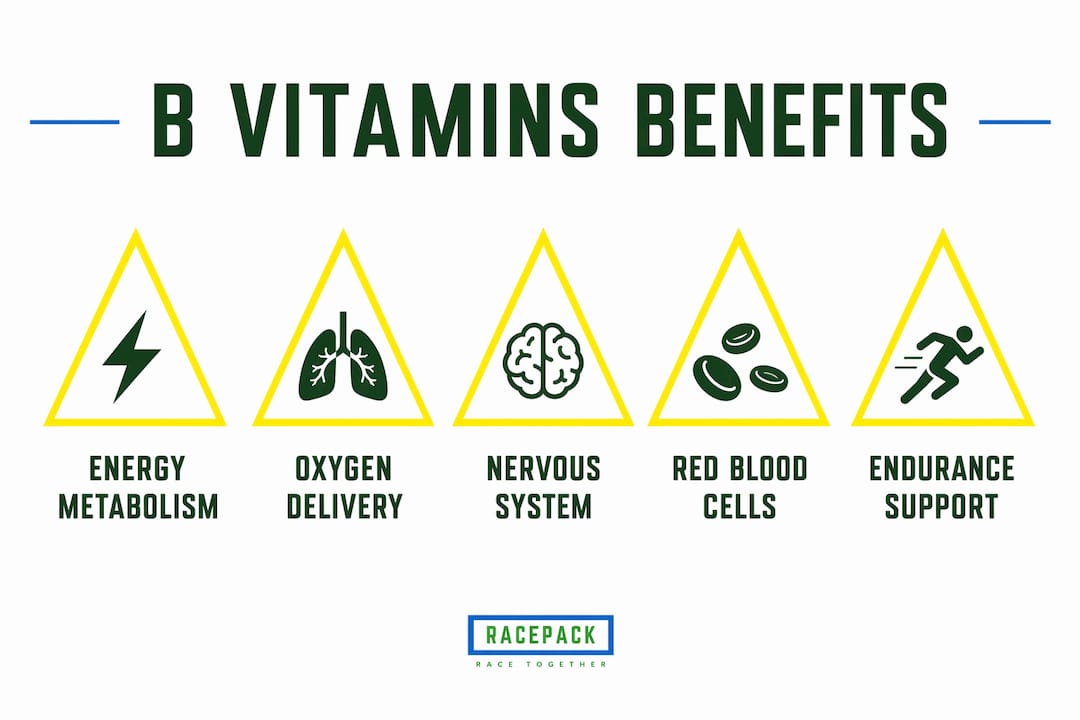
What the science says about B complex supplementation and running performance
The clinical evidence for B vitamin supplementation in runners is more specific than most general nutrition guides suggest. A randomized double-blind crossover trial tested 28 consecutive days of B complex supplementation (B1, B2, B6, and B12) in healthy non-athlete adults aged 20–30. The results were clear: supplementation increased running time to exhaustion by 1.26-fold compared to placebo, and significantly reduced blood lactate and blood ammonia concentrations during and after exercise.
Key finding: 28 days of B complex supplementation produced a 1.26-fold increase in running time to exhaustion and measurably reduced exercise fatigue markers compared to placebo in a randomized double-blind trial.
The lactate reduction matters because high lactate accelerates acidosis in muscles, which is a primary driver of fatigue during intense efforts. The ammonia reduction is equally relevant. Ammonia accumulates during prolonged exercise and contributes to both central and peripheral fatigue. B6 appears to play a role in reducing post-exercise ammonia concentrations, possibly by supporting more efficient amino acid metabolism during gluconeogenesis.
A few important nuances apply here:
- Supplementation benefits are most pronounced when there is an underlying dietary gap. Runners already meeting their B vitamin needs through food are unlikely to see dramatic performance gains from adding a supplement.
- Excessive B vitamin intake carries real risks. High-dose B6 supplementation can cause peripheral neuropathy. Excessive folate intake above 1,000 mcg per day can mask a B12 deficiency, allowing neurological damage to progress undetected.
- Water-soluble B vitamins are mostly excreted in urine when taken in excess, so mega-dosing wastes money at best and causes harm at worst.
- Supplementation without correcting the underlying diet can mask deficiency symptoms while leaving the root cause unaddressed.
For runners considering a B complex supplement, the guidance from registered dietitians and sports nutritionists is consistent: get tested first, correct diet first, and supplement only to fill a confirmed gap.
Best food sources and daily intake guidance for runners
Food is the most reliable way to maintain B vitamin status. Whole, minimally processed foods deliver B vitamins alongside the fiber, minerals, and phytonutrients that support absorption and overall health. Whole food sources like lean meats, eggs, legumes, and leafy greens are critical for sustainable energy metabolism, and supplements consistently fall short of compensating for a poor diet in endurance athletes.
Top B vitamin food sources for runners:
- Lean meats and poultry: Rich in B3, B6, and B12. Chicken breast and turkey are particularly good sources of B6.
- Eggs: Provide B2, B7, and B12. Two eggs daily contribute meaningfully to B12 intake, though they alone are unlikely to fully cover daily requirements for active runners.
- Legumes (lentils, chickpeas, black beans): Excellent sources of folate (B9) and B1. A cup of cooked lentils delivers a substantial portion of the daily folate target.
- Leafy greens (spinach, kale, romaine): High in folate and B2. Raw or lightly cooked preparations preserve more of these heat-sensitive vitamins.
- Whole grains (oats, brown rice, quinoa): Provide B1, B2, B3, and B5. Refined and processed grains lose the nutrient-dense bran and germ layers, making white bread and white rice significantly lower in B vitamins than their whole-grain equivalents.
- Fatty fish (salmon, tuna, mackerel): Strong sources of B3, B6, and B12, plus omega-3 fatty acids that support recovery.
- Dairy products (Greek yogurt, milk): Contribute B2 and B12.
Special considerations for plant-based runners:
Vegetarians and vegans face a genuine challenge with B12, which is found almost exclusively in animal products. Plant-based runners should work with a sports dietitian to assess B12 and B6 status and determine whether supplementation is warranted. Fortified foods such as nutritional yeast and plant-based milks can help, but may not fully close the gap for high-mileage athletes.
Timing and practical tips:
- Spread B vitamin intake across meals rather than loading it into one sitting. Because most B vitamins are water-soluble and not stored, consistent daily intake is more effective than periodic high-dose consumption.
- Avoid overcooking vegetables. Extended heat destroys B vitamins, particularly folate and B1. Steaming or light sautéing preserves more than boiling.
- Limit alcohol. Alcohol actively destroys B vitamins and impairs their absorption, which is a real concern for runners who train hard and socialize around race events.
Pro Tip: Build your pre-run and recovery meals around whole grains, eggs, and leafy greens. That combination covers B1, B2, B6, B9, and B12 without requiring a single supplement. Check out our trail running nutrition tips for practical meal ideas built around endurance training.
How B vitamin deficiencies affect athletic performance in practice
B vitamin deficiencies are more common among active adults than most runners realize. A significant portion of US adults carry at least one B vitamin deficiency, and the effects on athletic performance can be subtle enough to go undiagnosed for months. Marginal shortages, levels that fall below optimal but not yet into clinical deficiency territory, are enough to slow recovery and reduce output.
Performance impact: Exercise increases B6 turnover significantly. Studies show that marathon runners lose vitamin B6 during a single race, raising requirements above sedentary-population guidelines.
Runners at highest risk of B vitamin insufficiency include:
- High-mileage endurance athletes with restricted caloric intake, particularly those managing weight for performance.
- Plant-based runners who avoid animal products and may not adequately replace B12 and B6 through diet alone.
- Runners with gastrointestinal conditions that impair nutrient absorption, such as celiac disease or Crohn’s disease.
- Older runners, for whom absorption efficiency of B12 declines with age.
The performance consequences of marginal deficiency are not dramatic at first. You might notice that your easy pace feels harder, your legs feel heavier on back-to-back training days, or your mood and focus during long runs deteriorate faster than expected. These are all consistent with impaired energy metabolism and reduced oxygen delivery, the two core functions B vitamins support.
Consistent daily intake is the most effective defense. Exercise stress on B vitamin pathways means that runners’ requirements exceed those of sedentary adults, but those elevated needs can generally be met through diet when total caloric intake is adequate and food choices are varied. The problem arises when training volume goes up while food quality or quantity goes down.
How B vitamins interact with other nutrients runners depend on
B vitamins do not work in isolation. Their effectiveness depends on how they interact with other nutrients in your diet, and those interactions have direct implications for performance and recovery.

B12 and folate (B9) work together in the methylation cycle, a process critical for DNA synthesis and red blood cell production. Taking high doses of folate without adequate B12 can mask a B12 deficiency by correcting the blood picture while neurological damage continues. This is why B vitamins sometimes need to be balanced together rather than supplemented individually.
B6 and magnesium have a well-documented synergistic relationship. B6 supports magnesium absorption and transport into cells, and magnesium is critical for muscle contraction, nerve function, and sleep quality. Runners who sweat heavily lose magnesium rapidly, and low B6 can compound that loss by reducing cellular uptake.
B vitamins and iron interact at the level of red blood cell production. Iron is required to form hemoglobin, but folate and B12 are required to produce the red blood cells that carry it. A runner with adequate iron but low folate or B12 will still develop anemia. Addressing only iron without checking B vitamin status is a common and costly diagnostic gap.
Vitamin C supports the absorption of non-heme iron from plant sources, which is relevant for runners who rely on legumes and leafy greens for both iron and folate. While research on vitamin C and athletic performance shows mixed results for high-dose supplementation, getting adequate vitamin C through whole foods helps the broader nutrient absorption picture. For a deeper look at how B vitamins specifically support energy production, our guide on vitamin B12 and energy covers the mechanisms in detail.
For runners interested in key vitamins for athletes more broadly, resources on vitamins for sport performance provide useful context on how B vitamins fit into a complete micronutrient strategy.
Do endurance and sprint runners need different amounts of B vitamins?
The short answer is yes, though the difference is more about volume and specific vitamin emphasis than a completely different set of requirements.

Endurance runners place the highest demand on B vitamins overall. Long-duration aerobic exercise burns through thiamin, riboflavin, and B6 at elevated rates because these vitamins are directly involved in the sustained energy metabolism that powers miles of continuous running. The marathon runner losing approximately 1 mg of B6 per race is a concrete example of how endurance volume drives up requirements. Folate and B12 are also critical for endurance athletes because aerobic training stimulates red blood cell turnover, increasing the demand for erythropoiesis.
Sprint and power runners have a different metabolic profile. Their efforts are shorter and rely more heavily on the phosphocreatine and glycolytic systems, which are less B vitamin-dependent than the aerobic pathways. That said, B6 remains relevant for sprint athletes because of its role in amino acid metabolism and protein synthesis, both important for muscle repair after high-intensity sessions. B12 and folate still matter for nervous system integrity and cell repair.
The practical takeaway for most runners is that training volume and dietary quality are the two variables that determine whether B vitamin needs are being met. A runner doing 60+ miles per week on a restricted diet faces a much higher deficiency risk than a sprinter eating a varied, whole-food diet. For a complete picture of how to structure your B vitamin intake around your specific training load, our B complex health guide breaks it down by athlete type and training phase.
Fuel your runs with the right nutrition support

Getting your B vitamins right through food is the foundation, but on race day and during long training blocks, you also need fast, reliable fuel. At RacepackSingapore, we carry the endurance nutrition products that complement a solid micronutrient base.
Recommended products for runners:
- GU Energy Gel 24-pack — Clean, fast-acting carbohydrate fuel for long runs and race day, designed to keep energy output steady when glycogen stores run low.
- HIGH5 ZERO+ Multivitamins and Ultra Electrolytes — A hydration supplement that includes key vitamins alongside electrolytes, supporting both fluid balance and micronutrient intake during training.
- HIGH5 Isotonic Hydration Drink — Formulated for rapid absorption during exercise, keeping you hydrated and fueled through every mile.
- MyProtein Alpha Men Multivitamin — A daily multivitamin designed for active men, covering key B vitamins alongside other micronutrients that support training and recovery.
- MyProtein Supplement Storage Box — Keep your vitamins and supplements organized and portable, so your nutrition routine stays consistent on training days and race weekends.
Browse our full energy gels collection or explore our energy drinks range to find the right fuel for your next training block.
Buy Now at RacepackSingapore
Key Takeaways
B vitamins are the metabolic foundation of running performance, and endurance athletes need consistent daily intake to maintain energy output, oxygen delivery, and recovery capacity.
| Point | Details |
|---|---|
| B vitamins power ATP production | They activate enzymes that convert carbohydrates, fats, and proteins into usable energy for every run. |
| B6, B9, and B12 drive oxygen delivery | These three vitamins support red blood cell formation and hemoglobin synthesis, directly affecting aerobic capacity. |
| Supplementation shows measurable gains | A randomized double-blind trial found an increase in running time to exhaustion after about a month of B complex supplementation. |
| Endurance runners lose more B6 | Marathon runners lose approximately 1 mg of B6 per race, raising requirements above sedentary-population guidelines. |
| Whole foods outperform supplements | Lean meats, eggs, legumes, leafy greens, and whole grains remain the most reliable foundation for B vitamin status. |
FAQ
Do runners need more B vitamins than non-runners?
Yes. Exercise increases B vitamin turnover, particularly B6, and marathon runners lose approximately 1 mg of B6 per race, raising requirements above standard guidelines for sedentary adults.
What happens when your B12 is low as a runner?
Low B12 impairs red blood cell production and nervous system function, causing fatigue, breathlessness at moderate paces, and reduced muscle coordination. Untreated B12 deficiency can cause irreversible neurological damage.
Does vitamin B help with running fatigue?
Yes. B complex supplementation significantly reduced blood lactate and blood ammonia concentrations during exercise in a randomized double-blind trial, both of which are direct drivers of exercise-induced fatigue.
What depletes B vitamins in runners?
High training volume, alcohol consumption, extended cooking of vegetables, and a diet heavy in refined and processed foods all reduce B vitamin availability. Gastrointestinal conditions that impair absorption compound the risk further.
Are 2 eggs a day enough B12 for a runner?
Two eggs contribute to daily B12 intake but are unlikely to fully cover the elevated requirements of a high-mileage runner on their own. Combining eggs with other B12 sources such as dairy, fish, or lean meat provides more reliable coverage.
Can you take too many B vitamins as an athlete?
Yes. Excessive B6 can cause peripheral neuropathy, and high folate intake above 1,000 mcg per day can mask a B12 deficiency. Water-soluble B vitamins are excreted in urine when taken in excess, so mega-dosing is wasteful at best and harmful at worst.
Which B vitamins matter most for endurance running?
B1 (thiamin), B2 (riboflavin), B6, B9 (folate), and B12 are the most performance-relevant for endurance runners. B6, B9, and B12 are especially critical for red blood cell formation and oxygen transport.
Do plant-based runners need to supplement B vitamins?
Plant-based runners face a genuine risk of B12 and B6 insufficiency because these vitamins are found primarily in animal products. Working with a sports dietitian to assess status and determine whether supplementation is needed is strongly recommended.
How quickly can B vitamin deficiency affect running performance?
The body stores most B vitamins for only a short period. A few months of poor dietary intake can lead to measurable deficiency, with performance effects such as increased fatigue, slower recovery, and reduced aerobic output appearing before clinical symptoms are obvious.
Should I take a B vitamin supplement before a race?
Supplementation is most effective when taken consistently over weeks, not as a one-off pre-race strategy. The randomized trial evidence showing performance benefits used a 28-day supplementation protocol, not acute dosing.