

Neuromuscular Fatigue in Running: What Runners Need to Know
Neuromuscular fatigue in running is the nervous system’s reduced ability to activate your muscles fully, producing heavy legs, sluggish turnover, and a frustrating gap between how your lungs feel and how your legs respond. The single most important immediate step: reduce your training load now and do one or two short diagnostic strides to assess whether your legs are ready to re-engage.
Common sensations that signal neuromuscular fatigue:
- Heavy, wooden legs that don’t respond even when your breathing feels easy
- Loss of speed access — you can’t hit your normal pace despite low heart rate
- Sloppy form — overstriding, reduced arm drive, or a noticeable cadence drop
- Delayed ground contact — each foot strike feels slower and less springy than usual
- General leg dullness that persists into the second or third day after a hard run
If two or more of those match what you’re feeling right now, ease today’s session, add a short walk or easy spin, and hold off on any quality work until the strides feel sharp again.
Key Takeaways
Neuromuscular fatigue in running is primarily a neural problem — your nervous system throttles output before your muscles are truly depleted — and recovery requires rest, sleep, and nutrition before any additional training stimulus.
| Point | Details |
|---|---|
| Running fatigue is mostly neural | Running produces force losses driven largely by central (neural) impairments, not just muscle damage. |
| Force control loss persists | Measurable loss of force control can remain after exercise ends, raising injury risk if you train through it. |
| Recovery takes 1–7+ days | Light sessions clear in 24–72 hours; race efforts can extend neural fatigue to 7 days or more. |
| Monitor with CMJ and strides | A 5–8% CMJ drop or flat strides signal ongoing fatigue — use these daily to guide load decisions. |
| RacepackSingapore supports recovery | GU Energy Gels, MyProtein EAA Powder, HIGH5 ZERO+ electrolytes, and the Garmin Forerunner 165 cover fueling, repair, and monitoring. |
Table of Contents
- What causes neuromuscular fatigue in running?
- How does neuromuscular fatigue change your running performance?
- How long does neuromuscular fatigue last after a hard run?
- What should you actually do in the days after neuromuscular fatigue appears?
- How do you train to reduce neuromuscular fatigue over time?
- How can you test yourself for neuromuscular fatigue at home?
- When is neuromuscular fatigue a red flag?
- Nutrition and supplements that support neuromuscular recovery
- The priority order that actually matters for managing neural fatigue
- Stock your recovery toolkit with RacepackSingapore
- Sources
- FAQ
What causes neuromuscular fatigue in running?
Muscle fatigue is multifactorial and task-specific, meaning no single mechanism explains every case. For runners, two broad categories matter: central fatigue and peripheral fatigue.
Central fatigue originates in the brain and spinal cord. Motoneuron excitability drops, voluntary activation decreases, and the nervous system effectively throttles the signal sent to your muscles. You haven’t run out of muscle fiber capacity — your brain is dialing back output as a protective response. Runners often misread this as a fitness problem when it’s actually a neural one.
Peripheral fatigue happens inside the muscle itself: metabolite accumulation, calcium handling disruption, and contractile protein changes that reduce the force each fiber can produce. This is the burn you feel during a hard interval, and it typically clears faster than central fatigue.
Running’s intermittent, weight-bearing contraction pattern tends to emphasize the central (neural) side of this equation. A crossover study comparing prolonged running and cycling found similar force losses of approximately a quarter in both modalities, but running’s force loss was driven largely by neural impairments while cycling’s was more peripheral. That distinction matters practically: after a long run, your muscles may be contractually intact while your nervous system is still throttled.
Stat to know: Research on maximal voluntary contractions shows that both central and peripheral neuromuscular indexes decline after sustained effort, and that the muscle mass involved influences which side dominates. Larger, bilateral efforts tend to produce greater central contributions.
One additional layer: neuromuscular fatigue produces a measurable loss of force control, characterized by greater magnitude and lower complexity of force fluctuations, that can persist well after the exercise session ends. This is why your legs can still feel off 48 hours after a race even when soreness has faded.
How does neuromuscular fatigue change your running performance?
The performance consequences show up in ways you can observe in real time. Cadence drops, ground contact time lengthens, and stride stiffness decreases. Your pace slips even though your heart rate stays low. These aren’t just comfort issues — they’re signals that your force production and running cadence are compromised.
Observable performance signs include:
- Cadence fall of 3–5 steps per minute below your normal easy-run rate
- Longer ground contact time — each foot stays on the ground slightly longer as leg stiffness drops
- Inability to accelerate on demand, even for a short surge
- Reduced running economy — you burn more energy per kilometer at the same pace
The injury risk angle is where this gets serious. Loss of force control after fatiguing exercise can persist beyond the immediate recovery window. When your neuromuscular system can’t regulate force precisely, your gait mechanics shift: overstriding increases, hip drop worsens, and load distribution across the knee and ankle changes. Running through visible form breakdown raises overuse injury risk considerably. Practical coaching guidance identifies cadence loss and heavy legs as the clearest field signs of neuromuscular versus cardiorespiratory fatigue — and both coaches and exercise physiologists recommend backing off when those signs appear rather than pushing through.
Pro Tip: If your form looks sloppy on video or your running partner comments on your gait, treat that as a hard stop signal. Back off pace immediately. Running through form breakdown is one of the fastest routes to an overuse injury — and it won’t make you fitter that day. Check out our guide on preventing running injuries for a full breakdown of form-related risk factors.

How long does neuromuscular fatigue last after a hard run?
For most runners after a moderately hard workout, neural fatigue clears within 24–72 hours. After a race or very long effort, the timeline extends: many runners report leg dullness and reduced force access for 3–7 days, and some studies suggest measurable force deficits can linger even longer depending on effort intensity.
Recovery window: Practical coaching sources note that neuromuscular fatigue commonly lasts 1–3 days after a typical hard session, but can extend significantly after a marathon or ultra-distance effort. The aerobic system often recovers faster than the neural system, which is why runners feel cardiovascularly ready before their legs are.
Several factors lengthen recovery:
- High intensity or long duration of the effort (a 5K race vs. a marathon produce very different neural loads)
- Poor sleep in the nights immediately after — growth hormone release during deep sleep is a primary repair driver
- Inadequate carbohydrate and protein in the 24–48 hours post-run, which slows glycogen and tissue restoration
- Cumulative training load — fatigue stacks when weekly volume is high and easy days aren’t truly easy
- Heat and humidity, which add cardiovascular and thermoregulatory stress on top of neural load
- Illness or infection, which diverts immune and repair resources
If your legs still feel heavy and force access is poor after 7–10 days of reduced load and good sleep, that’s no longer normal recovery. That’s a signal to investigate further.
What should you actually do in the days after neuromuscular fatigue appears?
Recovery from neural fatigue follows a clear priority order: reduce load first, then restore, then gradually re-prime.
Immediate steps (Day 0–1):
- Cut today’s planned session by at least 50% in intensity and volume. If it was a quality day, convert it to easy movement only.
- Do 20–30 minutes of low-intensity active recovery: easy walk, light cycling, or a gentle swim.
- Eat a carbohydrate-rich meal within two hours of your last run to begin glycogen restoration.
- Prioritize 8–9 hours of sleep that night.
- Hydrate fully and include electrolytes, especially sodium and potassium.
Days 2–3:
- Run easy — genuinely easy, at conversational pace, for 30–40 minutes maximum.
- After the easy run, attempt 1–2 short strides (20–30 m) at roughly 85% effort.
- If the strides feel sharp and springy, your neural system is re-priming. If they feel flat or forced, stop and return to easy movement only.
- Continue prioritizing sleep and protein intake (aim for a quality protein source at each main meal).
- Avoid aggressive deep-tissue massage in the first 48 hours if central fatigue dominates — it adds stimulation without addressing the neural component.
Days 4–7:
- Reintroduce one moderate-quality session only if strides felt good on Days 2–3.
- Keep volume at 70–80% of your normal weekly load.
- Delay any maximal-effort sessions (race-pace intervals, time trials) until Day 7 at the earliest.
- Monitor cadence and perceived effort on every run — if RPE is disproportionately high for the pace, extend the recovery phase.
What not to do:
- Don’t add extra high-intensity sessions to “make up” for missed training
- Don’t ignore persistent form breakdown and push through
- Don’t rely on caffeine to mask fatigue and train through it
Pro Tip: Use short strides as a diagnostic, not a workout. Do one stride at 85% effort. If it feels effortless and your turnover is quick, do a second. If either feels labored or flat, that’s your answer — your nervous system needs more time. Stop there and treat the next 24 hours as recovery.
How do you train to reduce neuromuscular fatigue over time?
Building neuromuscular resilience means training your nervous system to recruit motor units faster, more efficiently, and with greater fatigue resistance. The tools are short, high-quality efforts and targeted strength work — not more volume.
Neuromuscular efficiency training focuses on improving power output and motor coordination through specific, repeatable stimuli. Two sessions per week of targeted neuromuscular work, integrated around your key runs, produces meaningful adaptation without adding excessive fatigue.
For runners wanting a deeper strength program to complement these sessions, a complete strength training guide for runners covers progressive loading and exercise selection in detail.
| Session Type | Target Reps / Duration | RPE Range | Frequency |
|---|---|---|---|
| Strides (20–30 m accelerations) | 4–8 reps, full recovery between | 7–8/10 | 2–3x per week |
| Short hill sprints (6–8 sec) | 6–10 reps, 2–3 min rest | 8–9/10 | 1–2x per week |
| Strength: squats, RDLs, calf raises | 3–4 sets of 4–6 reps (heavy) | 7–8/10 | 2x per week |
| Plyometrics: box jumps, bounding | 3–4 sets of 6–8 reps | 7/10 | 1x per week |
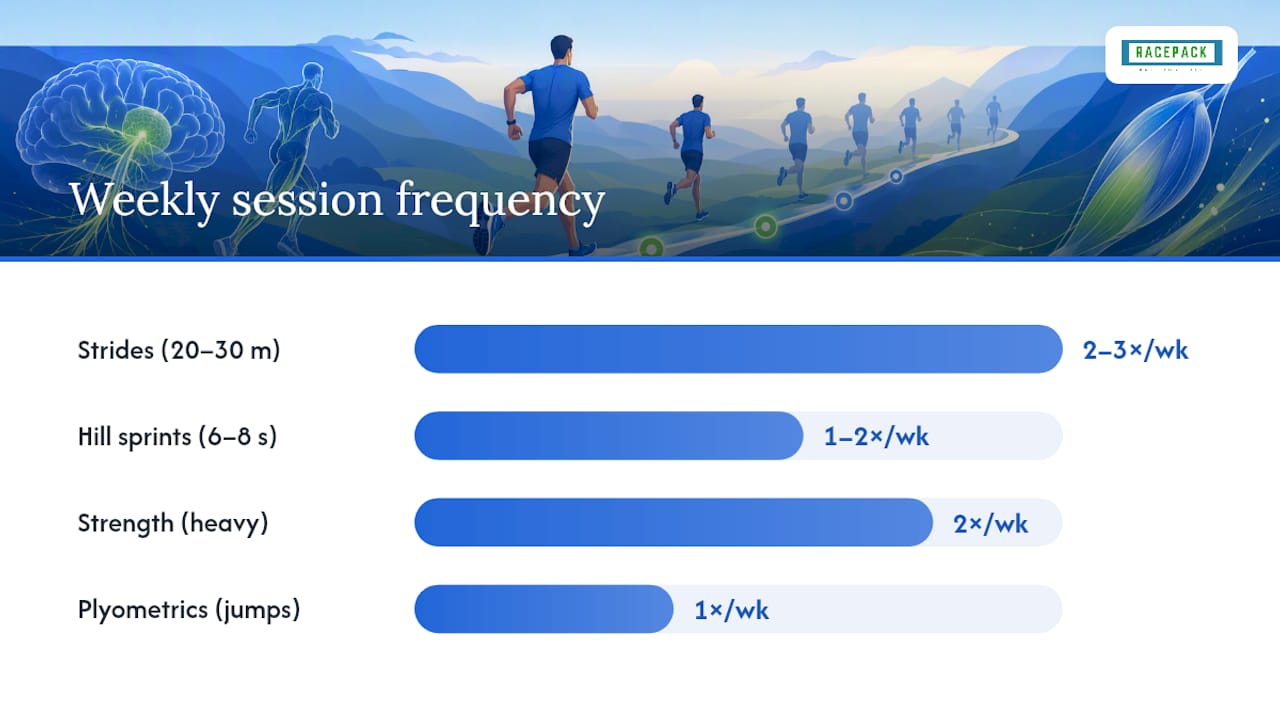
A few integration notes: place strides at the end of easy runs, not before quality sessions. Hill sprints work best on a day before a rest day so neural recovery is complete. Heavy strength sessions should sit 48 hours away from your hardest run of the week. Progress by adding one rep or one set every 2–3 weeks, not by shortening rest intervals.
How can you test yourself for neuromuscular fatigue at home?
You don’t need a lab to track neural fatigue. Three field-friendly tests give you reliable signals when done consistently.
-
Countermovement jump (CMJ) test. Stand on a flat surface, dip quickly, and jump as high as you can. Mark your baseline height on a wall or use a jump-mat app. A drop of more than 5–8% from your personal baseline on a given morning suggests meaningful neuromuscular fatigue. Do this test at the same time each day (morning, pre-run) for consistency.
-
20–30 m stride acceleration test. After a 10-minute warm-up, run one 20–30 m stride at your best controlled effort. Note how it feels: sharp and effortless, or labored and flat? If you have a GPS watch or phone, check your split. A noticeable slowdown from your normal stride time is a practical fatigue marker. Lab-based objective tests like TMS and peripheral nerve stimulation confirm central voluntary activation reductions after running; the CMJ and short-stride check are the best field proxies for those measures.
-
Cadence check at easy pace. Run your standard easy route and note your cadence in the first 10 minutes. A drop of 3–5 steps per minute below your normal easy-run cadence, without a corresponding increase in effort, is a reliable early signal of neural fatigue.
Combine these objective checks with three subjective measures every morning: sleep quality (1–10), mood/motivation (1–10), and perceived leg freshness (1–10). When two or more of those subjective scores drop below 6 alongside an objective decline, treat the day as a recovery day regardless of what the training plan says.
When is neuromuscular fatigue a red flag?
Normal post-run neural fatigue resolves with rest, sleep, and nutrition. When it doesn’t, the pattern shifts from recovery to a warning sign.
Seek professional evaluation if you experience: a progressive performance decline despite 10 or more days of reduced load; persistent force loss or leg heaviness beyond two weeks; large, sustained shifts in resting heart rate (5+ beats above normal) or HRV; visible gait changes that don’t resolve with easy running; frequent cramping, coordination loss, or unusual muscle twitching. These patterns can indicate overreaching, Relative Energy Deficiency in Sport (RED-S), systemic infection, or in rare cases a neurological issue that warrants medical assessment.
Who to contact: a sports physician or physiotherapist with experience in endurance athletes. Bring your training log for the past 4–6 weeks, your sleep and HRV data if you track it, and a clear description of when the fatigue started relative to your training load. A physiotherapist can assess force production and gait directly; a sports physician can rule out systemic causes including thyroid dysfunction, anemia, or infection.
One safety note: severe electrolyte disturbance and systemic illness can both mimic or worsen neuromuscular fatigue, so don’t dismiss persistent symptoms as “just overtraining” without a clinical check.
Nutrition and supplements that support neuromuscular recovery
Recovery from neural fatigue starts with the basics, and the basics are non-negotiable before any supplement adds meaningful value.
Priority nutrition actions:
- Carbohydrate first: Restoring muscle glycogen is the primary post-run nutrition task. Aim for 1–1.2 g of carbohydrate per kilogram of body weight in the two hours after a hard run. In-run fueling with energy gels also reduces the depth of glycogen depletion you’re recovering from.
- Protein for repair: 20–40 g of high-quality protein within two hours of finishing supports muscle protein synthesis and tissue repair. Essential amino acids (EAAs) are the active fraction — useful when a full meal isn’t practical.
- Electrolyte balance: Sodium, potassium, and magnesium losses through sweat affect both muscle contractility and nerve conduction. Replacing them promptly supports neuromuscular function.
- Total calorie adequacy: Chronic under-fueling is one of the fastest routes to persistent neural fatigue and RED-S. Adequate daily calories underpin every other recovery strategy.
Supplement note: EAA powders and multivitamin/electrolyte products have plausible roles in recovery support, particularly when dietary intake is incomplete. B vitamins support energy metabolism and nerve function — a deficiency can amplify fatigue. Supplement regulation varies by country; check with a clinician before adding new products, and avoid overclaiming any single supplement as a fatigue cure.
Practical product categories from RacepackSingapore that align with these priorities:
- Energy gels (GU Energy Gel): fast carbohydrate during runs to limit glycogen depletion depth
- EAA powder (MyProtein EAA Powder 360g): amino acid support post-run when a full protein meal isn’t immediate
- Electrolyte/multivitamin sachets (HIGH5 ZERO+ Multivitamins/Ultra Electrolytes): rehydration and micronutrient replenishment during recovery
- Protein supplement (MyProtein Pea Protein Isolate 2.5kg): plant-based protein for daily recovery support
- Supplement storage (MyProtein Supplement Storage Box): keeps your recovery stack organized and portable
The priority order that actually matters for managing neural fatigue
Most runners who struggle with recurring neuromuscular fatigue are making the same mistake: they add more neuromuscular sessions before they’ve fixed sleep, nutrition, and load management. The order matters enormously. Sleep and caloric adequacy are the foundation — without them, strides and hill sprints just add more stress to an already taxed system. Once those basics are solid, two targeted neuromuscular sessions per week (strides plus one strength day) build real resilience. Monitoring comes last, not because it’s unimportant, but because it only tells you something useful when you’ve already built a stable baseline to compare against. The runners who manage this well aren’t doing more — they’re recovering better, training smarter, and reading their body’s signals before those signals become injuries.
Stock your recovery toolkit with RacepackSingapore
Getting your nutrition and monitoring right after a hard run doesn’t have to be complicated. RacepackSingapore carries the exact products this guide recommends, with guaranteed authenticity and next-day delivery.

For in-run fueling that limits glycogen depletion, GU Energy Gel (24-pack) delivers fast, reliable carbohydrate in a format proven across endurance sport. Post-run, MyProtein EAA Powder (360g, 30 servings) gives you the essential amino acids your muscles need when a full meal isn’t immediate. For electrolyte and micronutrient replenishment, HIGH5 ZERO+ Multivitamins/Ultra Electrolytes (16 sachets) covers sodium, potassium, and key vitamins in one convenient sachet. And for tracking cadence, resting heart rate, and HRV trends that reveal accumulating fatigue before it becomes a problem, the Garmin Forerunner 165 is the monitoring tool we recommend for everyday runners. Buy now at RacepackSingapore and have your recovery stack ready for your next session.
Sources
- Mechanisms of neuromuscular fatigue and recovery in unilateral versus bilateral maximal voluntary contractions
- Exercise Modality Influences Why Our Muscles Fatigue
- How to Identify and Overcome Running Fatigue
This article is general information, not a substitute for advice from a qualified doctor. Consult a qualified healthcare professional about your own circumstances before acting on anything here.
FAQ
What does neuromuscular fatigue mean in running?
Neuromuscular fatigue in running is the nervous system’s reduced ability to fully activate your muscles, producing heavy legs and a gap between aerobic readiness and leg responsiveness. It involves both central (brain/spinal cord) and peripheral (muscle-level) contributors, with running tending to emphasize the neural side.
How long does neuromuscular fatigue last after a run?
After a typical hard workout, neural fatigue usually clears within 24–72 hours. After a marathon or ultra-distance effort, it can persist for 7 days or more, particularly when sleep and nutrition are suboptimal.
How do you fix neuromuscular fatigue quickly?
Reduce training load immediately, prioritize 8–9 hours of sleep, restore carbohydrate and protein intake, and use 1–2 short diagnostic strides on Day 2–3 to assess readiness. Avoid high-intensity sessions until strides feel sharp and effortless.
Why is the first 20 minutes of running so hard?
The first 20 minutes often feel hard because your neuromuscular system needs time to recruit motor units efficiently, your cardiovascular system is still ramping up oxygen delivery, and any residual neural fatigue from previous sessions is most noticeable before the body warms up and movement patterns settle.
What are the main symptoms of neuromuscular fatigue?
The clearest signs are heavy or wooden legs, inability to access faster paces despite low heart rate, a noticeable cadence drop, longer ground contact time, and reduced leg stiffness or springiness during running.
How is neuromuscular fatigue different from DOMS?
Delayed onset muscle soreness (DOMS) is primarily a peripheral, inflammatory response to muscle damage that peaks 24–48 hours after exercise. Neuromuscular fatigue is a neural and contractile impairment that reduces force production and can occur without significant soreness, particularly after long runs with less eccentric loading.
Can I still run with neuromuscular fatigue?
Easy running at genuinely conversational pace is generally fine and can support active recovery. Quality sessions, race-pace work, and any effort that demands high force output should be delayed until diagnostic strides feel sharp again.
What self-tests can I use to detect neuromuscular fatigue?
The countermovement jump (CMJ) test and a 20–30 m stride acceleration check are the most practical field tests.
When should I see a doctor about neuromuscular fatigue?
Seek evaluation if performance decline persists beyond 10 days of reduced load, if force loss or leg heaviness continues past two weeks, or if you notice large sustained shifts in resting heart rate, frequent cramping, coordination loss, or unusual gait changes. These patterns can indicate overreaching, RED-S, or systemic illness.
Which nutrition strategies help neuromuscular recovery?
Prioritize carbohydrate (1–1.2 g per kg body weight within two hours post-run), 20–40 g of quality protein, and electrolyte replacement. EAA powders and multivitamin/electrolyte products like HIGH5 ZERO+ can support recovery when dietary intake is incomplete.
What training builds neuromuscular resilience over time?
Short strides (4–8 reps, 20–30 m), hill sprints (6–10 reps of 6–8 seconds), heavy strength work (squats, Romanian deadlifts, calf raises at 4–6 reps), and plyometrics twice per week build the motor unit recruitment and force production capacity that reduce fatigue risk.
Does the Garmin Forerunner 165 help track neuromuscular fatigue?
The Garmin Forerunner 165 tracks cadence, resting heart rate, and HRV trends — all of which shift measurably when neural fatigue accumulates. Monitoring these metrics daily gives you objective data to guide load decisions before fatigue becomes a performance or injury problem.