

Racepack SG: Verify NSF Certified Supplements and Lot Numbers for Athletes
NSF certification confirms that a supplement’s label matches what’s actually in the bottle and that the product has been screened for a defined list of contaminants. The Certified for Sport® mark adds a screening layer for banned athletic substances, which meaningfully lowers, but never fully removes, the risk of a positive drug test. Before you buy or use any product, check the exact product and lot number in NSF’s registry rather than trusting the seal on sight.
TL;DR:
- NSF certification verifies label accuracy, contaminant screening, and ongoing facility audits, but it does not guarantee safety or product efficacy.
- The Certified for Sport® mark specifically screens against over 290 banned substances, making it essential for drug-tested athletes.
- Always confirm certification and lot number in NSF’s online directory or app before purchasing or using a supplement, especially for tested athletes.
- Certification is product-specific; a product claiming NSF or Certified for Sport® must be verified against official records to ensure validity.
- Certification reduces the risk of contamination and banned substances but does not eliminate the possibility of a positive drug test or adverse reactions.
Table of Contents
- What NSF Certification Actually Verifies
- Which NSF Standards Matter to Athletes and Everyday Shoppers
- How to Verify a Supplement or Lot Before You Buy
- Why Certification Matters More for Drug-Tested Athletes
- What NSF Certification Doesn’t Guarantee
- How Racepack SG Helps You Buy With Confidence
- The Seal Is a Tool, Not a Substitute for Reading the Label
- Get Verified Sports Nutrition Without the Guesswork
- Where to Verify Certification Yourself
- Sources
- FAQ
What NSF Certification Actually Verifies
NSF certification isn’t a vague “lab tested” sticker. It’s tied to a specific standard, NSF/ANSI 173, which checks whether the ingredients on the label match what’s in the product, in the amounts claimed. That distinction matters, because plenty of supplement brands print “third-party tested” on their packaging without naming any standard at all.
The contaminant screening under this program covers a defined set of risks, not a general safety sweep:
- Heavy metals, including lead, mercury, arsenic, cadmium, and chromium VI
- Microbial contaminants that can develop during manufacturing or storage
- Undeclared ingredients that don’t appear on the label
Facility audits are part of the deal too. NSF doesn’t just test a sample and move on. It inspects the manufacturing facility and verifies GMP compliance, then repeats those audits on an ongoing basis rather than certifying a product once and walking away. If you see language like “NSF Contents Certified” or “NSF Certified for Sport®” on a label, that’s the actual program mark. Generic phrases like “NSF approved” or “meets NSF standards” without the registered mark are a red flag worth a second look.
Which NSF Standards Matter to Athletes and Everyday Shoppers
Not every NSF mark means the same thing, and knowing the difference saves you from assuming a product covers ground it doesn’t.
- NSF/ANSI 173 is the foundational product standard. It verifies ingredient identity, confirms label amounts, and runs the contaminant testing described above. Most “NSF Certified” claims on supplement bottles trace back to this standard.
- NSF 306, better known as Certified for Sport®, builds on top of NSF/ANSI 173. A product has to already meet the base contaminant and label standards before it qualifies, and then it gets screened against a list of 290+ substances banned by major athletic organizations, according to independent supplement-testing coverage.
- NSF 229 applies to functional foods and beverages, a category that overlaps with sports drinks and fortified snacks rather than capsules or powders.
- NSF/ANSI 455 certifies management systems and GMP compliance at the facility level, separate from any single product.
If you’re a drug-tested athlete, Certified for Sport® is the mark to prioritize. NSF/ANSI 173 alone confirms label accuracy and contaminant limits, but it says nothing about banned substances. Racepack SG’s guide on Informed Sport supplements for tested athletes walks through how a comparable sport-specific program handles batch verification, which is worth reading alongside this one.
How to Verify a Supplement or Lot Before You Buy
Checking a claim takes a few minutes, and it’s worth doing every time you switch products or open a new batch.
- Read the exact wording on the label. “Contents Certified” and “Certified for Sport®” are different claims covering different scopes. Don’t assume one implies the other.
- Search the NSF certified product directory. NSF maintains an online directory where you can search by product name, brand, or UPC to confirm active certification.
- Use the Certified for Sport app for lot-level checks. Some products post lot-specific certification data, which matters more than a general brand-level claim if you’re facing a drug test.
- Contact the seller and the certifier if a claim doesn’t show up. A missing listing doesn’t always mean fraud, but it means you can’t verify the claim, so treat the purchase as unconfirmed until someone can explain the gap.
Pro Tip: Screenshot the registry entry and lot number the day you buy the product, not the day you get tested. Registries update, product lines change, and having your own timestamped record protects you if a certification lapses later.
Why Certification Matters More for Drug-Tested Athletes
Certified for Sport® screens for 290+ banned substances as part of a program that combines product testing, label review, supplier audits, and facility inspections, all repeated on an ongoing basis rather than as a one-time check. That’s a meaningfully different model from a brand simply printing “third-party tested” without naming what was tested for or how often.
Several major sporting organizations and anti-doping bodies recognize or recommend the Certified for Sport® mark specifically because it shifts verification work away from the individual athlete and onto an independent lab. That’s a real advantage, but it’s not a guarantee. Screening for a defined substance list at the point of certification is not the same as testing every single batch that ever ships, so the risk drops without hitting zero.
A practical checklist before you use anything as a tested athlete:
- Confirm the Certified for Sport® mark appears on the specific product, not just the brand generally
- Check the lot number against the registry or app where lot data is posted
- Keep your receipt and a saved registry screenshot in case a certification question comes up later
What NSF Certification Doesn’t Guarantee
Certification tells you what’s in the product and that it passed a defined contaminant and, where applicable, banned-substance screen. It does not tell you whether the supplement actually works for your goals, and it doesn’t confirm the product is safe for you personally.
A few things worth keeping in mind:
- A certified product can still cause an adverse reaction, especially if you’re on medication or have a condition that interacts with common ingredients like caffeine or high-dose creatine
- Certification reduces contamination risk; it doesn’t make a positive drug test impossible, since third-party seals verify content and screening scope, not absolute outcomes
- Treat the seal as one input in your decision, alongside advice from a doctor or sports dietitian, not as the entire decision
For background on when supplements are actually worth adding to your routine in the first place, Racepack SG’s piece on why sport supplements improve recovery is a useful next read. Partner research on complications linked to supplement use is also worth a look if you want a fuller picture of what certification does and doesn’t protect against.
How Racepack SG Helps You Buy With Confidence
Racepack SG operates with a focus on providing authentic products and prompt order delivery. That matters here because certification only means something if the product you receive is the real thing, not a counterfeit riding on a legitimate brand’s reputation.
Here’s how we support that:
- Authentic products and fast delivery service across Singapore
- Blog resources, including our Informed Sport verification guide and our broader evidence-based supplement guide, to help you make informed choices
- A catalog of products available for customers to review
We always recommend confirming a product’s NSF listing and lot number before use, especially if you’re subject to drug testing. Our job is to get you the real product fast. Verifying it against the registry is still on you, and it takes less time than the checkout process itself.
The Seal Is a Tool, Not a Substitute for Reading the Label
Here’s where a lot of well-meaning advice gets it backwards: people treat NSF certification like a stamp of overall quality, the supplement equivalent of a five-star rating. It isn’t. It’s a narrow, well-defined check on label accuracy and a specific contaminant list, and for athletes, a specific banned-substance list. That narrowness is exactly what makes it useful. A standard that tried to certify “quality” in some general sense would be too vague to test against and too easy to game with marketing language.
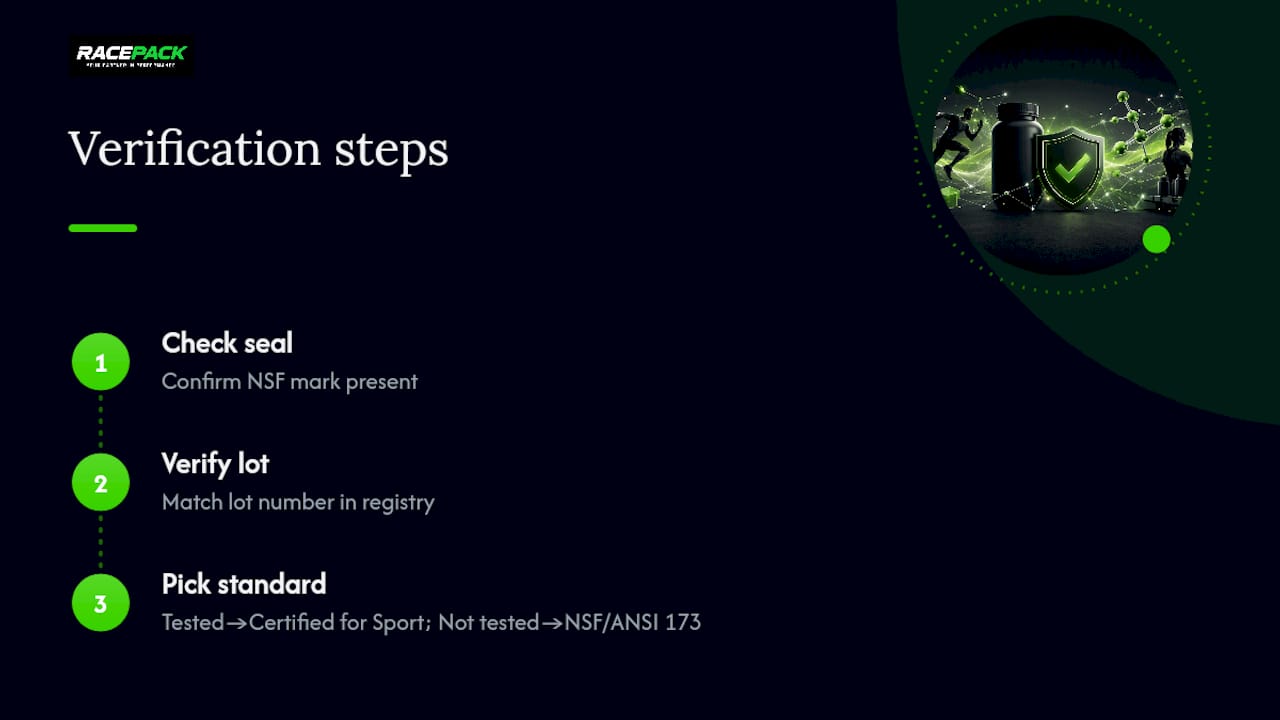
The bigger mistake I see is treating certification as the finish line instead of the starting point. Checking the mark is step one. Checking the actual lot number against the registry is the step that separates people who take verification seriously from people who feel reassured by a logo. Most consumers never get past step one.
If you’re not drug tested, NSF/ANSI 173 covers your real risk, which is contamination and mislabeling, not banned substances you’ll never be screened for. If you are tested, Certified for Sport® isn’t optional. It’s the one credential that directly addresses the thing you actually stand to lose.
— Jason John
Get Verified Sports Nutrition Without the Guesswork
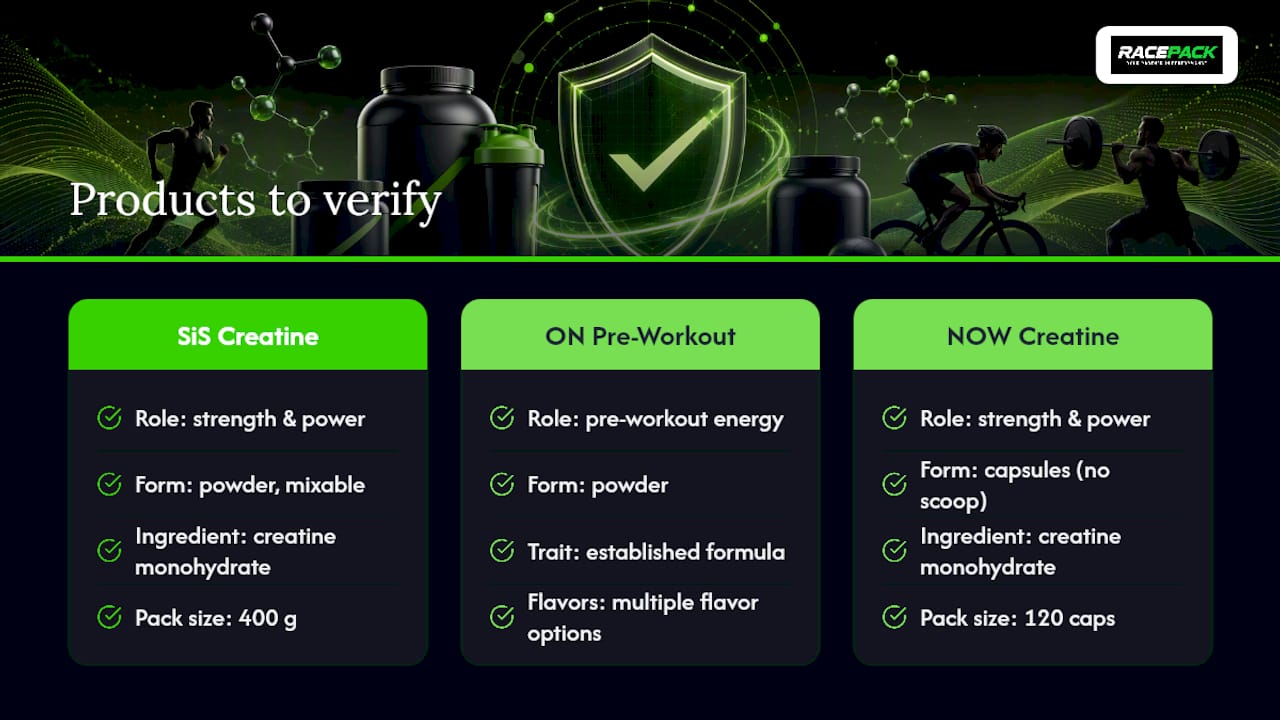
Racepack SG carries three products worth checking against the NSF registry before your next order, each built for a specific role in your training. SiS Creatine 400g is a straightforward monohydrate option for strength and power output, easy to dose and mix into your existing routine.
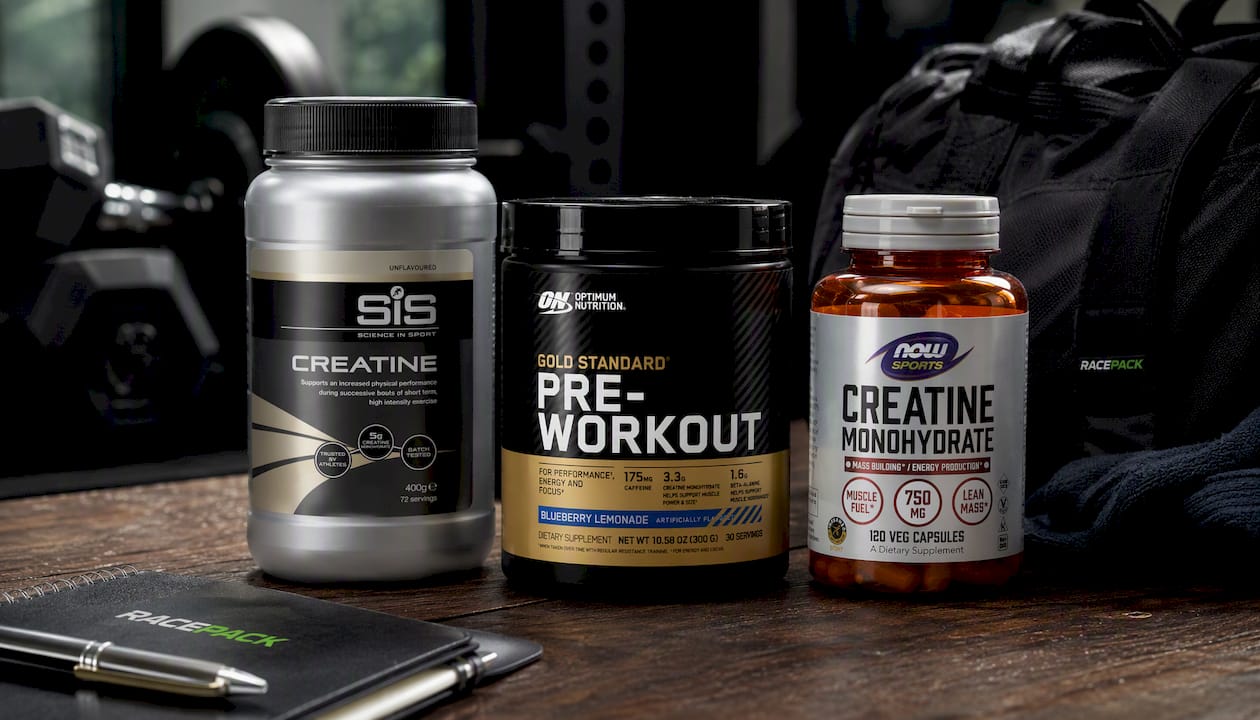
If pre-workout energy is what you’re after, the Optimum Nutrition Gold Standard Pre-Workout is one of the most established formulas on the market, with multiple flavor options. For a no-frills creatine option in capsule form, NOW Sports Creatine Monohydrate 120 Caps skips the powder and scoop entirely.
These products are offered with an emphasis on authenticity and prompt delivery within Singapore. If you’re drug tested, confirm the specific product and lot in NSF’s registry before your first dose, then head to our exclusive deals page to place your order and buy now.
Where to Verify Certification Yourself
Check active certifications directly through the NSF certified product directory or the Certified for Sport app. For banned-substance context beyond NSF’s own list, USADA and other national anti-doping agencies publish guidance tied to the WADA prohibited list. Racepack SG’s Informed Sport guide covers a comparable batch-verification process worth reading alongside NSF’s resources.
Sources
- NSF Certified for Sport — our mark
- NSF — Product and ingredient certification
- The Catalyst Feed — Is your supplement contaminated? What the NSF and Informed Sport seals actually verify
FAQ
Which Supplements Are NSF Certified?
Any supplement carrying the NSF Contents Certified or Certified for Sport® mark on its label has passed NSF’s testing and audit process. Confirm the specific product and brand in the NSF certified product directory, since certification applies product by product, not brand-wide.
What Does It Mean When a Supplement Is NSF Certified?
It means the product passed NSF/ANSI 173 testing, confirming the label matches the actual contents and that it’s been screened for contaminants like heavy metals and microbes. If it also carries the Certified for Sport® mark, it’s additionally been screened for a defined list of substances banned by major athletic organizations.
How Can I Tell if a Product Is NSF Certified?
Look for the registered NSF mark on the packaging, then confirm it in the NSF certified product directory or the Certified for Sport app using the product name or UPC. Generic claims like “NSF approved” without the actual registered mark aren’t reliable confirmation on their own.
Is NSF the Same as FDA?
No. NSF is an independent, private certification organization, while the FDA is a federal regulatory agency with entirely different authority and scope. The FDA doesn’t pre-approve supplements before sale, which is exactly why third-party certifiers like NSF exist to fill that verification gap.
What Is the Difference Between NSF Certified for Sport and NSF/ANSI 173?
NSF/ANSI 173 is the base standard covering label accuracy and general contaminant testing. Certified for Sport® (NSF 306) requires a product to already meet that base standard, then adds screening against a list of substances banned in competitive sport.
What Is the Difference Between NSF and Informed Sport?
Both are independent certification programs that screen supplements for contamination and banned substances, but they’re run by separate organizations with their own testing protocols and registries. Racepack SG’s Informed Sport guide breaks down how that program’s batch verification works in practice.
Does NSF Certification Guarantee a Supplement Is Safe?
No. It confirms label accuracy and screens for a defined contaminant list, but it doesn’t evaluate whether a supplement is clinically safe or effective for every individual, especially people on medication or with existing health conditions.
Can a Certified for Sport Product Still Cause a Positive Drug Test?
It’s far less likely, but not impossible. The program screens for a defined panel of substances at the point of certification and includes ongoing facility audits, which meaningfully lowers risk without reducing it to zero.
Where Can I Find the NSF Certified Products List?
NSF maintains a searchable online directory where you can look up products by name, brand, or UPC to confirm active certification status and scope.
Do All Racepack SG Products Carry NSF Certification?
Not every product in our catalog carries NSF certification, since certification is brand and product specific rather than universal. Always check the individual product’s certification status in the NSF directory before your purchase, and reach out to us if you need help confirming a listing.
Why Does the Lot Number Matter, Not Just the Product Name?
Some certification programs post verification at the batch or lot level, which means a general product-level certification doesn’t guarantee every single lot passed the same screening. Checking the lot number, when it’s available, gives you a more precise verification than the product name alone.
What Should I Do if a Product Claims NSF Certification but Isn’t Listed?
Treat the purchase as unverified and contact both the seller and NSF directly before using the product. A missing directory listing doesn’t automatically mean the claim is false, but it means you have no independent confirmation until someone resolves the discrepancy.