

3.2–6.4 g/day Beta Alanine for Endurance: 8 Week Dosing Plan
Beta-alanine can modestly improve performance in high-intensity endurance efforts of roughly one to ten minutes when you follow a 3.2–6.4 g/day loading protocol for at least four weeks. It won’t turn a steady marathon pace into something faster, and the main tradeoff is a tingling skin sensation called paresthesia, which is easy to manage by splitting doses. If your race or workout lives in that hard, lactate-heavy zone, this is one of the more evidence-backed supplements you can add to your training.
TL;DR:
- Beta-alanine supplementation requires four to six weeks of consistent dosing at 3.2–6.4 grams daily to effectively raise muscle carnosine levels.
- Its performance benefits are most evident in efforts lasting one to ten minutes that generate significant lactate buildup, such as 1500m to 5000m racing or high-intensity interval training.
- The main side effect is temporary tingling, which can be managed by splitting doses or using sustained-release formats, and doses should be carefully calibrated based on body weight and tolerance.
- Short-term, one-time pre-workout boosts are ineffective; regular loading over weeks is necessary to see meaningful improvements, especially in non-elite athletes.
- Athletes should prioritize proper training, fueling, and sleep first, then consider supplementing with high-quality beta-alanine to enhance high-intensity efforts within the optimal effort window.
Table of Contents
- How Beta-Alanine Fuels Endurance Performance
- What Does the Research Actually Show?
- Which Athletes and Events Benefit Most?
- How Should You Dose and Load Beta-Alanine?
- What Are the Side Effects and Safety Considerations?
- Combining Beta-Alanine With Other Supplements
- Your 8-Week Beta-Alanine Plan for Endurance Racing
- What Should Endurance Athletes Realistically Expect?
- Where to Buy Real Beta-Alanine for Your Training Block
- Sources
- FAQ
How Beta-Alanine Fuels Endurance Performance
Beta-alanine works by raising a molecule called carnosine inside your muscle fibers, and it does the heavy lifting there because it’s the rate-limiting substrate. Your body can produce plenty of histidine, carnosine’s other building block, but beta-alanine availability is what caps how much carnosine you can actually build. Feed it consistently, and carnosine levels climb; skip days, and the gains stall.
Carnosine matters because it acts as an intracellular buffer, soaking up hydrogen ions that accumulate when you push into high-lactate territory. That buffering slows the drop in muscle pH that contributes to the burning, heavy-legged fatigue you feel during hard intervals or a fast finish. Delay that acidosis even slightly, and you can sustain higher power output for longer before your legs give out.
This is a chronic supplement, not a pre-workout jolt. The ISSN position stand on beta-alanine confirms that four to six grams daily for at least two to four weeks measurably raises muscle carnosine and can improve exercise capacity, but there’s no acute effect from a single dose taken an hour before a race. A few practical mechanics worth knowing:
- Carnosine accumulation is dose-dependent: more total grams consumed over time generally means a bigger increase, though the relationship isn’t perfectly linear.
- Higher daily doses speed up how fast you reach your carnosine ceiling, but they don’t necessarily push that ceiling much higher.
- Once you stop supplementing, elevated carnosine doesn’t disappear overnight. Washout takes weeks to months, which matters for planning around a competition season.
Statistic to note: The Gatorade Sports Science Institute reports that 3–6 g/day over four to six weeks typically raises muscle carnosine by roughly 30–60%, with the biggest performance payoff clustering around efforts lasting one to ten minutes.
What Does the Research Actually Show?
The strongest, most consistent signal in the research points to short, high-intensity efforts, not long steady-state endurance work. That distinction shapes almost everything else in this section.
The ISSN position stand concludes that beta-alanine supplementation, at 4–6 g/day for a minimum of two to four weeks, increases muscle carnosine and can improve exercise performance, with the clearest benefits showing up in efforts that generate significant blood lactate. A 2018 randomized controlled trial backed this up in a real endurance context: physically active adults who supplemented with beta-alanine posted improved 10 km running time trial performance compared to placebo, which is a meaningful data point for anyone training for road races rather than track intervals.
Not every study agrees, though, and that’s worth being upfront about. A systematic review and meta-analysis examining aerobic-anaerobic transition performance found only small effects on time-to-exhaustion and time-trial measures, with considerable heterogeneity across studies. Some of that inconsistency comes down to differences in dosing protocols, supplementation duration, and how “endurance performance” gets tested. Time-to-exhaustion tests (where athletes go until they simply can’t continue) tend to show larger effects than paced time trials, where athletes naturally regulate their own effort and may not push into the same buffering demand.
A few patterns emerge across the better-designed trials:
- Trained athletes tend to see smaller relative gains than recreational exercisers, likely because they’re already closer to their physiological ceiling.
- Studies using at least four weeks of loading consistently outperform shorter protocols, reinforcing that this is a slow-build supplement.
- Effects concentrate in events or intervals lasting roughly one to ten minutes, which lines up with the buffering mechanism’s operating window.
None of this means beta-alanine is a guaranteed time-trial win. It means the effect is real but modest, most reliable in specific effort durations, and sensitive to how consistently you load it.
Which Athletes and Events Benefit Most?
If your event or training session involves sustained high-lactate effort somewhere between one and ten minutes, you’re in beta-alanine’s sweet spot. Outside that window, expect smaller returns.
Events and training scenarios most likely to benefit include:
- 1500m to 5000m track running, where pace stays hard enough to generate significant acidosis for several minutes at a stretch.
- Cycling breakaways and repeated attacks, the kind of surging efforts that punish buffering capacity more than steady tempo riding does.
- Hard hill repeats or interval sets, especially those in the 60 second to 4 minute range performed back-to-back with short recovery.
- Rowing and swimming events in the 1 to 10 minute range, where sustained high-intensity output is the entire race.
- Team sport conditioning drills involving repeated high-intensity bouts, even if the sport itself isn’t classic endurance racing.
Recreational and moderately trained athletes generally see more noticeable gains than elite competitors, whose training has already optimized much of their buffering capacity through years of high-intensity work. That doesn’t make beta-alanine irrelevant for experienced racers. It means expectations should scale down accordingly. A steady-pace marathoner grinding out three-plus hours at a submaximal, low-lactate effort is unlikely to notice much difference, while a runner doing 400m repeats or racing a 5K almost certainly will.
How Should You Dose and Load Beta-Alanine?
Getting the dosing right is where most people either see results or waste a month of supplementation for nothing. The research is fairly consistent on the framework, even if individual protocols vary slightly.
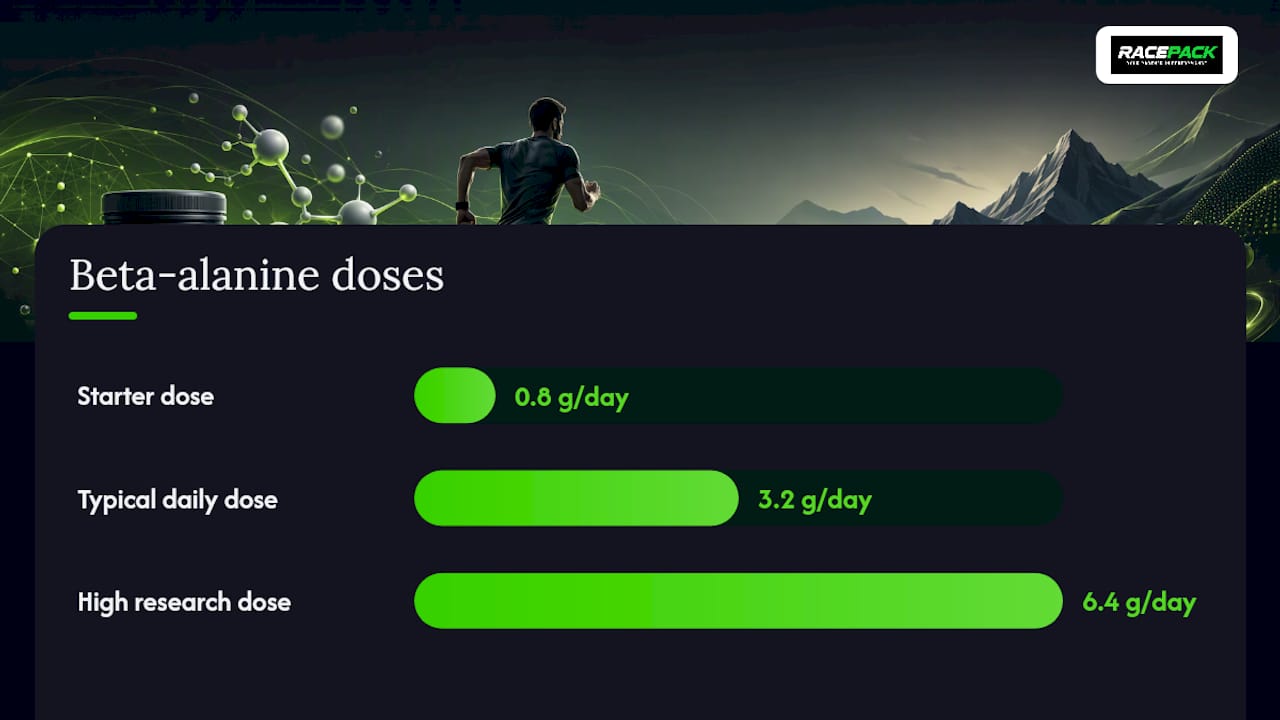
Standard performance-oriented dosing lands within a moderate daily range, split into smaller servings taken several times throughout the day. Splitting the dose is the single most effective way to avoid the tingling sensation that comes with larger single servings, and most athletes maintain this for a minimum of four weeks before expecting noticeable change. Examine’s dosage summary notes that clinical studies have used anywhere from 1 to 7 g/day, but 3.2–6.4 g/day is the range most consistently tied to performance outcomes.
Bodyweight-adjusted dosing offers a personalized approach, generally landing around a moderate fraction of bodyweight daily, fitting within common dosing ranges.
| Approach | Daily amount | Split pattern | Best for |
|---|---|---|---|
| Standard loading | 3.2–6.4 g/day | 4–8 servings of 0.8–1.6 g | Most athletes starting supplementation |
| Bodyweight-adjusted | Moderate fraction of bodyweight daily | Split across the day | Athletes wanting individualized dosing |
| Sustained-release | 1.6–3.2 g/day | 2 servings | Athletes prone to paresthesia |
Sustained-release capsules or tablets offer an alternative to frequent powder dosing throughout the day. Because they release beta-alanine more gradually, they tend to produce less of the skin-tingling side effect at a given dose, which makes them appealing if you’ve struggled with the sensation on powder protocols.
Timing matters more at the start of a training block than on any given day. Since carnosine accumulates gradually, practical dosing guidance recommends starting four to six weeks (or longer) before a target competition, so your carnosine stores are meaningfully elevated by race day rather than just beginning to climb. A few practical dosing reminders:
- Consistency matters more than perfect timing around workouts, since this isn’t an acute performance booster.
- Splitting doses with meals can further reduce the likelihood of tingling.
- Powder formats like NOW Sports Beta Alanine Powder let you fine-tune serving size to hit these gram targets precisely.
What Are the Side Effects and Safety Considerations?
The one side effect nearly every beta-alanine user encounters at some point is paresthesia, a tingling or prickling sensation typically felt in the face, neck, and hands. It’s harmless, temporary, and directly related to dose size and how quickly beta-alanine hits your bloodstream. Larger single doses taken all at once tend to trigger a stronger sensation; smaller, split doses spread across the day largely avoid it.
The ISSN position stand confirms paresthesia as the primary documented side effect in healthy adults and notes it’s effectively managed through divided dosing or sustained-release formulations. Beyond the tingling, the safety profile in healthy populations is considered favorable at the doses used in research, with no serious adverse events consistently reported across the trials informing that position stand.
That said, a few practical guardrails are worth following:
- Start with smaller doses (0.8 g) to gauge your personal sensitivity before scaling toward the higher end of the range.
- If tingling feels uncomfortable rather than just noticeable, switch to a sustained-release format or split doses further.
- Stop supplementation and consult a healthcare provider if you experience symptoms beyond typical tingling, such as persistent rash, swelling, or breathing difficulty.
- Pregnant or breastfeeding athletes, and anyone managing a chronic health condition, should check with a doctor before starting any new supplement regimen.
Pro Tip: If paresthesia bothers you, try taking your beta-alanine dose with a meal rather than on an empty stomach. Food slightly slows absorption, which can soften the tingling without changing the total daily dose you’re getting.
Combining Beta-Alanine With Other Supplements
Beta-alanine plays a different role than most of the ingredients sitting next to it in a pre-workout tub, and understanding that difference keeps your expectations realistic. Caffeine and nitric oxide boosters work acutely. They hit your system within an hour and are gone the next day. Beta-alanine works chronically, building an effect over weeks that has nothing to do with what you took that morning.
This distinction matters when you’re stacking supplements. Combining beta-alanine with creatine is common and reasonably well supported, since the two target different energy systems, but in a multi-ingredient pre-workout product it becomes genuinely hard to attribute a training session’s performance to any single ingredient. Examine’s review points out that multi-ingredient products frequently contain less beta-alanine per serving than the 3.2–6.4 g/day used in clinical research, so the label matters as much as the concept.
Practical steps worth taking:
- Read the supplement facts panel and calculate actual beta-alanine content per serving, not just what the front label implies.
- If a pre-workout blend underdoses beta-alanine, consider supplementing separately with a dedicated powder to hit your target range.
- Don’t expect an acute “kick” from beta-alanine the way you would from caffeine. Its contribution is cumulative, not immediate.
Your 8-Week Beta-Alanine Plan for Endurance Racing
Turning the research into a schedule you can actually follow removes most of the guesswork. Here’s a structure built around a typical race-prep timeline.
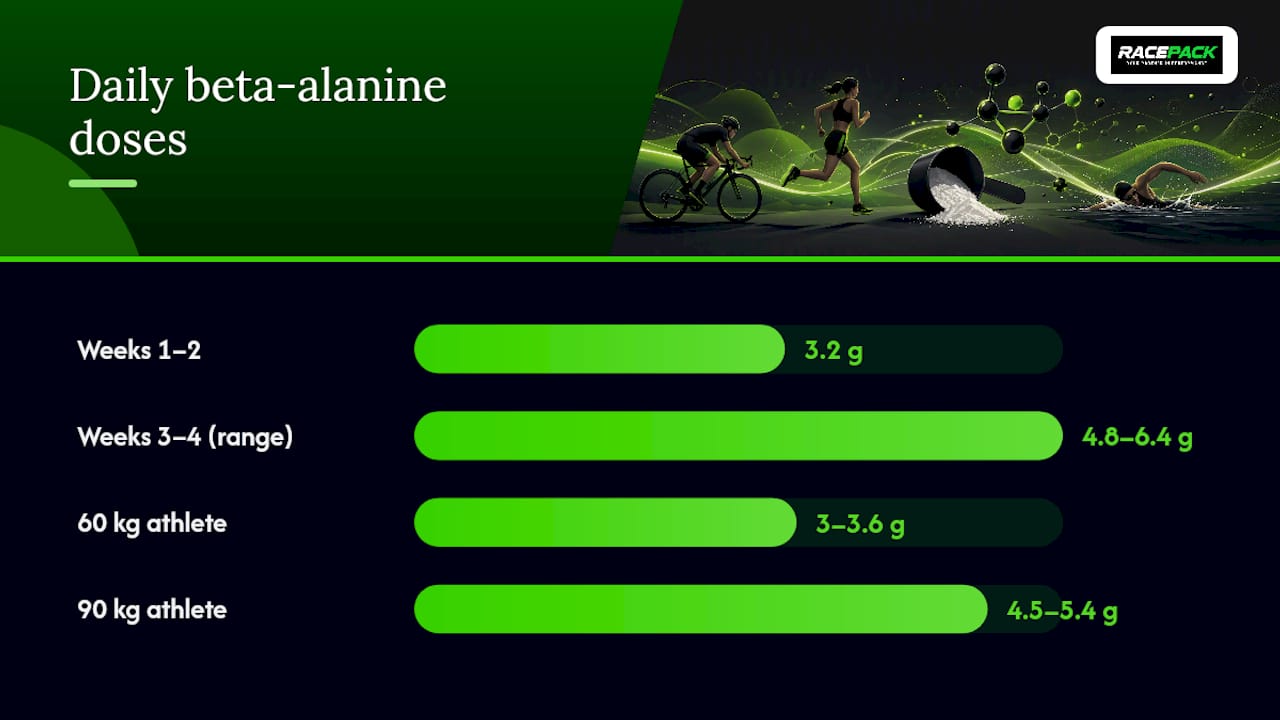
- Weeks 1–2: Start at 3.2 g/day, split into four servings of 0.8 g with meals. This eases you into any tingling sensation while beginning carnosine accumulation.
- Weeks 3–4: If tolerated well, increase to 4.8–6.4 g/day, still split across three to four servings. This is the range most closely tied to measurable performance benefit in the research.
- Weeks 5–6: Maintain your dose and start paying attention to training data: repeatable interval times, power output on hard efforts, or how you feel during your hardest weekly session.
- Weeks 7–8: Hold the same daily dose through your final race-prep block. Because washout takes weeks, you don’t need to taper off before competition.
For a 60 kg athlete, bodyweight-adjusted dosing lands around 3–3.6 g/day; a 90 kg athlete lands closer to 4.5–5.4 g/day. Either way, a single container of a powder like EVL Beta Alanine offering roughly 125 servings gives you months of runway to load and maintain without reordering mid-block.
Powder formats give you exact gram control for hitting these targets precisely, while sustained-release capsules trade some flexibility for reduced tingling. Racepack SG stocks both formats, and the right pick depends mostly on how sensitive you are to paresthesia and how much you value precise dose adjustment.
Pro Tip: Track a repeatable benchmark, like a 3-minute all-out effort on the bike or a 1200m time trial, before you start loading and again at week six. That’s the cleanest way to see whether beta-alanine is actually doing anything for you specifically.
What Should Endurance Athletes Realistically Expect?
The gap between what beta-alanine promises on a supplement label and what the research actually supports is smaller than most marketing suggests, but it’s not nothing either. If your training and racing regularly push you into that one to ten minute, high-lactate zone, a properly dosed four-plus week loading protocol gives you a real, if modest, shot at delayed fatigue and better repeat efforts.
Where I’d push back on conventional wisdom: too many athletes treat beta-alanine as an automatic addition to any endurance stack, when the honest answer is that its value depends heavily on your specific event profile. A recreational marathoner spending three hours at conversational pace probably won’t feel much. A track athlete grinding through 800m repeats almost certainly will. Test it against your own data rather than trusting a testimonial.
Before you spend money on any supplement, get your training volume, sleep, and fueling strategy right first. Beta-alanine amplifies a good training program; it doesn’t replace one. And when you do buy, source it from a supplier that guarantees authenticity, since underdosed or mislabeled beta-alanine products are common enough in this category to matter.
— Jason John
Where to Buy Real Beta-Alanine for Your Training Block
Racepack SG carries beta-alanine formats that match the dosing protocols covered above, sourced with guaranteed authenticity and delivered next-day across Singapore so you’re not waiting weeks to start a loading phase.
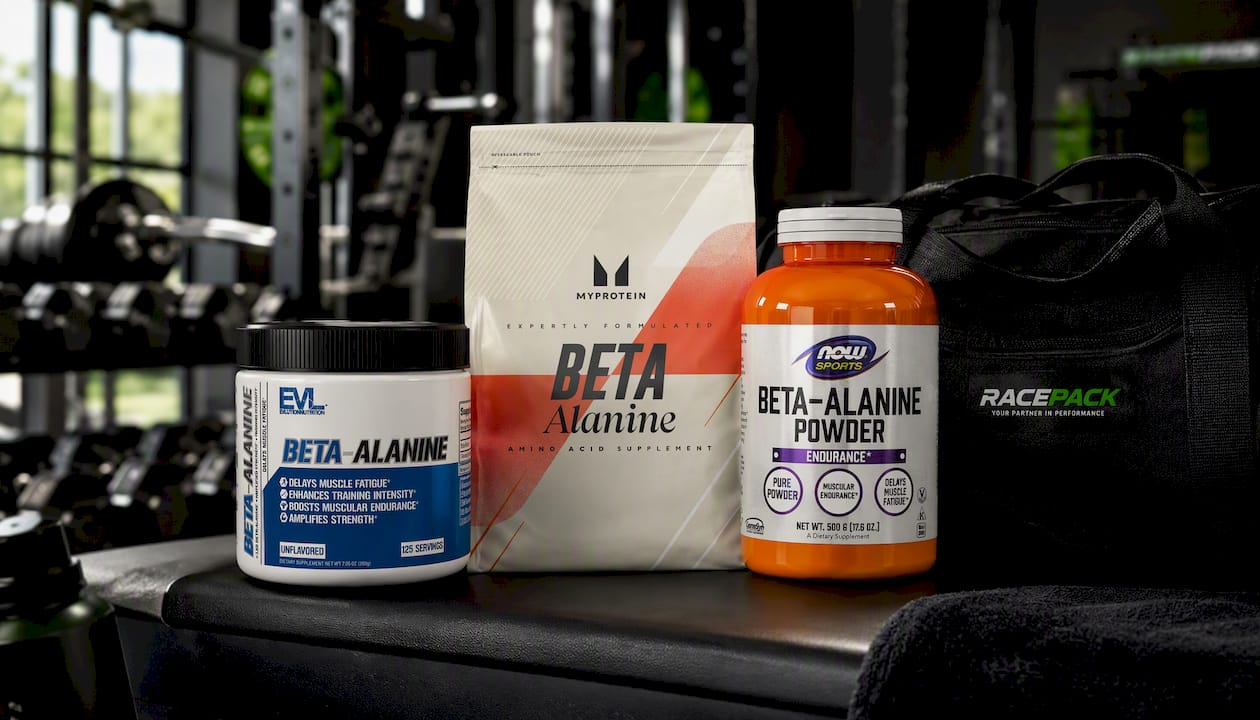
For athletes who want maximum dosing flexibility, EVLution Nutrition Beta Alanine offers 125 servings in an unflavored powder, which works out to roughly four months of daily use at a 3.2 g dose or about two and a half months at the higher 5 g range. It’s unflavored, so it mixes cleanly into any drink without fighting your other supplements for taste.
If you’d rather stick with a well-known name for a straightforward powder option, MyProtein Beta Alanine Amino Acid comes in 250g and 500g sizes, giving you the choice between a shorter trial run and a full training-block supply. For athletes planning a longer buildup toward a race season, the NOW Sports Beta Alanine Powder 500g tub supports extended loading and maintenance without needing a reorder mid-cycle.
Measuring servings is simple with any of these: a standard kitchen scale or the scoop provided gets you within range of the 0.8–1.6 g split doses covered earlier in this guide. Ready to start your loading phase? Buy Now and get your beta-alanine delivered next-day so you can begin building toward your next race.
Sources
The dosing and safety guidance throughout this article draws primarily from the ISSN position stand on beta-alanine, the systematic review and meta-analysis on aerobic-anaerobic transition performance, the 10 km time trial RCT, the Gatorade Sports Science Institute review, and Examine’s dosage summary. If you have an existing health condition or take prescription medication, talk to a doctor before starting any new supplement.
This article is general information, not a substitute for advice from a qualified doctor. Consult a qualified healthcare professional about your own circumstances before acting on anything here.
- International society of sports nutrition position stand: Beta-Alanine
- An Update On Beta-Alanine Supplementation For Athletes - Gatorade Sports Science Institute
- Beta-Alanine benefits, dosage, and side effects
FAQ
Does beta-alanine actually help with endurance?
It’s less effective for long, steady-state endurance events where blood lactate stays lower.
What are the downsides of beta-alanine?
The main downside is paresthesia, a harmless tingling sensation in the skin, which splitting your dose or using a sustained-release format largely resolves. It also requires several weeks of consistent use before benefits appear, so it’s not a quick fix.
Is BCAA or beta-alanine better for endurance athletes?
They serve different purposes: beta-alanine buffers acidity to delay fatigue during high-intensity efforts, while BCAAs primarily support muscle protein balance and may reduce perceived fatigue over longer sessions. Many endurance athletes use both rather than choosing one over the other.
Is 20g of beta-alanine too much?
Yes. Clinical protocols typically max out around 6.4 g/day, and much higher single-day doses would likely cause significant, uncomfortable paresthesia with no added performance benefit.
How long does it take for beta-alanine to work?
It’s not effective as a same-day pre-workout supplement.
Can I take beta-alanine every day, including rest days?
Yes, and you should. Since the benefit depends on cumulative carnosine buildup rather than acute timing, daily dosing (including rest days) is what the loading protocols are built around.
What’s the best beta-alanine dosage for a 5K or 10K runner?
A standard 3.2–6.4 g/day protocol, split into 0.8–1.6 g servings, for at least four to six weeks before your target race aligns well with the event durations and effort levels involved in 5K and 10K racing.
Does beta-alanine cause weight gain or water retention?
There’s no strong evidence linking beta-alanine to water retention or weight gain the way creatine sometimes does. Any change on the scale during a loading phase is more likely related to overall training load and diet.
Can I stack beta-alanine with creatine and caffeine?
Yes, and it’s a common combination since each works through a different mechanism, buffering, ATP resynthesis, and central nervous system stimulation, respectively. Just track your total beta-alanine intake separately, since pre-workout blends often underdose it relative to clinical protocols.
Do I need to cycle off beta-alanine?
There’s no strong evidence requiring cycling off, since long-term use in healthy adults has been studied without significant safety concerns. Many athletes maintain a lower daily dose year-round and increase it ahead of key competition blocks.
Which Racepack SG product is best for starting a beta-alanine loading phase?
A powder format like EVLution Nutrition Beta Alanine or NOW Sports Beta Alanine Powder gives you the gram-level dosing control needed to follow the 3.2–6.4 g/day protocols covered in this guide.
Will beta-alanine help my marathon time?
Probably not much, since marathon pacing keeps blood lactate relatively low for most of the race. Beta-alanine’s benefit is far more consistent in shorter, higher-intensity efforts like 5Ks, interval sessions, and hard hill repeats.