

Nutrition for Endurance Athletes: Periodized Performance Guide
TL;DR:
- Periodized nutrition aligns carbohydrate and calorie intake with training phases and uses certified supplements to enhance endurance performance. It involves adjusting macronutrients for different training blocks, trialing supplements in training, and tracking data to optimize fueling strategies. Always choose third-party-certified products and practice race-day nutrition during training to prevent issues.
Periodize your carbohydrate and calorie intake to match your macro-, meso-, and microcycles, then layer in evidence-backed supplements such as caffeine, creatine, dietary nitrate, and beta-alanine only after your food-first needs are met. The International Society of Sports Nutrition (ISSN) supports this approach for endurance athletes, and every supplement you use should carry NSF Certified for Sport or Informed Sport third-party certification. RacepackSingapore stocks authenticated products across all these categories.
Quick-start checklist:
- Target carbohydrate intake scaled to daily training volume according to energy needs
- Aim for a moderate protein intake; increase intake during carb-restricted blocks to support lean mass
- Trial every supplement and race product in training before competition
- Confirm NSF or Informed Sport certification on every product label
- Log RPE, pace, and recovery markers across a 2–4 week block to track what works
Pro Tip: Test your race-day gels and drinks at target race intensity and duration, not just on easy runs. Gut tolerance at 85% effort is very different from gut tolerance at 60%.
Table of Contents
- What periodized nutrition means for your performance
- Core nutrition principles every endurance athlete needs
- How to fuel before, during, and after sessions
- Hydration and electrolyte strategy for training and race day
- Which supplements actually have strong evidence?
- How to personalize your plan using data and professional support
- How to read labels and choose the right products
- A one-week periodized nutrition template you can adapt
- Race-day checklist and practical tips to prevent common issues
- Key Takeaways
- Why periodized nutrition is the only approach worth committing to
- Authoritative sources and further reading
- RacepackSingapore has everything you need to fuel your training
- FAQ
What periodized nutrition means for your performance
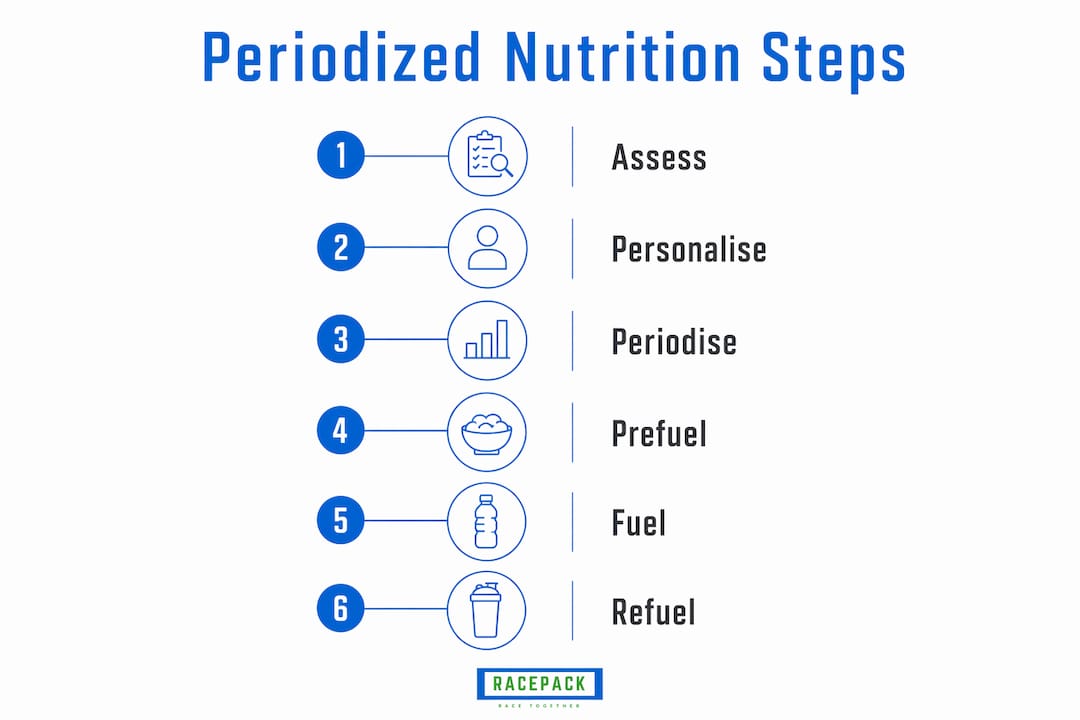
Periodized nutrition is the planned, purposeful manipulation of energy and macronutrients to match the goals of each training phase. It mirrors the structure of your training plan: a macrocycle (full season), broken into mesocycles (training blocks), broken further into microcycles (individual weeks). Your plate changes with your program.
The practical payoff is real. High-carbohydrate fueling on hard-intensity days preserves performance and supports glycogen-dependent adaptations. Deliberately lower carbohydrate intake on easy or recovery days can enhance fat oxidation and metabolic flexibility. This is not about eating less; it is about eating right for the work required.
“A periodised nutrition system integrates individualized metabolic data and wearables with planned nutrition across macro-, meso- and microcycles to improve training adaptations in elite athletes.” Fuelling gold medals, Springer Sports Medicine, 2025
Key phases and their nutrition focus:
- Base/aerobic block: moderate carbohydrate, higher fat tolerance, build gut capacity
- Threshold/intensity block: increase carbohydrate to fuel quality sessions
- Race-specific block: practice exact race-day fueling protocols
- Recovery/transition: reduce total calories, maintain protein to preserve lean mass
Core nutrition principles every endurance athlete needs
Carbohydrate is the primary fuel for endurance performance. Guidelines recommend 5–12 g·kg⁻¹·d⁻¹ depending on daily exercise duration and volume, with approximately 60% of total energy from carbohydrate for athletes in heavy training. A 70 kg runner logging 10 hours per week needs roughly 350–560 g of carbohydrate daily.
Protein targets matter more than most athletes realize. Habitual intake among endurance athletes often sits near 1.5 g·kg⁻¹·d⁻¹, but evidence supports targeting ~1.8 g·kg⁻¹·d⁻¹ for most athletes, rising to 2.0–2.5 g/kg during carb-restricted training blocks to protect lean mass. Fat fills the remaining calorie gap and supports hormone function; 20–35% of total energy is a practical range.
Practical meal examples:
- Breakfast (threshold day): oatmeal with banana, honey, and Greek yogurt (~90 g carbohydrate, 25 g protein)
- Pre-long-run meal (3–4 hours out): white rice, grilled chicken, and a small serving of fruit (~80 g carbohydrate, 30 g protein, low fiber)
- Recovery snack (within 30 minutes post-run): chocolate milk or a protein shake with a banana (~40 g carbohydrate, 20 g protein)
Avoid copying elite-level fueling volumes without matching training loads. Excess carbohydrate on easy days stores as fat, not performance.
How to fuel before, during, and after sessions
Timing is where nutrition strategy converts to race-day results. The 4Ps framework (Personalise, Periodise, Prefuel, Prepare) organizes this clearly.

| Phase | Target | Practical Example |
|---|---|---|
| Pre-event (3–4 hrs) | 1–3 g/kg body mass CHO | White rice + chicken + fruit juice |
| Pre-start top-up (~30 min) | ~30 g CHO | 1 energy gel or banana |
| In-event (60–90 min) | 30–60 g CHO/hr | 1–2 gels or isotonic drink |
| In-event (>2.5 hrs) | Up to 90 g CHO/hr | Multiple carb sources (glucose + fructose) |
| Ultra events | —; 5–10 g protein/hr | Gels + chews + real food |
| Post-session | 1 g/kg CHO + 20–40 g protein | Recovery shake + rice meal within 2 hrs |
Pre-event meals should be low in fiber and fat. Red meat digests significantly slower than chicken or tofu, making it a poor choice in the 3–4 hours before a race. For in-event fueling beyond 2.5 hours, combining glucose and fructose sources raises absorption to roughly 1.7 g/min versus 1.0 g/min from glucose alone.
Key fueling rules:
- Never try a new product on race day
- Start fueling within the first 30 minutes of efforts over 75 minutes
- In ultra events, include 5–10 g protein per hour to reduce muscle catabolism
Pro Tip: For sessions over 90 minutes, practice your exact race-day gel and drink sequence. Gut training is a trainable adaptation, not a fixed trait.
Hydration and electrolyte strategy for training and race day
Sweat rate varies widely between athletes. A simple pre/post-session weigh-in gives you a reliable estimate: every kilogram of body weight lost equals roughly 1 liter of fluid deficit. Account for any urine produced during the session to get a clean sweat-rate figure.
Step-by-step sweat test:
- Weigh yourself nude before the session (in kg)
- Train for exactly 60 minutes at race intensity; drink a measured volume
- Weigh yourself nude after (no toweling off)
- Calculate: fluid loss (L) = pre-weight minus post-weight plus fluid consumed
- Convert to mL·hr⁻¹ and use that as your hourly fluid target
Sodium is the electrolyte that matters most for endurance events. The ISSN position stand recommends higher sodium formulations in hot and humid conditions, with fluid intake of 450–750 mL·hr⁻¹ for ultra events. Products like HIGH5 ZERO+ electrolyte sachets and the HIGH5 bottle with hydration tablets make hitting sodium targets convenient during training and racing.
Hyponatremia (dangerously low blood sodium) is a real risk in long events when athletes overdrink plain water. Drink to thirst, not to a fixed schedule, and use sodium-containing drinks in events lasting more than 90 minutes. At altitude, fluid needs increase; in heat, both fluid and sodium requirements rise.
Which supplements actually have strong evidence?
Only a short list of supplements has consistent, sport-specific evidence. Apply them to clear use-cases and dose precisely. Everything else is food-first.
| Supplement | Dose | Timing | Primary Benefit | Caution |
|---|---|---|---|---|
| Caffeine | evidence-backed dose pre-event | benefits in alertness and endurance | possible GI and sleep effects | |
| Creatine | daily supplementation | supports power and glycogen | may cause water retention | |
| Dietary nitrate | pre-event dose | improves oxygen use and performance | avoid interference with mouthwash | |
| Beta-alanine | daily split doses | buffers acid in short efforts | can cause harmless tingling | |
| Sodium bicarbonate | pre-event dose | buffers acid in intense efforts | may cause GI distress, requires testing |
For creatine dosing details, RacepackSingapore’s guide covers loading protocols, timing, and safety. Beta-alanine powder is available directly from the RacepackSingapore store.
“Position statements recommend testing supplements in training before competition and using certified products to reduce anti-doping risk.” Sports nutrition supplements overview
Third-party certification (NSF Certified for Sport, Informed Sport) is the minimum standard. Never introduce a new supplement in a race.
How to personalize your plan using data and professional support
Wearable metrics — heart rate, power output, training load, and continuous glucose monitoring — give you real-time signals to tune your carbohydrate intake. A session where power drops in the final 20 minutes often signals under-fueling, not fitness. Track these patterns across a mesocycle and adjust carbohydrate targets accordingly.
A full-body training workflow that integrates nutrition timing with periodized training blocks is one of the most practical frameworks for connecting wearable data to daily food choices.
Bloodwork checklist (test every 6 months):
- Ferritin and serum iron (endurance athletes commonly deplete iron stores)
- Vitamin D (25-OH)
- Full blood count
- B12 (especially for plant-based athletes)
Action steps for anti-doping safety:
- Document every supplement ingredient before use
- Cross-reference against the WADA prohibited list
- Choose only NSF Certified for Sport or Informed Sport products
- Consult a registered sports dietitian for individualized macro targets
Pro Tip: If you follow a plant-based diet, prioritize selenium and B12 monitoring. Both are commonly low and both affect energy metabolism directly.
How to read labels and choose the right products
The label tells you everything you need to know, if you know what to look for. Start with carbohydrate type and concentration. An isotonic drink typically contains 6–8 g carbohydrate per 100 mL; a hypertonic gel delivers 20–25 g per serving. For events over 90 minutes, products combining glucose and fructose (2:1 ratio) maximize absorption.
Label checklist:
- Carbohydrate per serving (g) and carbohydrate type (glucose, fructose, maltodextrin)
- Sodium content (mg per serving)
- Sugar alcohols or FODMAPs (can cause GI distress)
- Allergens (gluten, dairy, soy)
- Third-party certification logo (NSF, Informed Sport)
Shopping checklist:
- Match product format to race logistics (gels for pockets; drinks for aid stations)
- Buy a single-serve option first to test gut tolerance before committing to bulk
- Check batch number and expiry date before race week
- Store gels at room temperature; avoid heat exposure that degrades consistency
The GU Energy Gel single pack (minimum order 8) is ideal for gut-testing in training without committing to a full box. Once you confirm tolerance, the GU Energy Gel 24-pack gives you race-block supply at better value. A MyProtein Supplement Storage Box keeps your race-kit supplements organized and protected.
Pro Tip: Carry a backup gel in every race pocket. Missed fueling windows in the second half of a race are almost impossible to recover from.
A one-week periodized nutrition template you can adapt
This template is built for a 70 kg athlete in a moderate-intensity training block. Scale carbohydrate bands up or down by 0.5–1 g/kg for heavier or lighter weeks.
- Monday (rest/recovery): 3–4 g/kg CHO, 1.8 g/kg protein. Focus on anti-inflammatory foods: salmon, leafy greens, berries. Light recovery nutrition applies here.
- Tuesday (threshold intervals): 6–7 g/kg CHO. Pre-session: oatmeal + banana. During: isotonic drink. Post: rice + protein shake with MyProtein EAA Powder.
- Wednesday (easy run/swim): 4–5 g/kg CHO. No in-session fueling needed under 60 minutes. Good day to trial a new electrolyte tablet.
- Thursday (strength + short tempo): 5–6 g/kg CHO. Pre-session caffeine (3–6 mg/kg) if testing race-day protocol. Post: 20–40 g protein within 30 minutes.
- Friday (rest or active recovery): 3–4 g/kg CHO. Prioritize sleep and micronutrient-dense foods.
- Saturday (long run/ride, 2–3 hrs): 7–8 g/kg CHO. In-session: 1 GU Energy Gel every 45 minutes plus 500–750 mL electrolyte drink per hour. Post: full recovery meal within 2 hours.
- Sunday (easy aerobic or brick): 5 g/kg CHO. Trial race-day breakfast timing and composition.
Scaling notes:
- Heat or altitude: add 200–300 mL fluid per hour and increase sodium intake
- Heavier training week: add 1–2 g/kg CHO on hard days only
- Taper week: reduce CHO on easy days; maintain protein to preserve muscle
Pro Tip: Use Thursday and Saturday as your supplement trial sessions. They match race intensity and duration closely enough to reveal any gut issues before race day.
Race-day checklist and practical tips to prevent common issues
Race-day kit checklist:
- Gels (1 per 45 min of racing, plus 1 backup)
- Electrolyte tablets or sachets
- Hydration bottle or vest filled and sodium-dosed
- Pre-race meal prepped and timed (3–4 hours before start)
- Caffeine dose confirmed and timed (45–60 min before start)
- Product batch numbers checked; expiry dates confirmed
Practical tips:
- Eat your pre-race meal at home, not at the venue. Unfamiliar food options cause last-minute changes that wreck gut tolerance.
- If you miss a fueling window, take the next one immediately. Do not double-dose to catch up.
- Gut-train progressively: start with 30 g CHO/hr in training, increase by 10 g/hr each week until you reach your race target.
- Caffeine works best for athletes who have reduced or eliminated it in the 5–7 days before a key race.
- Check every supplement against the WADA prohibited list and confirm third-party certification before race week.
Key Takeaways
Periodized nutrition that matches carbohydrate and calorie intake to training load, combined with evidence-backed supplements and third-party certified products, is the most reliable path to endurance performance gains.
| Point | Details |
|---|---|
| Periodize carbohydrates | Target 5–12 g·kg⁻¹·d⁻¹ CHO scaled to daily training volume and intensity. |
| Protein targets matter | Aim for ~1.8 g·kg⁻¹·d⁻¹; increase to 2.0–2.5 g/kg during carb-restricted blocks. |
| Trial supplements in training | Never introduce a new product on race day; test at race intensity and duration. |
| Hydrate with sodium | Use sodium-containing drinks for events over 90 minutes; drink to thirst, not a fixed schedule. |
| RacepackSingapore products | GU Energy Gels, HIGH5 electrolytes, and MyProtein recovery options are all available with guaranteed authenticity. |
Why periodized nutrition is the only approach worth committing to
Most athletes I speak with are either under-fueling hard sessions or over-fueling easy ones. Both patterns stall progress. The periodized approach fixes this by making nutrition a deliberate variable, not an afterthought. What makes it compelling is not complexity; it is the precision. When you align carbohydrate intake with training load and use wearable data to confirm your fueling is working, you stop guessing and start building.
The recovery-performance connection is just as real for endurance athletes as it is for strength-based sports. Under-recovering between sessions compounds over a mesocycle into chronic fatigue that no amount of motivation overcomes.
My recommendation: run a 3-week periodized block with one variable changed at a time. Log your RPE, power or pace, and morning heart rate. The data will tell you more than any generic plan ever could. Start with one product from RacepackSingapore’s energy gel range in your next long session and build from there.
Authoritative sources and further reading
The claims in this article draw from the following peer-reviewed and institutional sources:
- ISSN Position Stand: Ultra-Marathon Nutrition — calorie, CHO, fluid, and sodium ranges for ultra events
- Protein Nutrition for Endurance Athletes (Sports Medicine) — protein targets and carb-restricted contexts
- Fuelling Gold Medals: Periodised Nutrition System (Springer) — periodized nutrition framework and wearable integration
- The 4Ps Framework for Optimal Performance (Springer) — pre-event, in-event, and personalization structure
- Supplements with Robust Evidence (Frontiers in Nutrition) — evidence tiers for caffeine, creatine, nitrate, beta-alanine
- Sports Nutrition Supplements Overview (Brighton/IJSNEM) — anti-doping and third-party testing guidance
- Spanish Nutrition Society Consensus (SEN) — individualized strategy over single-diet dogma
- PMC Systematic Review: Female Athletes — CHO + protein supplementation evidence and absorption rates
“No single dietary strategy is universally superior. Nutrition strategies must be tailored to sport demands and individual athlete goals.” Spanish Nutrition Society Consensus
For deeper implementation reading, RacepackSingapore’s nutrition and supplements blog covers product-specific guides, periodization case studies, and recovery protocols.
RacepackSingapore has everything you need to fuel your training
Athletes who train with a periodized nutrition plan need products they can trust, delivered when they need them. RacepackSingapore carries authenticated GU Energy Gels, HIGH5 electrolyte products, and MyProtein recovery formulas, all sourced directly from the brands. Every product ships with next-day delivery within Singapore, so you are never caught short before a key session.
Whether you are building your first periodized fueling plan or dialing in race-week protocols, RacepackSingapore’s product range covers every phase. Browse the full GU Energy Gel 6/12/24 pack options to match your training volume, or pick up the MyProtein Pea Protein Isolate bundle for plant-based recovery support. Ready to stock your kit? Buy now at RacepackSingapore and get your next training block fueled right.
FAQ
What carbohydrate intake do endurance athletes need daily?
Endurance athletes need 5–12 g·kg⁻¹·d⁻¹ of carbohydrate depending on daily training volume, with approximately 60% of total energy from carbohydrate during heavy training blocks.
How much protein should an endurance athlete eat?
Target ~1.8 g·kg⁻¹·d⁻¹ as a baseline; increase to 2.0–2.5 g/kg during carb-restricted training blocks to protect lean mass and support adaptation.
Which supplements have the strongest evidence for endurance performance?
Caffeine, creatine, dietary nitrate, and beta-alanine have the most consistent evidence. Use them at evidence-based doses, trial each in training first, and choose only NSF Certified for Sport or Informed Sport products.
How do I avoid hyponatremia during a long race?
Drink to thirst rather than a fixed schedule, and use sodium-containing drinks for any event lasting over 90 minutes. Overdrinking plain water is the primary cause of exercise-associated hyponatremia.
What is periodized nutrition and why does it matter for athletes?
Periodized nutrition matches carbohydrate and calorie intake to the goals of each training phase (macrocycle, mesocycle, microcycle), fueling hard sessions fully while reducing intake on recovery days to support metabolic adaptation.
How do I gut-train for race-day fueling?
Start with 30 g CHO per hour in training and increase by 10 g/hr each week until you reach your race target. Practice at race intensity and duration, not just on easy sessions.
Are GU Energy Gels suitable for long-distance events?
Yes. GU Energy Gels provide a concentrated carbohydrate source suitable for events from 60 minutes to ultra distances. The GU Energy Gel 24-pack from RacepackSingapore is a practical bulk option for training blocks and race preparation.
How do I use wearable data to improve my nutrition plan?
Track power output, heart rate, and training load across a mesocycle. A consistent late-session power drop signals under-fueling; adjust carbohydrate targets on hard days first and reassess over 2–3 weeks.
What should I eat 3–4 hours before a race?
Choose a low-fiber, low-fat meal providing 1–3 g/kg body mass of carbohydrate. White rice with chicken or tofu and a small serving of fruit is a reliable, well-tolerated option. Avoid red meat, which digests more slowly.
How do I check if a supplement is safe for competition?
Verify the product carries NSF Certified for Sport or Informed Sport certification, then cross-reference every ingredient against the current WADA prohibited list before use.