

Strengthen Legs for Marathon Training: Plan for Runners
TL;DR:
- Two weekly strength sessions focused on single-leg and eccentric loading enhance marathon performance and protect against fatigue. Scheduling these workouts on easy-run days with proper rest before hard sessions maximizes gains and prevents injury. Consistent, progressive training over 16 weeks improves neuromuscular efficiency and running economy.
Start this week with two strength sessions of 30–40 minutes each, placed on easy-run days, built around single-leg and eccentric loading. That’s the core prescription for any runner who wants to strengthen legs for marathon training without wrecking their run quality.
Here’s your micro-prescription to begin immediately:
- Day A (force production): Back squat or goblet squat (3×8), Bulgarian split squat (3×8 per leg), single-leg Romanian deadlift (3×10 per leg). Rest 90 seconds between sets.
- Day B (endurance + stability): Step-ups (3×12 per leg), single-leg calf raises with a 3-second lower (3×15 per leg), single-leg hip thrust (3×10 per leg), dead bug or Pallof press (3×10). Rest 60 seconds between sets.
- Session length and rest: Keep each session to 30–40 minutes. If you’re new to lifting, start at the lower end of the rep ranges and leave 2 reps in reserve on every set.
Pro Tip: Never schedule a heavy leg session the evening before your long run or a key workout like a tempo or interval session. Separate strength from hard runs by at least 24 hours, or do a short session after an easy run on the same day.
Table of Contents
- Why stronger legs change your marathon performance
- The priority exercises every marathoner should know
- Sample workouts and a 16-week periodized plan
- How to fit strength sessions into your marathon schedule
- Exactly what sets, reps, and loads to use in each phase
- Warm-up, mobility, and how to avoid common mistakes
- How to adapt these sessions with minimal equipment
- Key Takeaways
- The honest coaching perspective on strength and marathon training
- Fuel and recovery products from RacepackSingapore
- FAQ
Why stronger legs change your marathon performance
Stronger legs improve running economy, reduce late-race form breakdown, and protect against the “dead legs” feeling that hits most runners somewhere after mile 20. Those three outcomes are the direct result of what targeted strength work does to your neuromuscular system and your posterior chain.
Running 26.2 miles is a repeated eccentric loading event. Every foot strike asks your quads, glutes, and calves to absorb force and then produce it again, thousands of times. When those muscles are undertrained, they fatigue faster, your form collapses, and your pace drops. Strength training addresses that directly by building the capacity to handle that load without breaking down.
The performance gains are well-documented. Two sessions per week of focused strength work, sustained for 8–12 weeks before a marathon, meaningfully reduce quad fatigue late in a race. Reviews of training studies show that regular strength training improves running economy by approximately 4–8% in middle- and long-distance runners. That kind of gain shows up as a more controlled pace, a stronger finish, and fewer missed training days from overuse injuries.
Single-leg work is where most runners get the biggest return. Because running is a chain of unilateral movements, exercises that train one leg at a time improve motor control, reduce side-to-side compensations, and directly translate to a cleaner, more efficient stride when glycogen is low and fatigue is high.
Weak glutes and undertrained calves create a cascade of problems. When your glutes stop controlling hip motion, your knees drift inward and stress the IT band. When your calves are underpowered, your lower legs absorb more shock than they should, and shin splints follow. Targeted strength work fixes those weak spots before they become race-day problems. Pairing your strength plan with solid electrolyte replenishment also helps muscles function at their best through long training blocks.
The priority exercises every marathoner should know
These moves give you the highest transfer to running. They’re organized by function so you can build sessions that hit every demand of a 26.2-mile race.
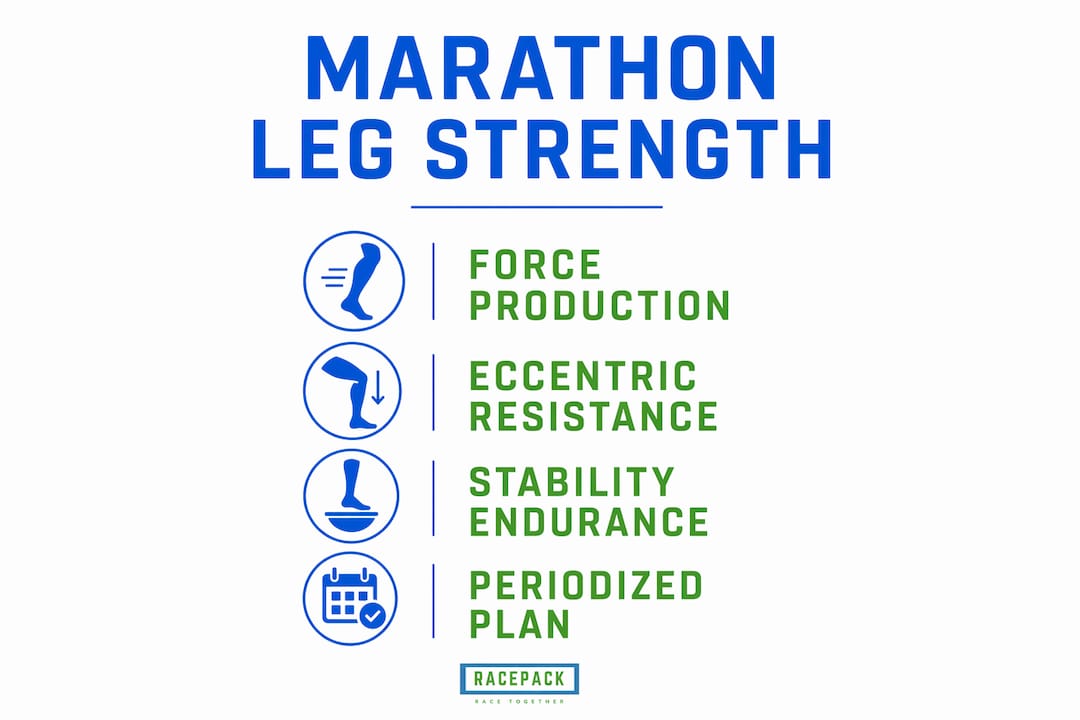
Force production: the big movers
Bulgarian split squat Directly targets quads, hip flexors, hamstrings, and glutes while adding a stability challenge that bilateral squats can’t replicate. Place your rear foot on a bench, lower until your front thigh is parallel to the floor, and drive through your front heel to stand. Keep your torso upright and your front knee tracking over your second toe. Common fault: leaning too far forward, which shifts load to the lower back. Regression: bodyweight reverse lunge. Progression: add dumbbells or a barbell.

Step-up A tremendous glute strengthener that mirrors the single-leg push-off of running. Use a box high enough that your knee is above your hip joint at the start. Drive through the heel of the working leg to full extension at the top, then return on the same leg to get the eccentric benefit. Common fault: pushing off the trailing foot. Regression: use a lower step. Progression: add a dumbbell in each hand.
Single-leg Romanian deadlift Running is a single-leg sport, and this move trains exactly that. Stand tall, soften the standing knee, and hinge at the hips while the free leg reaches back. Keep your back flat and hips square throughout. Aim for 3 sets of 10 per leg. Common fault: rotating the hips open as you lower. Regression: hold a wall for balance. Progression: add a dumbbell in the opposite hand.
Eccentric resistance: protecting your quads
Slow eccentric back squat or goblet squat Lower for 3–4 seconds, pause at the bottom, then drive up at normal speed. This eccentric emphasis is what prepares your quads for the downhill and late-race stress unique to marathon racing. Common fault: caving knees on the way up. Regression: bodyweight squat with a slow lower. Progression: increase load while maintaining the tempo.
Single-leg step-down (eccentric step-down) Stand on a box, lower your free foot slowly toward the floor over 3–4 seconds, then return. This directly trains the quad control you need on downhills. Common fault: the standing knee diving inward. Regression: use a lower step. Progression: add a light dumbbell.
Stability and endurance: the foundation
Single-leg calf raise with eccentric emphasis Lower over 3 seconds, rise on one foot. Strong calves support push-off and shock absorption on every stride. Common fault: rolling the ankle outward. Regression: bilateral calf raise. Progression: add load via a dumbbell or a weighted vest.

Pallof press or dead bug (anti-rotation core) These train the core to resist rotation rather than produce it, which is exactly what your trunk does during running. For the Pallof press, stand sideways to a cable or band, press straight out, hold for 2 seconds, and return. For the dead bug, lower opposite arm and leg slowly while keeping your lower back flat. Common fault: losing lumbar position. Regression: reduce range of motion.
Pro Tip: During easy runs, focus on driving one knee up aggressively with each stride for 20–30 seconds at a time. This forces single-leg control and activates the glutes in a running-specific pattern, reinforcing what you’re building in the gym.
Sample workouts and a 16-week periodized plan
The 16-week structure is divided into four blocks: a 5-week foundation, a 5-week muscular endurance and plyometrics phase, a 3-week strength and power build, and a 3-week taper with maintenance. Two sessions per week run throughout the entire cycle. For a deeper look at how periodization works across a full training cycle, the training periodization guide from HTK Training is a useful reference.
Sample session A: foundation phase (weeks 1–5)
Focus: movement quality, posterior chain activation, bodyweight control.
- Goblet squat: 3×12–15, 60-second rest
- Reverse lunge: 3×10 per leg, 60-second rest
- Glute bridge: 3×15, 45-second rest
- Single-leg calf raise: 3×15–20 per leg, 45-second rest
- Dead bug: 3×10 per side, 45-second rest
Sample session B: strength/power phase (weeks 11–13)
Focus: heavier load, lower reps, force production.
- Bulgarian split squat: 4×6 per leg, 90-second rest
- Single-leg Romanian deadlift: 3×8 per leg, 90-second rest
- Goblet squat with 3-second lower: 4×6, 90-second rest
- Step-up with dumbbell: 3×8 per leg, 90-second rest
- Pallof press: 3×10 per side, 60-second rest
Sample session C: eccentric taper session (weeks 14–16)
Focus: maintain neuromuscular sharpness, reduce volume, keep eccentric emphasis.
- Slow eccentric goblet squat (4-second lower): 2×6, 90-second rest
- Single-leg step-down: 2×8 per leg, 90-second rest
- Single-leg calf raise (3-second lower): 2×10 per leg, 60-second rest
- Side plank: 2×30 seconds per side, 45-second rest
16-week program overview
| Weeks | Phase | Session focus | Reps per set | Sets | Key rule |
|---|---|---|---|---|---|
| 1–5 | Foundation | Movement quality, posterior chain | 12–15 | 3 | Bodyweight or light load; prioritize form |
| 6–10 | Endurance/plyos | Muscular endurance + light plyos | 8–12 | 3–4 | Add moderate load; introduce jump variations |
| 11–13 | Strength/power | Heavy compound + single-leg | 4–8 | 4 | Heavier load; 90-second rest; eccentric tempo |
| 14–16 | Taper/maintenance | Low volume, eccentric emphasis | 6–10 | 2 | Cut volume substantially; keep load; stay sharp |
Sample weekly schedule (5-run week):
- Monday: Easy run + 30-minute Session A after
- Tuesday: Tempo run (no strength)
- Wednesday: Easy run or rest
- Thursday: Interval session (no strength)
- Friday: Session B (strength only or after easy run)
- Saturday: Long run (no strength within 24 hours prior)
- Sunday: Rest or light mobility
Progression rules:
- Add load only when you complete all sets and reps with clean form.
- Increase load by no more than 5–10% per week on compound lifts.
- If your legs feel flat going into a key run, reduce the previous session’s volume by one set.
How to fit strength sessions into your marathon schedule
Place strength on easy-run days or rest days, separate from hard workouts by several hours, and never within 24 hours before a long run or key session. That single rule protects your run quality while still letting you build meaningful leg strength.
Here’s how that plays out across different training schedules:
- 3-run week: Strength on 2 of the 4 non-run days; keep sessions 48 hours from your long run.
- 4-run week: Strength after Monday easy run and after Wednesday easy run; long run on Saturday.
- 5-run week: Strength after Monday easy run and on Friday (easy day); keep Thursday intervals and Saturday long run clean.
- 6-run week: Strength after two of the easy runs (e.g., Monday and Wednesday); treat Friday as a pure recovery day before Saturday’s long run.
- High-mileage week (70+ miles): Drop to one strength session; keep it short (20–25 minutes) and place it after the easiest run of the week.
- Race week: Replace strength sessions with light activation only: bodyweight squats, calf raises, and glute bridges for 10 minutes, no load.
If you’re juggling work and training, the marathon training with a full-time job guide has practical scheduling frameworks that pair well with this strength plan.
What to avoid:
- Heavy leg day the evening before a long run or tempo session.
- Skipping strength entirely during high-mileage weeks; reduce volume instead.
- Doing two hard strength sessions back-to-back without an easy run day between them.
- Adding new exercises or heavy loads in the final two weeks before race day.
Pro Tip: Short 3-minute routines done 3–4 times per week immediately after easy runs build consistent strength with almost no recovery cost. A single-leg step-up and rear-lunge sequence takes less time than a cool-down stretch and compounds into real durability over a training block.
Exactly what sets, reps, and loads to use in each phase
The ideal rep ranges by phase: foundation at 12–15 reps, endurance/power at 8–12 reps, strength at 4–8 reps, and taper at 6–10 reps with reduced volume. Each phase targets a different neuromuscular goal, and hitting the right range is what drives the right adaptation.
| Phase | Weeks | Reps | Sets | Eccentric tempo | Rest | Neuromuscular goal |
|---|---|---|---|---|---|---|
| Foundation | 1–5 | 12–15 | 3 | 2 seconds | 45–60 sec | Movement quality, tendon prep |
| Endurance/plyos | 6–10 | 8–12 | 3–4 | 2 seconds | 60 sec | Muscular endurance, power onset |
| Strength/power | 11–13 | 4–8 | 4 | 3 seconds | 90 sec | Force production, neuromuscular efficiency |
| Taper/maintenance | 14–16 | 6–10 | 2 | 3–4 seconds | 90 sec | Eccentric priming, freshness |
How to progress load week to week: Add weight only when you complete every rep of every set with clean form and still feel like you had 2 reps left. For beginners, that might mean adding a 5-pound dumbbell every 2 weeks. For experienced lifters, load can increase more quickly in the foundation phase and then stabilize during the strength block.
Experience-level adjustments:
- Beginners: start with bodyweight or very light dumbbells in weeks 1–5; don’t rush into the strength phase.
- Intermediate runners: can begin with moderate load in week 1 and reach heavier compound work by week 8.
- Advanced runners: may compress the foundation phase to 3 weeks and extend the strength/power block.
The primary adaptation you’re after is neuromuscular efficiency, not muscle mass. Lower-rep, heavier sets (4–8) build force production. Higher-rep sets (8–12) build muscular endurance. Both matter for a marathon, but the force-production work is what most runners skip, and it’s what pays off most in the final miles. For a practical breakdown of how to develop that leg power specifically, the explosive leg power guide from HTK Training covers the methods well.
Warm-up, mobility, and how to avoid common mistakes
Perform a targeted dynamic warm-up and activation routine before every strength session. Skipping it is the fastest way to turn a productive session into an injury risk, and it also reduces the neuromuscular transfer to running.
Dynamic warm-up (5–8 minutes)
Do these before every session, in order:
- Leg swings (front-to-back and side-to-side): 10 per leg. Loosens the hip flexors and adductors without passive stretching.
- Walking lunges with a twist: 8 per leg. Activates glutes and opens the thoracic spine simultaneously.
- Glute bridges: 15 reps. Fires the posterior chain before loading it.
- Bodyweight single-leg balance: 20 seconds per leg. Primes the stabilizers you’ll use in every single-leg exercise.
Mobility drills (3 key moves)
Hip 90/90 stretch: Sit on the floor with both knees bent at 90 degrees in opposite directions. Hold for 60 seconds per side. Hip mobility directly affects glute activation depth in split squats and step-ups.
Ankle circles and calf stretch on a step: 10 circles each direction, then a 30-second calf stretch with a straight knee and a bent knee. Ankle mobility limits squat depth and single-leg stability.
World’s greatest stretch: Step into a lunge, place the same-side hand on the floor, rotate the opposite arm to the ceiling. 5 reps per side. Addresses hip flexors, thoracic rotation, and hamstrings in one move.
Common mistakes and red flags
- Quad-only focus: Squats and leg extensions alone create imbalances. Prioritize posterior chain work (glutes, hamstrings, calves) to match what running actually demands.
- Too heavy too soon: Adding load before you have clean single-leg control leads to compensations that transfer into your running form.
- Poor single-leg control: If your knee dives inward during a step-up or split squat, reduce the load or regress to a bodyweight version before progressing.
- Red flag: Sharp joint pain (not muscle burn) during any exercise is a signal to stop and assess. Persistent soreness that doesn’t resolve within 48 hours warrants a rest day and a load reduction. For a broader look at preventing running injuries, that guide covers the recovery principles that apply here too.
How to adapt these sessions with minimal equipment
You can achieve effective eccentric and single-leg stimulus with dumbbells, bands, a step or box, or bodyweight progressions alone. The gym is useful, but it’s not required to get the right training effect.
Equipment swap list:
- Back squat → Goblet squat (dumbbell or kettlebell) or slow bodyweight squat
- Barbell Romanian deadlift → Single-leg RDL with one dumbbell
- Leg press → Wall sit with a slow lower, or Bulgarian split squat with bodyweight
- Cable Pallof press → Resistance band anchored to a door frame
- Weighted step-up → Bodyweight step-up on a stair or sturdy box, increase reps
At-home template A (dumbbells + a step)
- Goblet squat: 3×12, 60-second rest
- Single-leg RDL with dumbbell: 3×10 per leg, 60-second rest
- Step-up on a stair: 3×12 per leg, 60-second rest
- Single-leg calf raise (3-second lower): 3×15 per leg, 45-second rest
- Dead bug: 3×10 per side, 45-second rest
Bodyweight-only template B
- Slow bodyweight squat (3-second lower): 3×15
- Reverse lunge: 3×12 per leg
- Single-leg step-down on a stair: 3×10 per leg
- Single-leg glute bridge: 3×12 per leg
- Side plank: 3×30 seconds per side
A resistance band adds meaningful load to glute work (banded clamshells, banded hip thrusts) and costs almost nothing. A step or low box is the single most useful piece of equipment for runner-specific strength work at home. If you want to keep your supplements organized across training days, the MyProtein Supplement Storage Box is a practical option for managing your recovery stack. Post-session recovery matters too: MyProtein EAA Powder supports muscle repair after tough strength sessions, and MyProtein Pea Protein Isolate gives you a clean protein source to support adaptation between sessions.
Key Takeaways
Two strength sessions per week, built around single-leg and eccentric loading and placed on easy-run days, are the most effective way to build marathon-ready leg strength without compromising run quality.
| Point | Details |
|---|---|
| Session frequency and length | Two sessions per week, 30–40 minutes each, placed on easy-run days throughout the 16-week periodized marathon cycle. |
| Economy gains from strength work | Regular strength training improves running economy by approximately 4–8% in distance runners. |
| Eccentric emphasis in final weeks | Shift to 3–4 second lowering phases in weeks 14–16 to prime quads for late-race and downhill stress. |
| Scheduling rule | Never schedule heavy leg work within 24 hours of a long run or key workout. |
| RacepackSingapore | Stocks GU Energy Gels, HIGH5 electrolytes, and MyProtein recovery products to support every phase of your strength and marathon training block. |
The honest coaching perspective on strength and marathon training
Most runners who add strength work make the same mistake: they go hard in the gym for two weeks, feel sore, and drop it the moment mileage climbs. That pattern produces almost no benefit. The runners who actually improve their marathon times from strength training are the ones who treat it like a second discipline, consistent, progressive, and non-negotiable even during high-mileage weeks.
The realistic timeline is this: you won’t feel stronger in your runs for the first 3–4 weeks. The early adaptation is neuromuscular, not structural, and it happens below the surface. By weeks 6–8, you’ll notice your form holding together later in long runs. By weeks 11–13, your stride will feel more powerful on hills. That progression is real, but it requires patience.
Two common errors derail runners who are otherwise doing everything right. The first is chasing hypertrophy, adding mass you don’t need and that slows you down. Keep reps in the 4–12 range and load heavy enough to challenge force production, not to build size. The second is dropping strength entirely during peak training weeks. That’s exactly when your legs need the maintenance stimulus most. Cut volume by one set per exercise, but keep the sessions on the calendar.
Consistency in the gym, even at reduced volume, is what separates runners who hold form at mile 22 from those who don’t.
Fuel and recovery products from RacepackSingapore
Building leg strength for a marathon takes more than the right exercises. Your muscles need consistent fuel and recovery support to adapt between sessions and perform on race day. RacepackSingapore stocks the endurance nutrition products that serious runners rely on, with guaranteed authenticity and next-day delivery within Singapore.

For long training runs and race day, GU Energy Gels deliver clean, fast-acting carbohydrate energy to keep your legs working when glycogen runs low. The GU Energy Gel 6/12/24 Pack lets you stock up across your full training block, while the single-pack option is ideal for trialing flavors before committing. For hydration, HIGH5 ZERO+ Multivitamins and Ultra Electrolytes support muscle function through long sessions, and the HIGH5 750ml Bottle with Zero Hydration Tablets keeps your electrolyte replenishment simple and portable. Browse the full energy gel range and fuel every session the right way.
FAQ
Should you train legs while marathon training?
Yes. Two strength sessions per week focused on single-leg and posterior chain work reduce quad fatigue, improve running economy, and help you hold form late in a race.
Do stronger legs make you a better runner?
Stronger legs improve running economy by approximately 4–8% in distance runners, which translates to a more controlled pace, a stronger finish, and fewer overuse injuries across a training block.
Do marathon runners have strong legs?
Competitive marathon runners typically have well-developed posterior chains (glutes, hamstrings, calves) and strong stabilizers, but many recreational runners have undertrained legs relative to the eccentric demands of 26.2 miles.
What is the best exercise for marathon leg strength?
The Bulgarian split squat and single-leg Romanian deadlift give the highest transfer to running because they train single-leg force production and posterior chain strength simultaneously.
How often should runners do leg strength training?
Two sessions per week remains the standard across all phases of a 16-week marathon training cycle, with each session kept to 30–40 minutes and scheduled on easy-run days or rest days.
What rep range builds the best running-specific strength?
Use 12–15 reps in the foundation phase, 8–12 in the endurance/plyometrics phase, 4–8 in the strength/power block, and 6–10 with reduced volume during the taper.
When should you stop heavy leg training before a marathon?
Reduce strength volume by roughly half in weeks 14–16, shift to eccentric emphasis with lighter loads, and avoid any new heavy lifting in the final 10–14 days before race day.
What is the 3-3-3 rule in the gym?
The 3-3-3 rule is not a standardized training protocol; definitions vary. In a runner-specific context, a common version refers to 3 sets, 3 exercises, 3 times per week as a minimal maintenance template, but this is informal and not universally defined.
Can you build leg strength without a gym?
Yes. Bodyweight progressions (slow eccentric squats, single-leg step-downs, reverse lunges) and a pair of dumbbells with a step or box replicate the key stimuli of gym-based sessions.
How do electrolytes support leg strength during marathon training?
Electrolytes maintain muscle contraction efficiency during long runs and strength sessions. Products like HIGH5 ZERO+ electrolytes help prevent the muscle fatigue and cramping that can undermine both your strength sessions and your long runs.
What should you eat after a leg strength session during marathon training?
Prioritize protein within 30–60 minutes of your session to support muscle repair. MyProtein Pea Protein Isolate and MyProtein EAA Powder are practical recovery options that fit into a marathon training nutrition plan.
How do you prevent dead legs in a marathon?
Heavy eccentric loading in the 8–12 weeks before race day, particularly in the final 4 weeks with 3–4 second lowering phases, prepares your quads for the downhill and late-race stress that causes that heavy-legged feeling.
SEO Title: Strengthen Legs for Marathon Training: Plan for Runners
Buy Now: Shop GU Energy Gels, HIGH5 Electrolytes, and MyProtein Recovery at RacepackSingapore