

Marathon Training Plan Phases for Endurance Athletes
TL;DR:
- A four-phase marathon training model includes Base, Build, Peak, and Taper, each targeting a specific physiological goal. Consistent progression with scheduled step-back weeks and thorough fueling rehearsals prepares runners for race day. Proper attention to phase-specific nutrition and structured long runs reduces surprises and enhances performance.
A standard marathon training block is built from four phases: Base, Build, Peak (race-specific), and Taper. Each phase has one clear physiological job, and the four-phase model works because periodization drives peak fitness on race day rather than randomly mid-cycle.
- Base: Build your aerobic engine through Zone 2 volume and connective tissue adaptation
- Build: Raise lactate threshold and sustainable pace with tempo and interval work
- Peak: Convert fitness into race-specific durability with marathon-pace long runs
- Taper: Shed accumulated fatigue while keeping neuromuscular sharpness
Map your nutrition to these phases from day one. What you eat in Base looks nothing like what you need in Peak.
Table of Contents
- Your aerobic foundation starts here: the Base phase
- Adding quality: how the Build phase raises your threshold
- Peak phase: making every long run count
- Taper: trust the process and protect your sharpness
- How to map the four phases to 12–20 week blocks
- Load management and injury prevention across all phases
- Fueling by phase: what to eat and supplement at each stage
- A concrete 16-week plan: week-by-week phase mapping
- How to scale the four phases for your experience level
- Key Takeaways
- A coach’s perspective on what actually moves the needle
- RacepackSingapore fuels every phase of your training
- FAQ
Your aerobic foundation starts here: the Base phase
The Base phase does one thing well: it builds the capillary density, mitochondrial volume, and connective tissue resilience your body needs to handle harder work later.
is the single most common reason runners plateau or break down in Build.

In a 16-week block, Base typically covers the first several weeks. In a longer block, it stretches proportionally longer. Weekly mileage increases gradually, and step-back weeks every 3–4 weeks reduce total volume by 20–30% to let adaptation consolidate.
A sample Base week looks like this:
| Day | Session | Effort |
|---|---|---|
| Monday | Rest or 30 min mobility | Recovery |
| Tuesday | Easy Zone 2 run, 5–6 miles | Conversational |
| Wednesday | Easy Zone 2 run, 4–5 miles | Conversational |
| Thursday | Strides + easy run, 4 miles | Easy with 4×20 sec pickups |
| Friday | Rest | — |
| Saturday | Medium-long run, 8–10 miles | Zone 2 |
| Sunday | Strength or cross-train, 30–45 min | Low intensity |
Pro Tip: Track your easy-pace heart rate weekly. If your pace at the same heart rate improves over four weeks, your aerobic base is building. No gadget required — perceived effort at a fixed pace works just as well.
Adding quality: how the Build phase raises your threshold
The Build phase shifts your training from general aerobic development to raising lactate threshold and sustainable race pace. This is where the work gets interesting and where most of your physical development happens.
Tempo runs, threshold intervals, hill repeats, and progressive long runs form the core of this phase. Aim for multiple quality sessions per week, with easy running filling the rest. Your long run grows each week, and step-back weeks help manage volume.
A typical Build week features threshold intervals, easy runs, tempo efforts, long runs with some segments at goal pace, and easy cross-training. Total volume climbs steadily, with careful progression.
Start practicing fueling on long runs from week 6 onward. Your gut needs training just as much as your legs do. Check out our gut training guide for runners for practical strategies on reducing GI distress before race day.
Peak phase: making every long run count
The Peak phase is where fitness becomes race-readiness. Your long runs now include extended marathon-pace blocks, and your body learns what it feels like to hold goal pace on tired legs. Peak-phase long runs commonly reach 20 miles approximately 2–3 weeks before race day.
This phase typically covers weeks 11–14 in a 16-week block. Weekly volume is at its highest, and the quality of each session matters more than ever.
Race-fueling checklist for Peak long runs:
- Test your chosen energy gel brand and flavor at miles 5, 9, and 13 of an 18-mile run
- Practice drinking from a cup while running (not just from a handheld bottle)
- Wear your actual race shoes and socks for at least two long runs
- Log any GI discomfort and adjust gel timing or concentration accordingly
- Test electrolyte strategy: sodium intake matters, especially in warm conditions
The Maurten Full Marathon Starter Kit is built for exactly this kind of rehearsal. It gives you a structured fueling pack to test across multiple long runs before committing to a race-day strategy.
Pro Tip: Run one Peak long run as a full race rehearsal: set your alarm for race-day time, eat your planned pre-race breakfast, wear your race kit, and execute your fueling schedule mile by mile. Track everything. This single session eliminates more race-day surprises than any other preparation.
Taper: trust the process and protect your sharpness
The taper’s job is to eliminate accumulated fatigue while keeping neuromuscular firing intact. Taper sensations — sluggishness, phantom aches, anxiety — are normal. They reflect fatigue leaving your body, not fitness disappearing.
A taper of several weeks toward the end of the training block is standard. Volume drops progressively while short, sharp sessions preserve race-pace feel.
| Weeks Out | Volume vs. Peak | Key Sessions |
|---|---|---|
| 3 weeks | ~75% | One tempo run, long run 14–16 miles |
| 2 weeks | ~60% | Short intervals (3×1 mile at goal pace), easy runs |
| Race week | ~40% | Two easy runs with strides, rest 2 days before race |
Taper rules that protect your race:
- Keep 1–2 short, sharp sessions per week to maintain leg turnover
- Avoid new shoes, new gels, or major diet changes
- Sleep 8+ hours nightly; this is when supercompensation happens
- Start carb-loading 36–48 hours before race day, not earlier
How to map the four phases to 12–20 week blocks
Periodization is the structured division of your training into phases, each with a specific goal, arranged so fitness peaks on race day. Count backward from race day to place each phase.
Phase mapping by block length:
- 12 weeks: Base (3 weeks), Build (4 weeks), Peak (3 weeks), Taper (2 weeks)
- 16 weeks: Base (4 weeks), Build (6 weeks), Peak (4 weeks), Taper (2–3 weeks)
- 20 weeks: Base (6–8 weeks), Build (7–8 weeks), Peak (4 weeks), Taper (2–3 weeks)
A 16-week block sits in the sweet spot for most runners: enough time for cardiovascular and connective-tissue adaptation without mid-cycle staleness. If life constraints compress your window, shorten Base first, never Peak or Taper. Athletes with a strong aerobic base can run a solid 12-week cycle; first-timers benefit from 20 weeks.
Load management and injury prevention across all phases
Progressive overload has one non-negotiable rule: never increase weekly mileage by more than 10%. Step-back weeks every 3–4 weeks are not optional recovery; they are scheduled adaptation windows that consolidate fitness and reduce injury risk.
Recovery and strength checklist:
- Two strength sessions per week (30–40 min each), focused on posterior chain, glutes, and core
- Replace one easy run with cross-training (cycling, swimming) when fatigue accumulates
- Monitor resting heart rate: a sustained elevation of 5–7 bpm above baseline is a red flag
- Prioritize recovery nutrition within 30–45 minutes of hard sessions
- Sleep 7–9 hours; disrupted sleep is the earliest sign of overtraining
If perceived exertion at your easy pace climbs for more than three consecutive days, replace the next quality session with an easy run. Chasing the plan when your body signals overload is how stress fractures happen.
Fueling by phase: what to eat and supplement at each stage
Nutrition needs shift with training load. Matching your fueling to each phase is as important as matching your workouts.
Phase-by-phase fueling priorities:
- Base: Prioritize whole-food carbohydrates and consistent daily protein (0.7–1g per lb of body weight). Easy runs don’t demand intra-run fueling, but recovery nutrition matters.
- Build: Add pre-workout carbohydrates 60–90 minutes before quality sessions. Begin practicing gels on long runs from week 6. Focus on sodium and electrolyte replenishment after sweaty sessions.
- Peak: Full fueling rehearsal on every long run. Test your complete race-day nutrition plan, including the Maurten Full Marathon Starter Kit, at least twice at 18–20 mile distances. Track GI response and adjust if needed.
- Taper/Race week: Begin carb-loading 36–48 hours out. Reduce fiber and fat to minimize GI risk. Stick to foods and products you have already tested.
Never introduce a new supplement in the final three weeks. Verify labels for banned substances if you compete in sanctioned events. For a full race-day nutrition breakdown, our marathon race day nutrition guide covers timing, quantities, and product choices in detail.
A concrete 16-week plan: week-by-week phase mapping
Week-by-week overview:
| Weeks | Phase | Focus | Step-back? |
|---|---|---|---|
| 1–4 | Base | Zone 2 volume, routine, strength | Week 4 |
| 5–8 | Build | Tempo + intervals introduced | Week 8 |
| 9–12 | Build/Peak | Long runs 18–20 miles, race-pace work | Week 12 |
| 13–14 | Peak | Peak long runs, full fueling rehearsal | No |
| 15–16 | Taper | Volume down, intensity maintained | Race day |
Sample peak week (week 13):
| Day | Session | Duration/Distance |
|---|---|---|
| Monday | Rest | — |
| Tuesday | 4×1 mile at 10K pace | 7 miles total |
| Wednesday | Easy Zone 2 | 6 miles |
| Thursday | Marathon-pace tempo | 8 miles (4 at race pace) |
| Friday | Rest | — |
| Saturday | Long run with race-pace miles | 20 miles |
| Sunday | Easy cross-train | 30–40 min |
To shorten to 12 weeks, compress Base to 3 weeks and Build to 4. To extend to 20 weeks, add 4 weeks of Base volume before week 1. Never skip step-back weeks regardless of how good you feel.
How to scale the four phases for your experience level
Peak weekly mileage targets vary by experience, ranging from moderate volumes for beginners to higher volumes for advanced athletes. The phase structure stays the same; only the volume and intensity targets shift.
For time-pressed athletes, quality over quantity is the operating rule. When you can only run four days a week, keep your tempo run, your long run, and one interval session. Cut easy mileage before cutting quality sessions. A 45-minute threshold run does more for your lactate threshold than two 30-minute easy jogs.
If you’re training around a demanding schedule, our marathon training with a full-time job guide maps out exactly which sessions to protect and which to flex. Beginners should also review our beginner marathon training plan for a phase-appropriate starting point.
Key Takeaways
A well-structured marathon training block follows four phases in sequence: Base, Build, Peak, and Taper, with step-back weeks every 3–4 weeks and fueling rehearsal built into every long run from week 6 onward.
| Point | Details |
|---|---|
| Four-phase structure | Base, Build, Peak, and Taper each have one physiological job; skipping or compressing any phase limits race-day performance. |
| Step-back weeks | Reduce volume by 20–30% every 3–4 weeks; these are scheduled adaptation windows, not optional rest. |
| Taper discipline | Cut volume to ~75% at three weeks out, ~60% at two weeks out, and ~40% in race week; keep short, sharp sessions to maintain neuromuscular readiness. |
| Fueling rehearsal | Test gels, electrolytes, and pacing on long runs from week 6; run at least one full race-rehearsal long run at 18–20 miles in Peak. |
| RacepackSingapore | The Maurten Full Marathon Starter Kit is a structured fueling pack designed for Peak-phase rehearsal and race-day execution. |
A coach’s perspective on what actually moves the needle
Most runners over-complicate the middle of their training block and under-invest in the two things that matter most: consistent Zone 2 volume in Base and disciplined fueling rehearsal in Peak. The four-phase model is not a rigid prescription. It is a framework that keeps your training purposeful.
The athletes who race well are rarely the ones who ran the most miles. They are the ones who showed up consistently, respected step-back weeks, and arrived at race day knowing exactly what they would eat at mile 8, mile 13, and mile 18. That knowledge only comes from treating long runs as controlled experiments, not just mileage checks.
One practical habit worth building: every Sunday night, write down your planned sessions for the week and your fueling plan for Saturday’s long run. That five-minute ritual eliminates the “I forgot my gels” problem and keeps you accountable to the phase you are actually in. For race-week fueling, RacepackSingapore’s vetted product range, including the Maurten Full Marathon Starter Kit, gives you authenticated products you can trust when it matters most.
RacepackSingapore fuels every phase of your training
Every phase of your marathon preparation demands the right nutrition at the right time. RacepackSingapore stocks the full range of Maurten, SIS, GU, and Optimum Nutrition products you need from Base through race day, with guaranteed authenticity and next-day delivery in Singapore.
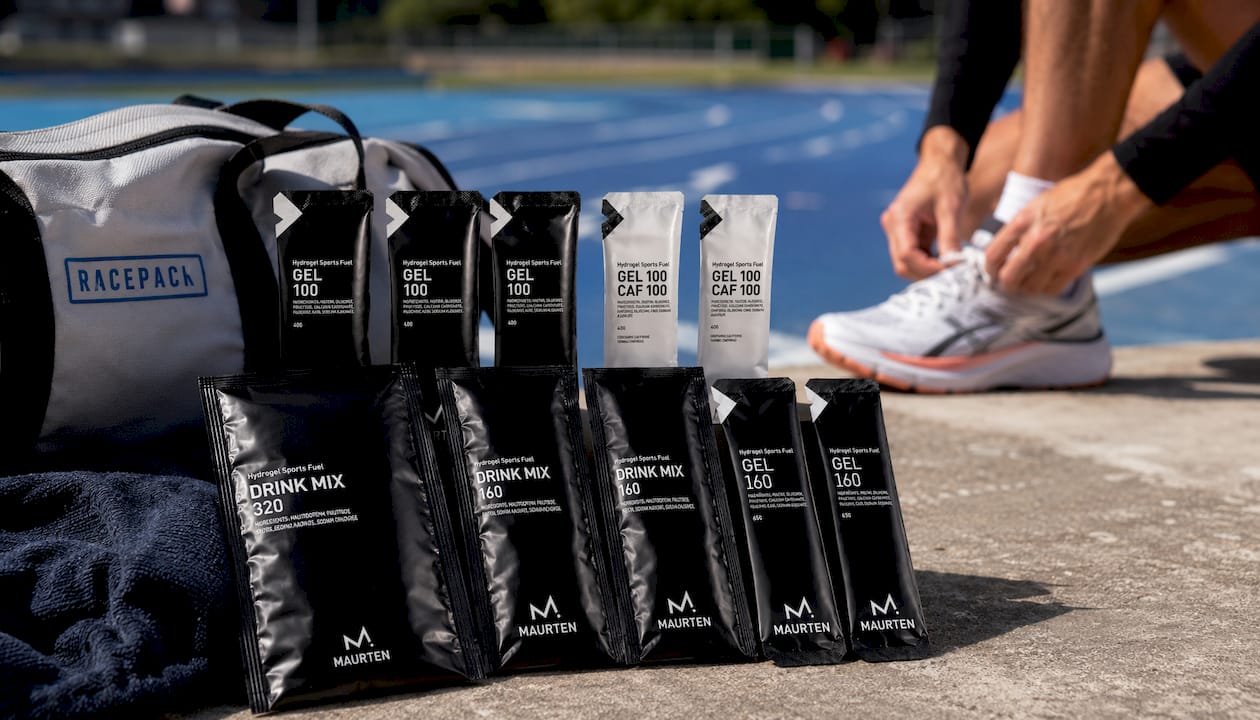
The Maurten Full Marathon Starter Kit is the most direct path to a tested, race-ready fueling strategy. It gives you a structured pack of Maurten gels and drink mixes to rehearse across your Peak-phase long runs, so nothing on race day is a surprise. Browse the full range at RacepackSingapore and get your fueling plan locked in before your next long run.
FAQ
What are the four phases of marathon training?
The four phases are Base (aerobic foundation), Build (lactate threshold and volume), Peak (race-specific long runs and marathon-pace work), and Taper (fatigue reduction). Consensus across major coaching methodologies supports this four-phase structure as the standard periodization model.
How long should each phase be in a 16-week plan?
In a 16-week block, Base covers weeks 1–4, Build covers weeks 5–10, Peak covers weeks 11–14, and Taper covers weeks 15–16. Step-back weeks fall at weeks 4, 8, and 12.
How much should I reduce volume during the taper?
Common guidance recommends reducing weekly volume by roughly 25% at three weeks out (~75% of peak volume), 40% at two weeks out (~60% of peak volume), and 60% in race week (~40% of peak volume), while keeping short, sharp sessions to maintain leg speed.
When should I start practicing race-day fueling?
Start practicing gels and electrolytes on long runs from week 6 of your training block. Run at least one full fueling rehearsal at 18–20 miles during the Peak phase and track any GI response. The Maurten Full Marathon Starter Kit is designed for exactly this kind of structured rehearsal.
Can I use AI to customize my marathon training plan?
AI tools can help you map phase lengths, adjust mileage targets, and flag scheduling conflicts, but they cannot account for your injury history, current fitness, or real-time fatigue signals. Use AI-generated plans as a starting framework, then adjust based on how your body responds week by week, and always verify supplement choices against official banned-substance lists if you compete in sanctioned events.
What is the 10% rule in marathon training?
The 10% rule states that weekly mileage should never increase by more than 10% from one week to the next. This limit, combined with step-back weeks every 3–4 weeks, is the primary guardrail against overuse injuries across all phases of marathon preparation.
How do I scale the plan if I only have four days a week to train?
Keep your tempo run, long run, and one interval session as non-negotiable. Cut easy mileage before cutting quality sessions. Replacing one easy run with cross-training (cycling or swimming) preserves aerobic volume without adding impact stress.
What should I eat differently during the Peak phase?
In Peak, shift from general daily fueling to full race-day nutrition rehearsal on every long run. Test your gel brand, timing, and electrolyte strategy at race-effort conditions. Increase caloric intake slightly to support the highest training volume weeks, and prioritize recovery nutrition within 45 minutes of every hard session.