

How to Choose Marathon Training Zones That Actually Work
TL;DR:
- Heart rate training zones help runners target specific effort levels for optimal marathon preparation. Personalizing zones through physiological testing ensures more accurate training intensity, especially for aerobic base building in Zone 2. Proper zone distribution and nutrition support lead to better performance and recovery during marathon training.
Heart rate training zones are specific physiological effort ranges that tell you exactly how hard your body is working during each run. To choose marathon training zones effectively, you need two numbers: your maximum heart rate and your resting heart rate. From those, you build personalized zones using the Heart Rate Reserve (Karvonen) method rather than relying on the generic 220-minus-age formula, which can be off by 10–15 beats for many runners.
Here is what the research and coaching consensus agree on for marathon training:
- Zone 2 is your foundation. Marathon training plans consistently show roughly a majority of total volume should fall here.
- Zone 3 supports marathon-pace work. About a moderate portion of your weekly volume belongs in this range.
- Zones 4 and 5 are used sparingly. Together they account for only a small fraction of training, reserved for intervals and VO2max sessions.
- Personalized testing beats population averages. Lactate threshold testing or the talk test anchors your zones to your actual physiology, not a formula built for someone else.
- Heart rate reflects internal effort. On hot days or at altitude, your pace will slow at the same heart rate, and that is the correct response.
Table of Contents
- What each heart rate zone means for your marathon training
- What equipment do you actually need for heart rate training?
- How to calculate your personalized heart rate training zones
- How to apply heart rate zones in your marathon training plan
- Factors that can throw off your heart rate data and how to manage them
- What the research says about the best training zones for marathon runners
- How to individualize heart rate zones using lactate threshold
- Adjusting heart rate zones for age, fitness level, and health conditions
- Recommended marathon training plans structured around heart rate zones
- Common mistakes when choosing and using heart rate zones
- Fuel your training zones with the right nutrition
- Key Takeaways
- FAQ
What each heart rate zone means for your marathon training
Heart rate zones divide your effort spectrum into five bands, each triggering different physiological adaptations. Understanding what happens in each zone helps you train with purpose rather than just logging miles.
| Zone | % of Max HR | Perceived Effort | Primary Adaptation |
|---|---|---|---|
| Zone 1 | 50–60% | Very easy, fully conversational | Active recovery, blood flow |
| Zone 2 | 60–75% | Easy, comfortable conversation | Aerobic base, fat oxidation |
| Zone 3 | 75–85% | Moderately hard, short sentences | Lactate clearance, marathon pace |
| Zone 4 | 85% | Hard, few words at a time | Lactate threshold, tempo capacity |
| Zone 5 | 92% | Maximum, cannot speak | VO2max, neuromuscular power |
Zone 1 is pure recovery. Your body clears metabolic waste, and your muscles absorb the stress from harder sessions. Most runners skip this zone entirely, treating every easy day as a Zone 2 effort. That is a mistake.
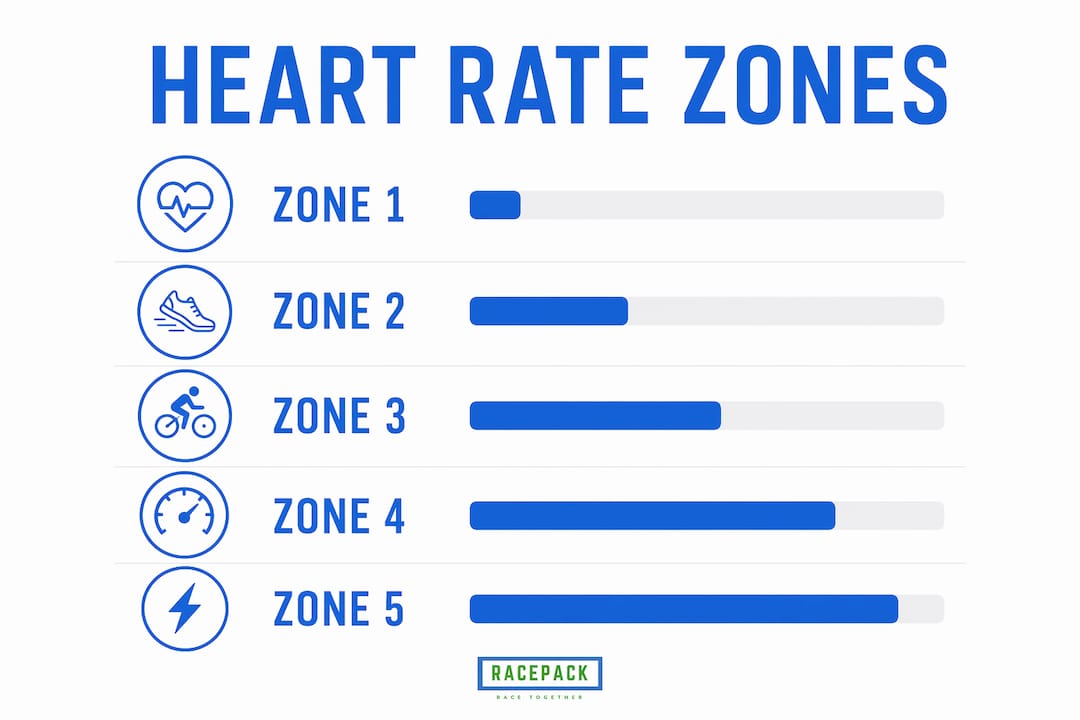
Zone 2 is where marathon fitness is built. At 60–75% of max heart rate, your body becomes more efficient at burning fat as fuel, your mitochondrial density increases, and your cardiovascular system strengthens without accumulating significant fatigue. The pyramidal training model supported by endurance research places the majority of volume here for a reason: it builds durability without burning you out.
Zone 3 sits at the high end of aerobic effort and the low end of tempo. This is where marathon pace typically lands for most recreational runners. It is not easy, but it is sustainable for hours with proper fueling. Treating it as a casual jog or an all-out effort both lead to problems.
Zone 4 is threshold training. You are working hard enough that lactate accumulates faster than your body can clear it. Sessions here are short and purposeful: tempo runs, cruise intervals, and race-specific workouts.
Zone 5 is reserved for short, high-intensity intervals targeting VO2max. Most recreational marathoners need very little of this. The benefits are real, but the recovery cost is high.
Key benefits of training across all five zones:
- Improved fat oxidation and glycogen sparing during long efforts
- Greater cardiac stroke volume, meaning your heart pumps more blood per beat
- Enhanced lactate buffering capacity from threshold work
- Better neuromuscular recruitment from occasional high-intensity efforts
- Faster recovery between sessions from consistent Zone 1 use
What equipment do you actually need for heart rate training?
You do not need an expensive lab setup to train by heart rate. Three categories of devices cover most runners’ needs, and the differences between them matter more than most people realize.
Chest straps are the gold standard. Devices like the Garmin HRM-Pro or Polar H10 measure electrical signals from your heart directly, giving you beat-by-beat accuracy. For zone training, where a 5-beat difference can shift you from Zone 2 to Zone 3, that precision matters. Chest straps are especially reliable during interval sessions when heart rate changes rapidly.
Wrist-based optical monitors on GPS watches (Garmin, Polar, COROS, Apple Watch) use light to detect blood flow. They are convenient and accurate enough for steady-state Zone 2 runs, but they lag during fast efforts and can be thrown off by wrist movement, cold temperatures, or tattoos. For easy long runs, they work well. For intervals, pair your watch with a chest strap.
Smartwatches with built-in training platforms like Garmin Connect, Polar Flow, or TrainingPeaks let you set custom heart rate zones and review zone distribution after every run. This post-run analysis is where zone training pays off. You can see exactly how much time you spent in each zone and adjust your next session accordingly.
Practical usage tips:
- Wet the chest strap electrodes before putting it on to improve conductivity.
- Wear your watch snug, two finger-widths above the wrist bone, for better optical readings.
- Let your heart rate stabilize for 5–10 minutes after starting a run before making effort adjustments.
- Review zone distribution weekly, not just after individual runs.
Pro Tip: If your budget allows only one upgrade, choose a chest strap over a more expensive watch. Accurate data from a $60 chest strap paired with a basic GPS watch beats inaccurate data from a $500 smartwatch.
How to calculate your personalized heart rate training zones
Generic formulas are a starting point, not a destination. Here is how to build zones that actually reflect your physiology.
Step 1: Measure your resting heart rate
Take your pulse first thing in the morning before getting out of bed, ideally over three consecutive days and average the results. A typical resting heart rate for a recreational runner falls between 50 and 65 beats per minute.
Step 2: Find your true maximum heart rate
The 220-minus-age formula is widely used and widely inaccurate. A better approach is a field test. After a thorough 15-minute warm-up, run three hard 3-minute intervals at maximum sustainable effort with 2-minute easy recoveries between them. The highest heart rate you record in the final interval is close to your true maximum.

Step 3: Calculate Heart Rate Reserve (HRR)
Heart Rate Reserve = Max HR minus Resting HR
Step 4: Apply the Karvonen formula
Target HR = (HRR × Zone Percentage) + Resting HR
Example calculation for a runner with Max HR of 185 and Resting HR of 52:
| Zone | % Range | Calculation | Target HR Range |
|---|---|---|---|
| Zone 1 | 50–60% | (133 × 0.60) + 52 | — |
| Zone 2 | 60–75% | (133 × 0.60–0.75) + 52 | 132–150 bpm |
| Zone 3 | 75–85% | (133 × 0.75–0.85) + 52 | — |
| Zone 4 | 85% | (133 × 0.85) + 52 | — |
| Zone 5 | 92% | (133 × 0.92) + 52 | — |
This approach accounts for your individual cardiovascular fitness in a way that percentage-of-max-HR alone cannot. A runner with a resting HR of 40 (highly trained) and one with a resting HR of 70 (deconditioned) will have very different Zone 2 ranges even if their max heart rates are identical.
For runners who want to go further, a lactate threshold test at a sports medicine facility gives you the most precise zone anchors available. The American Heart Association also provides target heart rate guidelines as a general reference, though these are population-level figures rather than individualized zones.
How to apply heart rate zones in your marathon training plan
Knowing your zones is one thing. Distributing your training volume across them correctly is where the real gains happen. Research on marathon training intensity distribution shows a consistent pattern across training levels: the majority of volume in Zone 2, a smaller portion in Zone 3, and a minimal amount spread across Zones 4 and 5.

Here is what a sample training week looks like for a runner logging 40 miles:
| Day | Run Type | Zone Target | Approx. Miles |
|---|---|---|---|
| Monday | Recovery run | Zone 1 | 4 |
| Tuesday | Easy aerobic | Zone 2 | 7 |
| Wednesday | Tempo intervals | Zone 4 | 6 |
| Thursday | Easy aerobic | Zone 2 | 6 |
| Friday | Rest or cross-train | — | — |
| Saturday | Long run | Zone 2 (mostly) | 14 |
| Sunday | Easy recovery | Zone 1–2 | 5 |
The long run deserves special attention. Most of it should stay in Zone 2, but the final 20–25% can drift toward Zone 3 as glycogen depletes and effort increases. This mirrors race-day conditions and teaches your body to maintain pace under fatigue. Proper fueling during training runs keeps you in the right zone longer by preventing the glycogen crash that forces you into Zone 1 survival mode.
Zone 3 work belongs in mid-week sessions: marathon-pace runs, cruise intervals at 75–85% of max HR, and progression runs that build from Zone 2 into Zone 3 over the final miles.
Zone 4 and 5 sessions are short and infrequent. One quality session per week is enough for most recreational marathoners. More than that and recovery suffers, which pushes your easy runs into Zone 3 when they should be Zone 2.
- Keep easy days genuinely easy. If you need to slow down to stay in Zone 2, slow down.
- Use heart rate, not pace, as your guide on hot days or hilly courses.
- Track your zone distribution weekly to catch drift before it becomes a pattern.
Pro Tip: Monitor your heart rate at the same pace over several weeks. If you are running the same route at the same pace but your heart rate is dropping, your aerobic fitness is improving. That is the signal you are looking for.
Factors that can throw off your heart rate data and how to manage them
Heart rate is a reliable measure of internal effort, but it is not immune to outside interference. Several factors can push your heart rate higher or lower without any change in actual running effort, and misreading those signals leads to training errors.
Environmental factors:
- Heat and humidity: Heart rate can run 10–20 beats higher at the same pace in hot conditions. Your cardiovascular system is simultaneously powering your muscles and cooling your body. On hot days, run by heart rate and accept the slower pace.
- Altitude: Reduced oxygen availability forces your heart to beat faster to deliver the same amount of oxygen. Runners training above 5,000 feet should expect elevated heart rates for the first 10–14 days until acclimatization occurs.
- Cold: Cold air can cause mild heart rate suppression and also increases the effort of breathing, which can make perceived exertion feel higher than heart rate suggests.
Physiological factors:
- Dehydration: Even mild dehydration reduces blood volume, forcing your heart to beat faster to maintain cardiac output. Staying on top of electrolyte balance is directly tied to heart rate reliability during long efforts.
- Illness and fatigue: A resting heart rate that is 5–7 beats above your normal baseline is a reliable early warning sign of illness or accumulated fatigue. Check your resting HR every morning.
- Caffeine: Pre-run caffeine raises heart rate by 3–5 beats in most people. If you use caffeine before training, account for this when interpreting your zone data.
- Medications: Beta-blockers significantly suppress heart rate and make standard zone calculations unreliable. Runners on these medications should work with a physician to establish appropriate training intensities.
Cardiac drift is a specific phenomenon worth understanding on its own. During prolonged efforts, heart rate gradually rises even when pace stays constant. This happens because dehydration reduces blood volume and your heart compensates by beating faster. Cardiac drift can cause a 5–10% heart rate increase over the course of a long run, which means a Zone 2 run that starts at 140 bpm might read 152–155 bpm by mile 16 without any increase in effort.
Cardiac drift is not a sign that you are working harder. It is a sign that your blood volume is dropping. Recognize the pattern, stay hydrated, and do not chase a rising heart rate by slowing down more than necessary. If drift exceeds 5–10% on your long runs, your fueling and hydration strategy needs attention before race day.
What the research says about the best training zones for marathon runners
The scientific consensus on marathon training intensity is clearer than most runners realize. Studies on endurance performance consistently show that faster marathoners accumulate larger aerobic volumes in Zones 1 and 2, with excessive anaerobic training linked to burnout and performance decline rather than improvement.
The pyramidal intensity distribution, with the bulk of volume at low intensity and progressively less at higher intensities, is the dominant model in marathon research. A quantitative analysis of marathon training plans found intensity distribution roughly follows a predominance of volume in Zones 1 and 2, with decreasing amounts in higher zones, with long runs of 30–32 km appearing consistently regardless of total weekly volume.
| Training Model | Zone 1–2 Volume | Zone 3 Volume | Zone 4–5 Volume | Best For |
|---|---|---|---|---|
| Pyramidal | 65–70% | 15–20% | 5–10% | Most recreational and intermediate runners |
| Polarized | 80–90% | 5–10% | 10–15% | Experienced runners with high weekly volume |
| Threshold-heavy | 50–60% | 30–40% | 10–15% | Short-term race-specific preparation |
The 80/20 rule, meaning 80% of training at easy intensity and 20% at harder efforts, is backed by decades of research on elite endurance athletes and translates well to recreational marathon training. What matters most is that the hard 20% is genuinely hard and the easy 80% is genuinely easy, not a moderate gray zone that accumulates fatigue without delivering adaptation.
The most common mistake in marathon training is not doing too little hard work. It is doing too much moderate work. Running at a pace that feels “comfortably uncomfortable” every day keeps you out of Zone 2 and prevents the aerobic adaptations that make marathon racing possible.
Pro Tip: Use training periodization principles to structure your zone distribution across your training block. Base phase: 80–85% Zone 1–2. Build phase: introduce more Zone 3–4 work. Peak phase: race-specific intensities. Taper: return to Zone 1–2 dominance.
How to individualize heart rate zones using lactate threshold
The default zones on your GPS watch are built on a single estimate: your lactate threshold heart rate (LTHR), calculated from an age formula or a guided test. Then the device applies generic percentages to derive all other zones. The problem is that the relationship between your aerobic threshold (LT1) and your anaerobic threshold (LT2) is unique to you.
For a highly trained athlete, LT1 might sit at 85–90% of LT2. For a beginner, it might be as low as 70–75%. A generic formula cannot know that. This is why physiological anchoring of zones produces better training outcomes than population-average percentages.
Finding LT1 with the talk test: The talk test is a practical, no-equipment method for identifying your aerobic threshold. Start at an easy pace and every 4 minutes, try to speak a 30–40 word phrase comfortably. The highest heart rate at which you can do this without strain is your LT1. Record that number.
Finding LT2 with a 30-minute field test: After a 15-minute warm-up, run at the hardest pace you can sustain for 30 minutes. After the first 10 minutes, start your lap timer. Your average heart rate over the final 20 minutes is your LTHR (LT2). This is the anchor for your Zone 4 ceiling.
Once you have both numbers, set your zones in Garmin Connect or TrainingPeaks using percentage of LTHR rather than percentage of max HR. Manually adjust the top of Zone 2 to match your LT1 heart rate. Your zones now reflect your actual physiology rather than a population average.
This two-threshold approach creates three real training zones that map cleanly onto the five-zone model:
- Below LT1: True easy training (Zones 1–2). You can sustain this for hours.
- Between LT1 and LT2: Tempo zone (Zone 3). Productive but not sustainable for long.
- Above LT2: High-intensity work (Zones 4–5). Short, hard, and infrequent.
Adjusting heart rate zones for age, fitness level, and health conditions
Heart rate zones are not static. They shift as your fitness improves, as you age, and in response to health conditions. Treating your zones as permanent numbers is one of the more common errors recreational runners make.
Age: Maximum heart rate naturally declines with age, roughly 1 beat per year after 30. This means your absolute zone ranges shift downward over time. A 50-year-old runner with a max HR of 168 will have lower absolute zone targets than a 30-year-old with a max HR of 190, even if their relative fitness is similar. Retest your max HR annually rather than relying on an age formula that was set years ago.
Fitness level: As your aerobic fitness improves, your heart becomes more efficient. You will notice that the pace required to stay in Zone 2 increases over months of consistent training. This is the adaptation you are training for. Recalculate your zones every 8–12 weeks during active training blocks to keep them accurate.
Health conditions: Runners with cardiovascular conditions, hypertension, or diabetes should establish training zones with a physician or sports cardiologist rather than relying on self-testing. An exercise stress test at Cleveland Clinic or a similar facility can identify safe training intensities and flag any cardiac responses that require medical attention. The American Heart Association recommends that adults with known heart conditions consult a physician before beginning vigorous exercise programs.
Overtraining signals: If your resting heart rate is consistently elevated by 5 or more beats above your baseline, your easy runs feel harder than usual at the same heart rate, or your motivation to train drops significantly, these are signs your zones may be set too high or your training load is too heavy. Pull back to Zone 1 for several days before reassessing.
For runners building their first structured plan, the beginner marathon training plan from RacepackSingapore provides a practical framework for applying zone-based intensity across a full training block.
Recommended marathon training plans structured around heart rate zones
Three plan structures work well for recreational and intermediate marathoners, each with a different emphasis on zone distribution.
Beginner plan: Zone 2 foundation (16–20 weeks)
This plan prioritizes aerobic base building. The first 10–12 weeks keep nearly all running in Zones 1 and 2, with weekly mileage building gradually. The final 6–8 weeks introduce one Zone 3–4 session per week. Long runs cap at 20–22 miles and stay in Zone 2 throughout. This approach suits first-time marathoners and runners returning after a long break.
A 12-week half marathon training plan follows similar principles and serves as a useful stepping stone before committing to a full marathon block.
Intermediate plan: Pyramidal distribution (18–20 weeks)
This plan follows the research-backed pyramidal model: approximately 65–70% of weekly volume should fall in Zone 2, with 15–20% in Zone 3 and 5–10% in Zones 4 and 5. It includes two quality sessions per week (one tempo, one interval), with all other runs in Zones 1–2. Long runs extend to 20–22 miles with the final 4–6 miles at Zone 3 marathon pace. This is the most effective structure for runners targeting a specific finish time.
Avoiding common tactical training errors during this phase, particularly running quality sessions too hard or easy days too fast, is what separates runners who peak on race day from those who arrive fatigued.
Performance plan: Polarized distribution (20 weeks)
For runners with 5+ years of marathon experience and weekly volumes above 50 miles, a polarized approach shifts more volume to Zones 1–2 (80–90%) while making Zone 4–5 sessions genuinely hard. Zone 3 is minimized. This model suits runners who have already built a strong aerobic base and need higher-intensity stimuli to continue improving.
Regardless of which plan you follow, nutrition timing around zone-specific sessions matters. Carb loading strategies become particularly relevant in the final 2–3 weeks of any marathon block, and race day nutrition should be practiced during long Zone 2 runs to train your gut alongside your cardiovascular system.
Common mistakes when choosing and using heart rate zones
Most runners make the same errors when they first start training by heart rate. Recognizing them early saves months of misdirected effort.
1. Using 220-minus-age without testing. This formula can place your Zone 2 ceiling 10–15 beats too high or too low. A runner whose true max HR is 195 but whose formula predicts 180 will be running in Zone 3 while thinking they are in Zone 2. Test your max HR with a field test.
2. Running easy days too fast. This is the most common error in recreational marathon training. Zone 2 often feels embarrassingly slow, especially for runners used to training by pace. If you need to slow down by 60–90 seconds per mile to stay in Zone 2, that is the correct response, not a sign of weakness.
3. Ignoring cardiac drift on long runs. Runners who see their heart rate climb during a long run often speed up to compensate, which pushes them deeper into Zone 3 or 4. Cardiac drift is a hydration and fueling signal, not a pacing signal. Slow down slightly, drink, and fuel rather than fighting the drift with pace adjustments.
4. Never recalculating zones. Zones set in January are not accurate in June after 5 months of consistent training. Retest every 8–12 weeks and update your zones in your training platform.
5. Treating all Zone 3 work the same. Marathon pace sits at the low end of Zone 3 for most recreational runners. Threshold pace sits at the high end. These are different stimuli with different recovery costs. A 10-mile marathon-pace run and a 5-mile threshold run both register as Zone 3 but are not interchangeable.
6. Skipping Zone 1 entirely. Recovery runs in Zone 1 are not junk miles. They promote blood flow, accelerate muscle repair, and keep weekly volume up without adding fatigue. Runners who skip Zone 1 and run every easy day in Zone 2 accumulate more fatigue than their training load warrants.
7. Relying solely on wrist-based heart rate for interval sessions. Optical sensors lag by 15–30 seconds during rapid heart rate changes. For Zone 4–5 interval work, a chest strap gives you real-time data that actually reflects your effort during the hard portion of the interval.
Gut training is another overlooked element. Running long Zone 2 efforts while practicing race-day fueling teaches your digestive system to process carbohydrates under aerobic stress. The gut training guide from RacepackSingapore covers this in detail and pairs naturally with zone-based long run planning.
Fuel your training zones with the right nutrition
Choosing the right heart rate zones is only half the equation. What you put in your body during training directly affects how long you can hold Zone 2 and how well you recover between sessions. The Maurten Full Marathon Starter Kit is built specifically for this: it includes Maurten’s Drink Mix and Gel products, which use a hydrogel technology that delivers carbohydrates with minimal GI stress, even during sustained aerobic efforts.

For runners training in Zone 2 for 2+ hours, maintaining glycogen availability is what keeps you in the aerobic zone rather than drifting into survival mode. Maurten’s products are designed to be consumed during those long efforts without the stomach issues that derail many runners. RacepackSingapore stocks the full Maurten range with guaranteed product authenticity and next-day delivery within Singapore, so your nutrition arrives ready for your next long run.
Whether you are building your aerobic base or dialing in marathon-pace sessions, having the right fuel on hand is what lets you execute the training your zones demand. Check out the Maurten Full Marathon Starter Kit and give your Zone 2 runs the endurance support they deserve.
Key Takeaways
Choosing marathon training zones based on personalized physiological testing, not age formulas, is the single most effective change recreational runners can make to their training.
| Point | Details |
|---|---|
| Zone 2 dominates marathon training | Approximately 65–70% of weekly training volume should fall in Zone 2 for optimal aerobic development. |
| Test, don’t estimate | Age-based formulas can be inaccurate; field tests for max HR and LT1/LT2 give more accurate zones. |
| Cardiac drift is manageable | A 5–10% heart rate rise during long runs signals dehydration, not increased effort. |
| Recalculate zones regularly | Update your zones every 8–12 weeks as fitness improves to keep training targets accurate. |
| RacepackSingapore supports your fueling | The Maurten Full Marathon Starter Kit provides race-tested nutrition for Zone 2 long runs and marathon-pace sessions. |
FAQ
What are heart rate training zones for marathon runners?
Heart rate training zones are five effort ranges based on percentages of your maximum heart rate, each targeting different physiological adaptations. For marathon training, Zone 2 (60–75% of max HR) builds the aerobic base that race performance depends on.
How do I find my max heart rate for zone calculations?
The 220-minus-age formula can be off by 10–15 beats. A more reliable method is a field test: after a 15-minute warm-up, run three 3-minute hard intervals with 2-minute recoveries and record the highest heart rate you hit in the final interval.
How much of my marathon training should be in Zone 2?
Research on marathon training intensity distribution shows approximately 65–70% of total weekly volume should fall in Zone 2, with 15–20% in Zone 3 and 5–10% in Zones 4 and 5.
Why does my heart rate keep rising during long runs even when I don’t speed up?
That is cardiac drift, a normal physiological response to dehydration and prolonged effort. Cardiac drift can cause a 5–10% heart rate increase over the course of a long run. Address it with consistent hydration and fueling rather than slowing your pace dramatically.
Can I use the heart rate zones on my GPS watch without testing?
Watch-default zones are based on population averages and often inaccurate for individual runners. For better results, test your LT1 using the talk test and your LT2 with a 30-minute field test, then set zones in Garmin Connect or TrainingPeaks using percentage of LTHR.
How often should I recalculate my heart rate zones?
Recalculate every 8–12 weeks during active training blocks. As your aerobic fitness improves, the pace you can sustain in Zone 2 will increase, and your zones need to reflect that progress.
Does heat affect my heart rate training zones?
Yes. Heart rate can run 10–20 beats higher at the same pace in hot conditions. On hot days, train by heart rate rather than pace and accept the slower speed. After 10–14 days of consistent heat exposure, your body acclimatizes and heart rate begins to normalize.
What is the Karvonen method for calculating heart rate zones?
The Karvonen (Heart Rate Reserve) method calculates zones using the formula: Target HR = (Heart Rate Reserve × Zone Percentage) + Resting HR, where Heart Rate Reserve equals Max HR minus Resting HR. This accounts for individual cardiovascular fitness more accurately than percentage-of-max-HR alone.
How do I know if I am overtraining based on heart rate data?
A resting heart rate consistently 5 or more beats above your normal baseline, combined with easy runs feeling harder than usual at the same heart rate, are reliable overtraining signals. Pull back to Zone 1 for several days and reassess before continuing structured training.
What nutrition supports Zone 2 marathon training?
Zone 2 long runs lasting 2+ hours require consistent carbohydrate intake to maintain aerobic effort without glycogen depletion. The Maurten Full Marathon Starter Kit provides hydrogel-based energy products designed for sustained aerobic efforts with minimal gastrointestinal stress.
Is the talk test a reliable way to find my aerobic threshold?
Yes. The talk test identifies LT1 as the highest heart rate at which you can speak a 30–40 word phrase comfortably. It requires no equipment and is a practical, research-supported method for recreational runners to anchor their Zone 2 ceiling to actual physiology.
Should I train by heart rate or pace for marathon preparation?
Use both. Heart rate reflects internal effort and keeps you honest when conditions change (heat, hills, fatigue). Pace reflects external output and is more useful for interval sessions where heart rate lags behind effort. On easy days and long runs, heart rate is the primary guide.
Ready to fuel every zone of your marathon training? Buy Now and get the Maurten Full Marathon Starter Kit delivered to your door.