

Mass Gainer Scoop: How Many to Take for Your Goals
Start with one scoop per day. Most lifters need just 1–2 scoops daily—an amount that typically translates to 50–150 grams of powder per day—consumed as part of a meal or as a shake. Jumping straight to a full manufacturer serving is one of the most common mistakes beginners make.
Here are the quick rules to know before you mix your first shake:
- Start at 1 scoop (50–75g) if you are new to mass gainers, have a sensitive stomach, or are within 200–300 calories of your daily target.
- Move to 2 scoops (100–150g) if you have been training consistently for 6+ months, struggle to eat enough whole food, or your weight has not moved after two weeks at 1 scoop.
- Consider 3+ scoops only if you are a hardgainer with a high daily calorie target and your digestion handles the lower doses without issue. Pro Tip: Track your bodyweight every morning for two weeks before changing your scoop count. A flat or dropping trend is the only reliable signal to add more.
Table of Contents
- How many scoops should you take based on your goal?
- How to read the label and measure scoops correctly
- Mixing ratios, liquid volume, and texture tips
- When to take mass gainer and why splitting servings works
- How to calculate exactly how many scoops you need
- Safety, side effects, hydration, and when to stop
- How serving sizes vary across product types
- A seven-day starter plan to find your right scoop amount
- How mass gainers interact with other supplements and medications
- Key Takeaways
- What coaches and dietitians actually say about mass gainer dosing
- Useful sources and tools for calculating your scoop needs
- RacepackSingapore has the mass gainers your training actually needs
- FAQ
How many scoops should you take based on your goal?
Your experience level and calorie target determine your starting point more than any label instruction does.
Beginner (under 6 months of consistent training): One scoop per day (typically 50–75g powder) is the right entry point. Your gut needs time to adapt to the dense carbohydrate load, and your calorie needs are lower than you probably think. A 70kg beginner aiming for a moderate calorie surplus above maintenance typically needs only 1 scoop of a mid-range gainer to close that gap, especially when whole-food meals are already in place.
Intermediate lifter pursuing a lean bulk (6–24 months training): Two scoops per day (100–150g powder), split across two meals or post-workout plus morning, fits most people in this category. The goal is a controlled calorie surplus rather than a dramatic spike. Macronutrient targets for this phase often include a majority of carbs, a moderate protein share, and a smaller fat proportion, which aligns well with most mid-range gainers at a two-scoop dose.
Hardgainer or advanced bulk: Two to three scoops (up to 150g+ powder daily) may be warranted, but only after confirming that your weight trend has stalled at a lower dose. An 80kg lifter with high daily calorie expenditure who cannot eat enough whole food might need a substantial calorie supplement contribution, which could mean 2–3 scoops depending on the product’s calorie density. Even then, coaches recommend building up one scoop at a time rather than jumping to the full target dose.
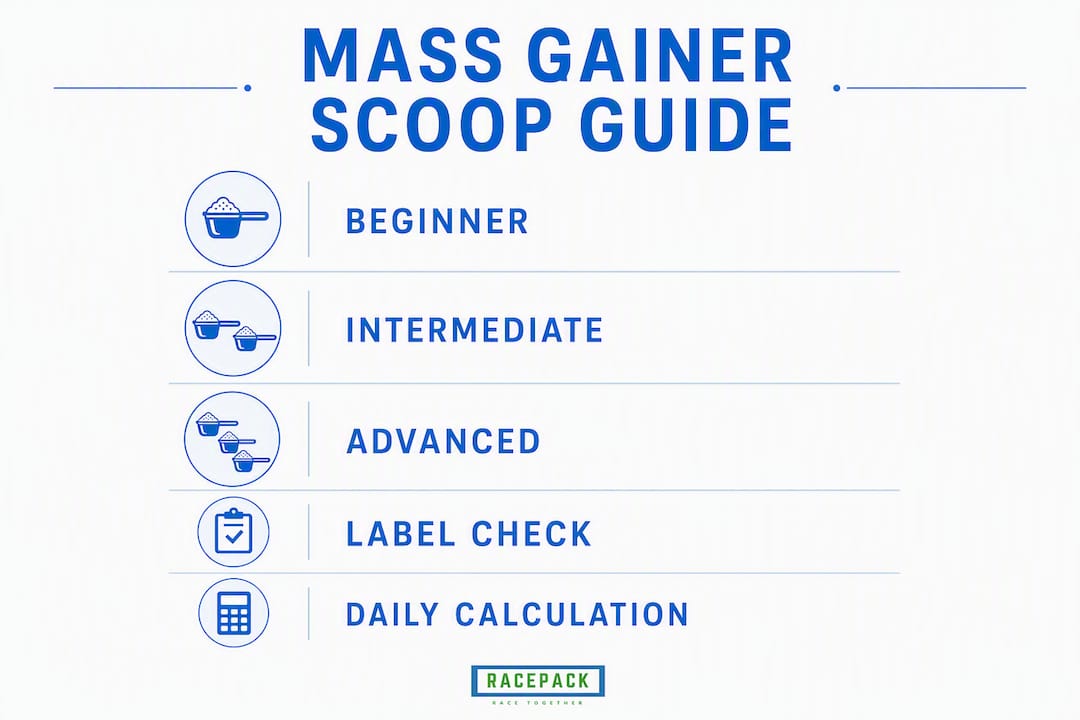
The key reminder: “scoop” has no universal size. A scoop from one brand may be smaller and deliver fewer calories; another brand’s scoop may be larger and deliver substantially more calories. Always anchor your decisions to calories per scoop, not the raw scoop count.
How to read the label and measure scoops correctly
Misreading a mass gainer label is easier than it sounds. Manufacturers report nutrition facts per serving, and serving sizes range from 2 to 6 scoops depending on the formula. That means the calorie number printed in large type on the front panel may represent three or four scoops, not one.
Step-by-step label checklist:
- Serving size (grams): The total weight of one serving. Divide by scoops per serving to get grams per scoop.
- Scoops per serving: Often buried in the serving-size line. This is the number you need to calculate per-scoop calories.
- Calories per serving: The headline number. Divide by scoops per serving to get calories per scoop.
- Protein / carbs / fat per serving: Divide each by scoops per serving to understand the macro contribution of a single scoop.
- Suggested use: Manufacturer timing and mixing guidance. Read it, but treat it as a ceiling, not a mandate.
Practical label-reading prevents the most common dosing error: accidentally consuming double the intended calories because the front-panel number referred to a 4-scoop serving.
Calculation example:
| Label field | Example value | Per-scoop calculation |
|---|---|---|
| Serving size | — | 167g per scoop |
| Calories per serving | — | 625 kcal per scoop |
| Fat per serving | 4g | 2g per scoop |
Use a kitchen scale the first time you mix. Scoop compression varies; a loosely filled scoop can weigh 20–30g less than a packed one, which meaningfully changes your calorie count over a week.
Mixing ratios, liquid volume, and texture tips
Getting the liquid ratio right makes a real difference in how well you absorb a mass gainer serving and how easy it is to finish.
A general starting point is about half a liter of liquid per 100g of powder. For a single scoop of a mid-range gainer, that means enough water or milk to keep the shake drinkable without being too thick or watery.
- Water vs. milk: Water keeps calories predictable and digestion lighter. Whole milk adds additional calories per cup and extra protein, which can push a 2-scoop shake well past 1,000 calories. Use milk intentionally, not by default.
- Blender vs. shaker: For 1–2 scoops, a shaker bottle works. For 4–6 scoop servings, a blender is the better choice. Blending improves dissolution, reduces clumping, and makes the texture easier on your stomach.
- Adding whole foods: Mixing in a tablespoon of nut butter adds 90–100 calories and healthy fats. Half a cup of oats adds roughly 150 calories and slow-digesting carbs. Both raise the calorie count, so factor them into your daily target.
Pro Tip: Blend large servings with ice. Cold temperature slows the rate at which you drink, which reduces the risk of bloating from drinking too fast.
When to take mass gainer and why splitting servings works
Timing your mass gainer serving around training and splitting large doses across the day both improve how your body uses the calories.
Best timing options:
- Post-workout: The most common recommendation. Your muscles are primed for carbohydrates and protein after training, making this the highest-utility window. A post-workout shake supports the anabolic recovery window and pairs well with the carbohydrate-heavy profile of most gainers.
- Morning (on rest days): A morning serving replaces the overnight calorie deficit and sets a positive energy balance early. Keep the dose to 1 scoop on rest days unless your calorie target specifically requires more.
- Between meals: Useful for hardgainers who cannot eat large meals. A half-scoop shake between lunch and dinner adds calories without competing with appetite at main meals.
Splitting a large serving into two smaller doses, such as post-workout plus morning, delivers nutrients more steadily and reduces the GI load on your digestive system at any one time. A single 4-scoop shake consumed at once is a common cause of bloating and cramps; the same calories spread across two servings are far easier to tolerate.
Hydration matters here too. High-carb supplements pull water into the gut during digestion. Aim for 8–10 glasses of water daily as a baseline when using mass gainers, and increase that on training days. Pairing your shake with HIGH5 ZERO+ electrolytes helps maintain fluid balance without adding significant calories.

How to calculate exactly how many scoops you need
The formula is straightforward:
Desired daily calorie surplus ÷ calories per scoop = scoops per day

Before running the numbers, confirm your maintenance calories using a TDEE calculator, then decide your surplus target.
Worked example 1: Lean bulk
A 175 lb intermediate lifter has a maintenance intake of 2,800 calories and wants a 400-calorie surplus. He uses a mid-range gainer with 625 calories per scoop.
| Step | Calculation | Result |
|---|---|---|
| Target surplus | 400 kcal above maintenance | — |
| Calories from food | ~2,800 kcal (existing meals) | 400 kcal gap to fill |
| Calories per scoop | 625 kcal | — |
| Scoops needed | 400 ÷ 625 | — |
One scoop covers the gap. He does not need two.
Worked example 2: Hardgainer bulk
A 145 lb hardgainer has a maintenance intake of 3,000 calories and needs a 600-calorie surplus. He uses a high-calorie gainer with 300 calories per scoop.
| Step | Calculation | Result |
|---|---|---|
| Target surplus | 600 kcal above maintenance | — |
| Calories from food | ~3,000 kcal (existing meals) | 600 kcal gap to fill |
| Calories per scoop | 300 kcal | — |
| Scoops needed | 600 ÷ 300 | 2 scoops |
Before increasing scoops, cross-check these four things:
- Has your bodyweight trended upward over the past two weeks?
- Is your training volume high enough to use the extra calories for muscle, not fat?
- Are you tolerating the current dose without GI issues?
- Are your whole-food meals consistent, or are you compensating for skipped meals with extra scoops?
If any answer is “no,” address that variable before adding powder.
Safety, side effects, hydration, and when to stop
Mass gainers are generally safe for healthy adults, but the calorie density creates real risks when dosing is not matched to actual energy needs.
Common side effects and how to manage them:
- Bloating and gas: Usually caused by large single servings or lactose sensitivity. Split servings and try a lactose-free formula if symptoms persist.
- Cramps: Often a sign of insufficient water intake alongside a high-carb shake. Increase fluid intake and slow your drinking pace.
- Water retention: Normal in the first week, especially when carbohydrate intake rises sharply. It typically stabilizes.
- Unwanted fat gain: The most consequential risk. Even 1–2 scoops can drive fat accumulation if your total daily calories already exceed your needs. Weekly weight trends above 0.5–1% of bodyweight per week suggest the dose is too high.
Hydration and supplement interactions:
When stacking mass gainers with creatine, the combined water-retention effect can be significant. Creatine draws water into muscle cells; the high-carb load of a gainer compounds that. Drink at least 8–10 glasses of water daily and consider adding an electrolyte product to maintain balance. For support with recovery and supplement stacking, the guidance on timing and hydration applies directly here.
Allergy and intolerance notes:
Most mass gainers use whey protein concentrate, which contains lactose. Users with lactose intolerance should look for isolate-based or plant-based formulas. Always check the allergen panel for soy, gluten, and tree nuts, which appear in many formulas.
Red flags that warrant stopping and consulting a clinician:
- Persistent nausea or vomiting after multiple attempts at lower doses
- Severe abdominal pain or diarrhea lasting more than 48 hours
- Unexplained rapid weight gain (more than 2–3 lbs per week beyond the first two weeks)
- Any pre-existing kidney or liver condition, since high-protein, high-calorie supplements place additional load on both organs
This article is general nutrition information, not medical advice. Confirm any supplement use with a qualified healthcare provider, especially if you take prescription medications or have a diagnosed health condition.
How serving sizes vary across product types
“One scoop” means something completely different depending on which product you pick up. Here is how the three main categories break down:
| Product type | Scoops per serving | Grams per scoop (approx.) | Calories per serving | Protein per serving | Carbs per serving | Mixing volume |
|---|---|---|---|---|---|---|
| High-calorie extreme gainer | 4–6 scoops per serving | 75–100g per scoop | — | 50g | 250–300g | 24 oz |
| Mid-range gainer | 2–3 scoops per serving | 50–75g per scoop | 600–900 kcal per serving | 50g | — | 16–24 oz |
| Low-volume lean gainer | 1–2 scoops per serving | 25–75g per scoop | 300–500 kcal per serving | — | 50g | 12–16 oz |
What this means for your daily scoop count:
- A single scoop of a high-calorie extreme gainer typically delivers about 75–100g of powder and 250–375 calories. That is a meaningful calorie jump, so even one scoop moves the needle for most users.
- A mid-range gainer at 2 scoops (one full serving) typically lands at 100–150g of powder and 600–900 calories, which covers most lean-bulk surplus targets in one shake.
- A low-volume lean gainer is closer to a protein powder with extra carbs. You may need 2 scoops to see a real calorie contribution beyond what a standard whey shake provides.
Typical “Suggested Use” language on mass gainer labels reads something like: “Mix 2 heaping scoops with 24 oz of cold water or milk. Consume once daily between meals or post-workout.” That language is a manufacturer recommendation, not a prescription. Your actual dose should come from your calorie calculation, not the label’s suggested serving.
A seven-day starter plan to find your right scoop amount
This protocol gives your gut time to adapt and gives you real data before committing to a daily dose.
- Days 1–3: Mix half a scoop with 10–12 oz of water or milk. Drink it post-workout or with breakfast. Note any bloating, gas, or discomfort in a simple log.
- Days 4–5: If digestion is comfortable, increase to one full scoop. Keep the liquid volume proportional (12–16 oz). Continue logging.
- Days 6–7: Weigh yourself each morning. If digestion is still clean and your weight has not moved, you have confirmed your baseline tolerance and can now apply the calorie formula to decide whether a second scoop is needed.
Monitoring checklist during the seven days:
- Morning bodyweight (same time, same conditions)
- Digestion notes: bloating, gas, cramps, or none
- Energy levels during training
- Training performance: any change in strength or endurance output
When to escalate to 2 scoops:
Do not make this decision based on a single day’s weigh-in. Use a two-week average trend. If your weight is flat or dropping after two full weeks at 1 scoop, and your whole-food intake is consistent, add a second scoop. If weight is already rising at 0.5–1% of bodyweight per week, stay at 1 scoop.
Pair this protocol with a structured workout routine that matches your calorie intake. Extra calories without adequate training stimulus tend to accumulate as fat rather than muscle.
How mass gainers interact with other supplements and medications
Mass gainers are not isolated products. They sit inside a broader supplement stack and, for some users, alongside prescription medications.
Common supplement interactions:
- Creatine: Stacking creatine with a high-carb mass gainer is one of the most studied combinations in sports nutrition. The insulin spike from carbohydrates may enhance creatine uptake into muscle cells. The combined water-retention effect is real, so hydration becomes even more important.
- Pre-workout stimulants: Many pre-workouts contain caffeine and sodium. Adding a high-calorie gainer post-workout on top of a stimulant-heavy pre-workout can push total sodium and stimulant load high. Check labels and keep total caffeine under 400mg per day.
- Whey protein: Taking a full mass gainer serving plus a separate whey shake in the same day can push protein intake well above what muscle protein synthesis can use acutely. Research on protein distribution suggests spreading intake across meals is more effective than concentrating it. If you use both, count total daily protein and adjust accordingly.
- Multivitamins: High-dose mass gainers often include added vitamins and minerals. Stacking a separate multivitamin can push fat-soluble vitamins (A, D, E, K) above safe upper limits. Read both labels before combining.
Medication considerations:
Users on medications for diabetes, kidney disease, or cardiovascular conditions should consult a clinician before starting any high-calorie, high-carbohydrate supplement. The carbohydrate load in a mass gainer can affect blood glucose management, and the protein density places additional filtration demand on the kidneys. This is not a reason to avoid mass gainers, but it is a reason to get clearance first.
For a broader look at how supplements work together for performance and recovery, the body recomposition guide covers the interaction between calorie surplus, training load, and supplement timing in practical terms.
Key Takeaways
Most lifters need just 1–2 scoops of mass gainer per day—typically 50–150 grams of powder daily—calculated from their actual calorie surplus target rather than the manufacturer’s suggested serving.
| Point | Details |
|---|---|
| Start with 1 scoop | Begin at one scoop (50–75g powder) for the first week and monitor digestion before increasing. |
| Calculate from calories | Divide your desired surplus by calories per scoop to find your actual dose. |
| Split large servings | Splitting a 2–3 scoop (100–150g+) dose across two meals reduces bloating and improves nutrient delivery. |
| Use a two-week trend | Only add a scoop if bodyweight has been flat or dropping for two full weeks at the current dose. |
| RacepackSingapore | Browse the mass gainer range at RacepackSingapore for authentic products with next-day delivery. |
What coaches and dietitians actually say about mass gainer dosing
The conventional advice to “follow the label” misses the most important variable: your current calorie intake from whole food. Every practitioner worth listening to starts there.
The label’s suggested serving is calibrated for someone eating at or below maintenance. If you are already eating 500 calories above maintenance from whole food, adding a full 4-scoop serving on top of that does not build more muscle. It builds more fat. The label does not know your diet. You do.
Coaches consistently flag two mistakes above all others. The first is jumping to a full serving on day one, which almost always causes GI distress and convinces the user the product “doesn’t agree with them.” The second is using mass gainers as meal replacements rather than calorie supplements. A shake does not replace the micronutrients, fiber, and satiety of a real meal. Treat it as a tool to close a calorie gap, not as a substitute for eating.
A practical shortcut from practitioners: if you train in the morning, add a small carbohydrate source to your pre-workout meal (a banana, a slice of toast) rather than relying entirely on a post-workout shake to fuel the session. The gainer then serves its actual purpose: topping up calories after the work is done.
For anyone comparing mass gainers to standard whey protein, the protein powder guide at RacepackSingapore explains when each type fits your goals.
Useful sources and tools for calculating your scoop needs
Reliable references and practical tools make the difference between guessing and knowing.
Authoritative sources:
- PubMed: Protein distribution and muscle protein synthesis — research on how spreading protein across meals affects muscle-building outcomes.
- PubMed: Resistance training and protein supplementation — foundational research on protein and strength training.
- PubMed: Carbohydrate and protein co-ingestion — relevant to understanding the carb-heavy profile of mass gainers.
- MedicineNet: Mass gainer dosage and side effects — practical dosage guidance with a clinical perspective.
Practical tools:
RacepackSingapore product pages:
- BS Nutrition Mass Gainer — serving size and macro details available on the product page.
- Applied Nutrition Lean Mass Gainer — a lower-calorie-per-scoop option suited to lean-bulk targets.
- Mass gainer category — full range with product specs for comparison.
RacepackSingapore has the mass gainers your training actually needs
Getting the scoop count right only matters if the product in your shaker is authentic and accurately labeled. That is where RacepackSingapore delivers a concrete advantage: every product ships with guaranteed authenticity, so the calorie and macro figures on the label match what is in the bag.
RacepackSingapore carries a curated selection of mass gainers, from lean-bulk options like the Applied Nutrition Lean Mass Gainer to higher-calorie formulas for hardgainers, alongside hydration support products like HIGH5 ZERO+ electrolytes to keep fluid balance on track. Next-day delivery means you are not waiting a week to start your protocol. Browse the full sports nutrition range and pick the product that matches your calorie target.
Shop mass gainers now at RacepackSingapore
FAQ
How much powder is in one mass gainer scoop?
Scoop weight varies by brand, typically ranging from 75g to 167g per scoop. Check the label’s serving size in grams and divide by the number of scoops per serving to find the exact weight of one scoop.
How many scoops of mass gainer should you take per day?
Most lifters need 1–2 scoops per day, typically 50–150 grams of powder according to most recommendations. Beginners should start with 1 scoop and only increase after confirming a flat or dropping weight trend over two weeks.
Is 1 scoop the same as 30 grams?
Not for mass gainers. A 30g scoop is typical for standard whey protein, but mass gainer scoops are much larger, often 75–167g, because the serving includes a significant carbohydrate load on top of protein.
How much water should you use for 1 scoop of mass gainer?
A practical starting ratio is 12–16 oz of liquid per 100g of powder. For a single mid-range scoop of roughly 100–167g, that means 12–20 oz of water or milk.
Can you mix mass gainer with milk instead of water?
Yes, and whole milk adds roughly 150 calories per cup plus extra protein. Use milk intentionally when you need the additional calories, and account for it in your daily total so you do not overshoot your surplus target.
What happens if you take too many scoops?
Excess calories from mass gainer accumulate as body fat when they exceed your total daily energy needs. Common short-term signs of too much include bloating, cramps, and rapid weight gain above 1% of bodyweight per week.
Should you take mass gainer on rest days?
Yes, but typically at a lower dose. One scoop in the morning on rest days helps maintain a positive calorie balance without the large post-workout spike your body does not need on a non-training day.
Do mass gainers interact with creatine?
Stacking creatine with a high-carb mass gainer is common and generally well-tolerated. The carbohydrate spike may support creatine uptake, but the combined water-retention effect makes adequate hydration, at least 8–10 glasses of water daily, especially important.
How long before you see results from mass gainer?
Weight trends typically become visible within two to four weeks of consistent use at the correct dose, paired with progressive resistance training. Muscle mass changes take longer, usually 6–12 weeks, to measure reliably.
Where can you buy authentic mass gainers with fast delivery?
RacepackSingapore carries a verified range of mass gainers, including the BS Nutrition Mass Gainer and Applied Nutrition Lean Mass Gainer, with next-day delivery and guaranteed product authenticity.