

3–5 g/day Is Enough for Athletes: Creatine Monohydrate vs HCl
For almost every athlete and fitness enthusiast, creatine monohydrate is the smarter pick because it has the deepest clinical evidence, the best cost per effective dose, and easy availability. Creatine HCl earns a narrow exception: if you get persistent stomach upset on monohydrate or want the smallest possible mixing volume for travel, it’s a reasonable swap. The rest of this guide breaks down the research and gives you practical dosing and shopping guidance, including specific Racepack SG products.
TL;DR:
- Creatine monohydrate has hundreds of trials confirming its safety, efficacy, and cost-effectiveness, making it the default choice for most athletes.
- Creatine HCl offers quicker dissolution and smaller scoops but does not demonstrate superior muscle saturation or performance benefits in long-term studies.
- Dosing 3 to 5 grams daily of monohydrate maintains muscle creatine without a loading phase, while HCl doses often suggest 1 to 2 grams, which lacks strong supporting evidence.
- Most GI issues with creatine can be fixed by splitting doses or switching to micronized monohydrate, reducing the need to consider HCl solely for stomach comfort.
- Long-term safety data favor monohydrate, with no evidence of kidney harm in healthy users, and it provides better value per effective dose compared to HCl.
Table of Contents
- Creatine Monohydrate vs HCl: A Quick Comparison
- How Creatine Monohydrate and HCl Actually Work in the Body
- What Do Head-to-Head Trials and Reviews Actually Show?
- How to Dose Creatine Monohydrate (and How HCl Labels Differ)
- Is Creatine Monohydrate Safe? What About Side Effects?
- Cost Per Effective Dose: Which Form Gives You More Value?
- Who Should Choose Monohydrate, and Who Might Try HCl?
- Racepack SG’s Recommended Monohydrate Picks
- The Editor’s Take: Stop Overthinking the Form
- Ready to Buy? Here’s the Straightforward Choice
- Sources
- FAQ
Creatine Monohydrate vs HCl: A Quick Comparison
If you want the short version before the deep dive, here it is.
- Evidence strength: Creatine monohydrate has hundreds of clinical trials behind it, including a large safety and efficacy review covering decades of research. Creatine HCl has a handful of head-to-head trials, and none show it beating monohydrate.
- Typical dose: Monohydrate maintenance sits at 3 to 5 grams daily. HCl labels often suggest 1 to 2 grams, based on the idea that its higher solubility means less is needed, though this hasn’t been shown to change outcomes.
- Solubility and mixing: HCl dissolves faster in water and leaves less grit at the bottom of a shaker. Monohydrate, especially a micronized version, mixes well enough for most people once you know a couple of tricks covered below.
- GI tolerance: Both forms cause occasional stomach discomfort in some users. Splitting the dose or switching to a micronized monohydrate resolves most complaints without changing forms at all.
- Price per effective dose: Monohydrate is almost always cheaper per gram of active creatine. HCl commands a premium for its solubility advantage, not for any proven performance edge.
If you’re a serious lifter chasing verified results: stick with monohydrate. If you’re GI-sensitive: try dosing fixes before switching forms. If you’re a frequent traveler: HCl’s smaller scoop size might be worth the extra cost for convenience alone.
The research gap is stark. Monohydrate’s evidence base runs into the hundreds of trials, while a recent review notes that HCl still lacks the multi-week, muscle-saturation studies needed to challenge monohydrate’s standing.
How Creatine Monohydrate and HCl Actually Work in the Body
Both supplements deliver the exact same active molecule: creatine. The difference is what it’s bonded to. Monohydrate pairs creatine with a water molecule, and it’s roughly 88% creatine by weight. HCl binds creatine to hydrochloric acid, which makes the compound more soluble in water and slightly lower in creatine percentage by mass, since some of that weight is the acid group itself.
That solubility difference is real, but it doesn’t automatically translate into better results. Once either form hits your stomach, it dissolves in an environment that’s already highly acidic. Your stomach’s own hydrochloric acid is far stronger than anything a supplement label can add, so the extra solubility HCl offers in a glass of water at room temperature mostly disappears by the time the compound reaches your gut.
From there, creatine crosses into the bloodstream and gets pulled into muscle tissue by a specific transporter called CRT (creatine transporter protein). This transporter doesn’t distinguish between creatine that arrived as monohydrate or as HCl. It just moves creatine into the cell. This is the central point that marketing claims tend to skip: muscle creatine saturation is what predicts strength and performance gains, not how quickly a powder dissolves in a shaker.
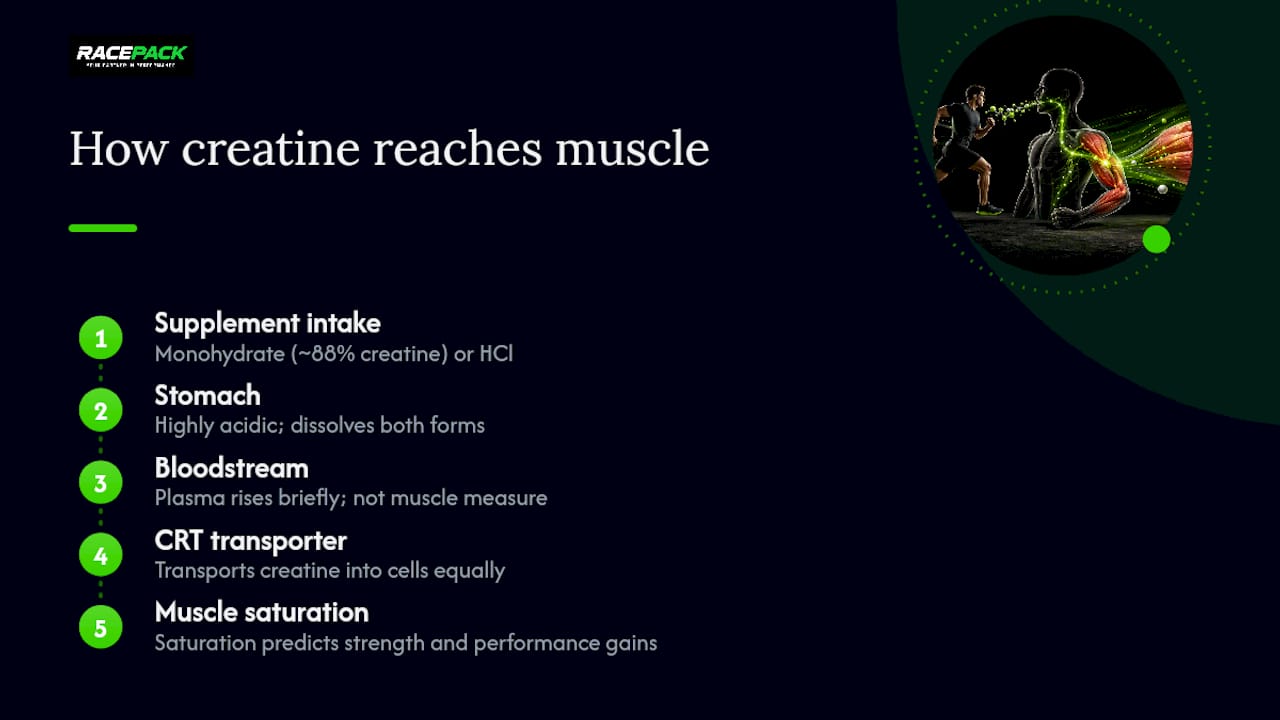
That distinction also explains a common flaw in studies that favor HCl. Some early comparisons measured plasma creatine concentration shortly after ingestion; a marker of how much creatine is circulating in the blood at a given moment, not how much has actually loaded into muscle tissue. Plasma levels rise and fall quickly and don’t reliably predict long-term muscle saturation, which is better measured through methods like muscle biopsy or magnetic resonance spectroscopy (MRS). Trials that rely on short-term plasma measurements are answering a different, less useful question than trials that track weeks of muscle saturation and actual strength output. That’s a big part of why solubility claims for HCl haven’t held up once researchers looked at real performance outcomes over multiple weeks.
What Do Head-to-Head Trials and Reviews Actually Show?
The clearest way to settle a creatine effectiveness debate is to look at trials that put both forms head-to-head in the same study, using the same training program, and measure real outcomes: strength, body composition, and muscle creatine content.
The results are consistent. A study on resistance-trained participants found that creatine HCl and creatine monohydrate produced similar improvements in anabolic and catabolic hormone markers, strength, and body composition. Neither form pulled ahead of the other. That’s not a fluke result, either. A separate placebo-controlled trial in elite team-sport athletes compared low-dose monohydrate against creatine HCl and found the two produced similar neuromuscular and body-composition outcomes, with no statistically meaningful edge for HCl even at a reduced dose.
Here’s what that pattern looks like across the current research:
- Multiple RCTs directly comparing the two forms show parity, not superiority, for HCl on strength and body composition.
- No published multi-week trial has demonstrated that HCl loads muscle creatine stores faster or more completely than monohydrate.
- Reviews addressing the creatine types comparison broadly conclude that monohydrate remains the reference standard because its evidence base is both larger and longer in duration.
- Claims about HCl’s advantages tend to rest on small sample sizes, short trial durations, or surrogate measures like blood plasma levels rather than muscle biopsy data.
A recent review summarizing the state of the field put it plainly:
That’s essentially the same conclusion echoed across multiple sources. The extensive NIH review on creatine monohydrate’s efficacy and safety cites hundreds of trials showing consistent improvements in high-intensity exercise performance. HCl simply hasn’t accumulated that volume of evidence, and the trials that do exist keep landing on the same “no difference” result rather than showing an HCl advantage.
This doesn’t mean HCl is a bad product. It means the marketing claim, that a more soluble salt form translates into better muscle loading or performance, hasn’t been backed up once researchers ran controlled comparisons. If anything, the consistency of “no difference” results across different labs, athlete populations, and training protocols is itself a strong signal. When multiple independent trials keep landing on the same conclusion, that’s harder to dismiss than a single favorable study would be.
How to Dose Creatine Monohydrate (and How HCl Labels Differ)
Dosing is where the practical decision actually gets made, and the evidence-backed default is straightforward.
- Skip loading if you want simplicity. A steady 3 to 5 grams per day of creatine monohydrate saturates muscle stores within three to four weeks. ISSN guidance treats continuous daily intake in this range as sufficient for maintaining tissue creatine content, and cycling on and off isn’t necessary for most people.
- Use a loading phase only if you want faster results. Taking a higher daily dose split across several intakes for a short period can speed up saturation, followed by a standard maintenance dose. Our detailed breakdown of the loading phase walks through when this is actually worth the extra grams.
- Compare that to HCl labels, which often suggest 1 to 2 grams daily. The logic is that higher solubility means a smaller dose delivers comparable creatine to the muscle. That claim hasn’t been validated in long-term muscle-saturation trials, so treat the lower HCl dose as a marketing convenience, not a proven equivalence.
- If mixing or GI comfort is your real issue, try splitting your monohydrate dose in half and taking it with meals, or switch to a micronized powder that dissolves more completely. Both fixes resolve most complaints without switching forms at all.
- Give any change four weeks before judging it. Creatine saturation and its effects on strength don’t show up overnight, so a shorter trial won’t tell you much either way.
Pro Tip: If your shaker always has a gritty residue at the bottom, that’s often a mixing technique problem, not a creatine problem. Add the powder to room-temperature water first, shake hard for 20 seconds, then let it sit for a minute before your final shake. Cold water and thin liquids make monohydrate harder to dissolve completely.
Our full guide on creatine monohydrate benefits, dosage, and timing covers timing around workouts in more depth if you want to fine-tune further.
Is Creatine Monohydrate Safe? What About Side Effects?
Creatine monohydrate has one of the longest continuous safety records of any sports supplement. Long-term studies and large reviews consistently report no meaningful kidney harm in healthy people taking recommended doses, and Mayo Clinic’s overview of creatine reflects that same consensus for general use.
The side effects people actually notice are minor and manageable:
- Water retention is common in the first one to two weeks, mostly inside muscle cells rather than under the skin, and it levels off as your body adjusts.
- GI symptoms like bloating or mild cramping usually stem from taking too large a single dose, not from the creatine itself. Splitting the dose or switching to a micronized powder resolves most of these cases without needing to change forms.
- Rare individual sensitivity happens, but it’s uncommon enough that switching forms should be a later step, not a first response.
If you have existing kidney disease, are on medications that affect kidney function, or have any other chronic medical condition, talk to a clinician before starting creatine in either form. That guidance applies equally whether you’re considering monohydrate or HCl. Interestingly, creatine’s benefits reach beyond athletic performance too. Research on creatine and bone health suggests it may support bone density when paired with resistance training, a benefit relevant for older athletes and anyone managing bone health long term.
Cost Per Effective Dose: Which Form Gives You More Value?
Price per gram tells only part of the story. What matters is price per effective dose, since HCl’s smaller recommended serving can make it look cheaper on the label while actually costing more per gram of active creatine delivered.
Monohydrate wins this comparison in almost every case. A large-scale evidence review comparing the two forms concludes that monohydrate remains the best choice for most users on a value basis, with HCl reserved for niche convenience cases. You’re paying HCl’s premium for faster dissolving and a smaller scoop, not for any performance advantage the trials have found.
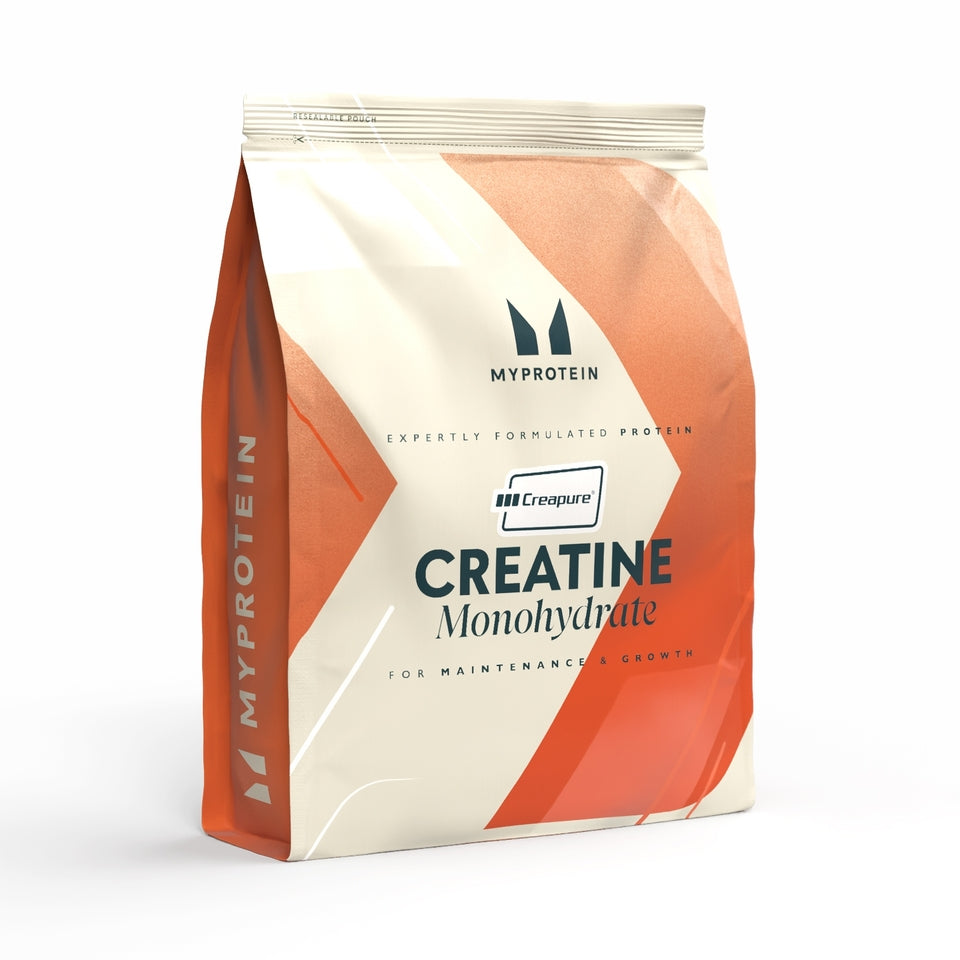
When shopping for monohydrate, look for third-party testing and a pharmaceutical-grade source like Creapure, which verifies purity and consistent dosing batch to batch. A Forbes roundup of top creatine supplements makes the same point: consistency in what you actually take matters more than chasing the newest form on the shelf, and a verified, third-party-tested monohydrate beats a novel form with a thinner research trail.
Who Should Choose Monohydrate, and Who Might Try HCl?
Matching the evidence to your specific situation makes this decision easier than it sounds.
- The evidence-first lifter. If you want the best type of creatine backed by the deepest research, monohydrate is the clear answer. It has the trial volume, the safety data, and the price advantage.
- The budget-conscious athlete. Monohydrate costs less per effective dose in nearly every case, making it the practical default when you’re tracking supplement spend closely.
- The GI-sensitive user. Don’t jump to HCl first. Run a three-step trial: split your monohydrate dose across two meals, switch to a micronized powder if you haven’t already, and give it four weeks. Most GI complaints resolve well before you’d need to consider switching forms.
- The frequent traveler. If minimal mixing volume genuinely matters for your situation, HCl’s faster dissolving and smaller scoop size is a legitimate, if minor, convenience trade.
If your current monohydrate routine is working and you’re tolerating it fine, there’s no evidence-based reason to switch. Is HCl better than monohydrate for you specifically? Only if you’ve already tried the tolerance fixes above and still have persistent issues, or you have a genuine, ongoing need for smaller mixing volumes.
Racepack SG’s Recommended Monohydrate Picks
Some retailers stock creatine monohydrate products chosen to match what the research supports: verified purity, consistent dosing, and no unnecessary premium for unproven claims.
- MyProtein Creatine Powder 250g is a smaller package suited to anyone who wants to trial monohydrate before committing to a larger tub, or who’s traveling and doesn’t want to carry a full-size container.
Before buying any creatine product, check the product page for batch and testing information. Authenticity and verified sourcing matter more for a supplement you’re taking daily than a flashy label claim ever will.
The Editor’s Take: Stop Overthinking the Form
The creatine effectiveness debate gets more attention than it deserves. Head-to-head trials keep landing on the same result: monohydrate and HCl perform equivalently, and the burden of proof sits with HCl to show an advantage it hasn’t demonstrated yet. Conventional advice often treats this as a close call requiring careful weighing of pros and cons. It isn’t. The RCT evidence and the ISSN-aligned reviews point in one direction.
What’s genuinely underrated here isn’t the choice between forms. It’s dosing consistency and mixing technique. Most people who think they have a “creatine tolerance problem” actually have a “I took 10 grams in one sitting on an empty stomach” problem, and that gets fixed with a split dose, not a different salt form.
If you’re deciding where to put your attention, put it on taking a verified monohydrate consistently at 3 to 5 grams a day, not on chasing marginal solubility claims that haven’t moved the needle in a single well-run trial.
— Jason John
Ready to Buy? Here’s the Straightforward Choice
Some retailers carry monohydrate products verified for authenticity and offer delivery services, helping customers avoid uncertainty about product authenticity.
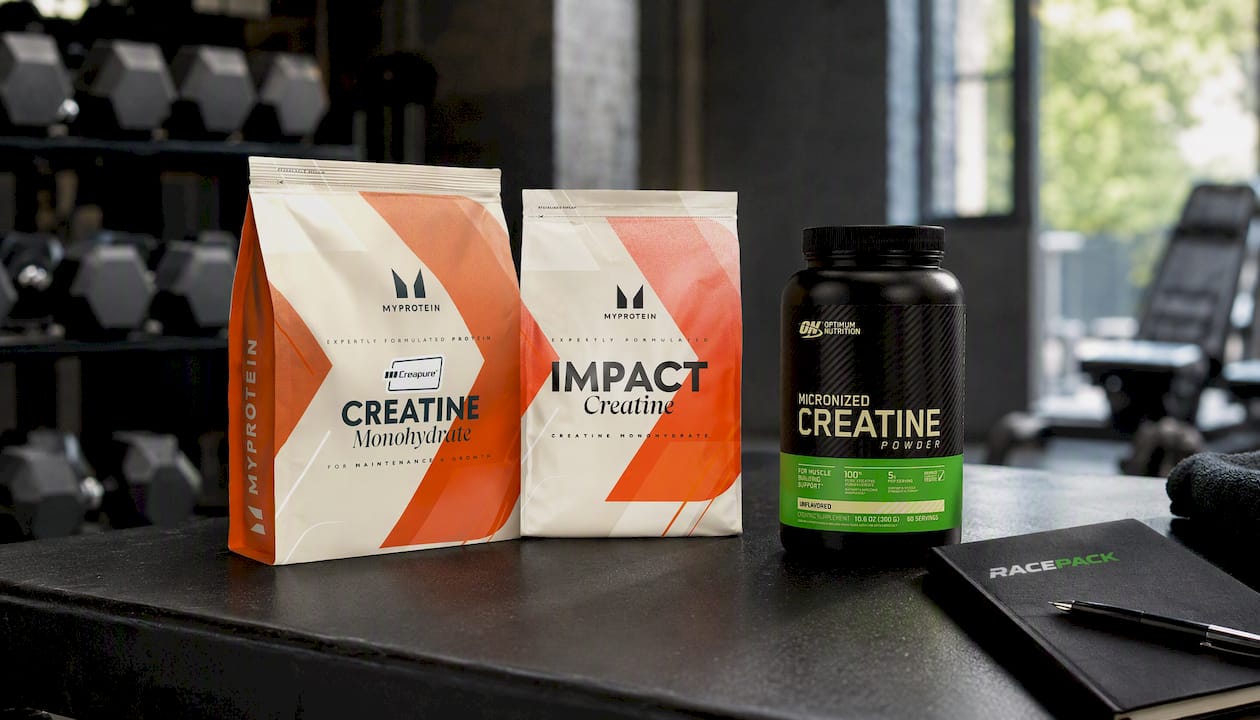
If you want the highest purity bar, the MyProtein Creatine Monohydrate with Creapure is the pharmaceutical-grade standard. Want to start smaller before committing? The MyProtein Creatine Powder 250g is a lower-cost entry point. If mixability and smooth shakes matter most to you, the ON Micronized Creatine Powder solves that directly. Pick the one that fits your training right now and add it to your cart. Buy now and get it delivered next-day.
Sources
For readers who want to go straight to the primary evidence:
- Extensive review of creatine monohydrate efficacy and safety (NIH/PMC review)
- Recent narrative/systematic review supporting monohydrate as the preferred form
FAQ
Which Is Best, Creatine HCl or Monohydrate?
Creatine monohydrate is best for most people because it has a far larger evidence base, a lower cost per effective dose, and a long-established safety record. HCl performs equivalently in head-to-head trials but hasn’t shown any measurable advantage.
Is Creatine HCl Better Than Normal Creatine?
No RCT has shown creatine HCl outperforming standard creatine monohydrate on strength, body composition, or muscle saturation. HCl’s main practical advantage is faster dissolving, not better results.
Is Creatine Better With HCl?
Not based on current evidence. HCl’s acid bond improves solubility in water, but stomach acid and the body’s creatine transporter process both forms the same way once ingested, so muscle uptake ends up equivalent.
Is It Safe to Switch From Creatine HCl to Creatine Monohydrate?
Yes, switching is safe for healthy adults. Since both forms deliver the same active creatine molecule, transitioning from HCl to monohydrate (or the reverse) doesn’t require a washout period or special precautions.
What Is the Recommended Daily Dose of Creatine Monohydrate?
A maintenance dose of 3 to 5 grams per day is sufficient to saturate and maintain muscle creatine stores, according to ISSN guidance. A loading phase of about 20 grams daily, split into four doses, can speed up saturation over five to seven days.
Does Creatine Cause Kidney Damage?
Long-term studies and large reviews report no meaningful kidney harm in healthy individuals taking recommended doses of creatine monohydrate. People with existing kidney disease should consult a clinician before starting any creatine supplement.
Why Does Creatine Monohydrate Cause Bloating for Some People?
Bloating usually comes from taking a large single dose at once, not from creatine itself. Splitting the dose across two meals or switching to a micronized monohydrate typically resolves it.
Do I Need to Load Creatine or Can I Just Take the Maintenance Dose?
Loading isn’t necessary. A steady 3 to 5 gram daily dose reaches full muscle saturation within three to four weeks, just a bit slower than a loading protocol.
Which Racepack SG Creatine Product Should I Buy?
For the highest purity standard, choose the MyProtein Creatine Monohydrate with Creapure. For better mixability, the ON Micronized Creatine Powder is a strong choice.
Is Micronized Creatine Different From Regular Monohydrate?
Micronized creatine is standard monohydrate processed into smaller particles, which improves how completely it dissolves in liquid. The active compound and its effects on the body are the same.
How Long Should I Trial a New Creatine Form Before Judging It?
Give any new dosing approach or form at least four weeks before evaluating results, since muscle creatine saturation and its performance effects build gradually rather than appearing immediately.