

Sweat Rate Test: How to Calculate Your Hourly Fluid Loss
The fastest way to find your hydration number is a 45 to 90 minute weigh-before/after test. The formula is simple: (pre-exercise weight − post-exercise weight + fluid consumed) ÷ hours = liters per hour of sweat loss.
Here’s a worked example. A runner weighs 70.0 kg before a 60-minute tempo run and 69.3 kg after, having drunk 0.5 L during the session. That’s 0.7 kg lost from the scale, plus the 0.5 L consumed, for a total loss of 1.2 L over one hour. Her sweat rate is 1.2 L/hr.
Typical sweat rate ranges for athletes:
- Low: 0.5 to 0.8 L/hr
- Moderate: 0.8 to 1.4 L/hr
- Heavy: 1.4 to 2.0 L/hr
- Very heavy: 2.0+ L/hr
Most recreational athletes land in the moderate zone, but heat, pace, and gear shift that number fast. The rest of this guide walks you through the exact protocol, the math, and what to actually do with your result.
Key Takeaways
A valid sweat rate test uses a 45 to 90 minute session and the formula (pre-weight − post-weight + fluid consumed) ÷ hours to produce a reliable L/hr figure for hydration planning.
| Point | Details |
|---|---|
| Use the core formula | (pre-weight − post-weight + fluid consumed) ÷ duration in hours = L/hr. |
| Test at race conditions | Match intensity, clothing, and temperature to your actual event for an accurate result. |
| Retest across conditions | Sweat rate shifts with heat, acclimation, and pace, so average two or three tests. |
| Replace 70 to 90 percent | Overdrinking carries risk, so target a conservative share of your measured hourly loss. |
| Remember volume isn’t sodium | Sweat rate measures fluid loss only; visible salt stains or cramping warrant lab testing. |
| Act on your number | RacepackSingapore’s measured bottles, electrolyte sachets, and gels help you execute the plan you calculate. |
Table of Contents
- What You Need for a Valid Sweat Rate Test
- How to Run the Sweat Rate Test Step by Step
- Sweat Rate Formula and Two Worked Examples
- What Your Sweat Rate Number Actually Means
- Common Mistakes That Skew Your Sweat Test Results
- Turning Your L/hr Result Into a Hydration Plan
- Put Your Sweat Rate Number to Work
- Sources
- FAQ
What You Need for a Valid Sweat Rate Test
Precision starts with your gear. You’ll need a scale accurate to 0.1 kg (or 0.2 lb), a bottle with clear volume markings, a stopwatch or GPS watch, a towel, and minimal, consistent clothing you’d wear on race day.
Pick a 45 to 90 minute session at the intensity and conditions you’d actually race in. Testing an easy jog won’t tell you much about a tempo effort in humid heat.
- Empty your bladder immediately before weighing in.
- Skip food during the test. Solid intake adds weight that muddies your result.
- Track every sip of fluid and log any bathroom breaks.
- Weigh in wearing the same clothing you’ll weigh out in, ideally as little as practical.
Pro Tip: Use the same scale for both weigh-ins. Switching scales, even between two accurate ones, introduces enough drift to throw off a 60-minute result.
How to Run the Sweat Rate Test Step by Step
A clean protocol removes guesswork later. Follow this order and you’ll get a number worth trusting.
- Warm up briefly, then use the bathroom and towel off any sweat before your first weigh-in.
- Weigh in naked or in minimal, dry clothing. Record this as your pre-weight.
- Start your session at the intensity you’re testing (easy run, race-pace bike, tempo swim effort).
- Drink only measured fluid from your marked bottle. Note exactly how much you consume.
- Log any urination during the test. Estimate 0.3 L per bathroom break and subtract it later.
- Finish the session, towel off thoroughly, and remove sweat-soaked gear if you weighed in dry.
- Weigh out immediately in the same state as your pre-weigh. Delay lets evaporative loss continue, skewing your number low.
A 45 to 90 minute window is the sweet spot. Shorter sessions amplify small measurement errors when you scale up to an hourly rate. Longer sessions past two hours start pulling in glycogen loss and fuel weight changes that have nothing to do with sweat.
If you only have 30 minutes, you can still test. Just double your net loss to estimate the hourly rate, understanding the margin of error grows the shorter your window gets.
What to record every time:
- Pre-weight and post-weight
- Total fluid consumed (mL or oz)
- Exact session duration
- Number and estimated volume of urine breaks
Sweat Rate Formula and Two Worked Examples
The core formula works in either unit system. In metric: (pre-weight kg − post-weight kg + fluid consumed L) ÷ hours = L/hr, using the rough conversion that 1 kg of body mass lost equals about 1 L of sweat. In imperial: (pre-weight lb − post-weight lb) × 16 (to get fluid ounces) + fluid consumed in oz, divided by hours, gives you oz/hr. If you need to cross units, 1 lb converts to roughly 0.4536 kg, and 1 L equals about 33.8 fl oz, or use the quick rule of thumb that 30 mL is close enough to 1 oz for fieldwork.
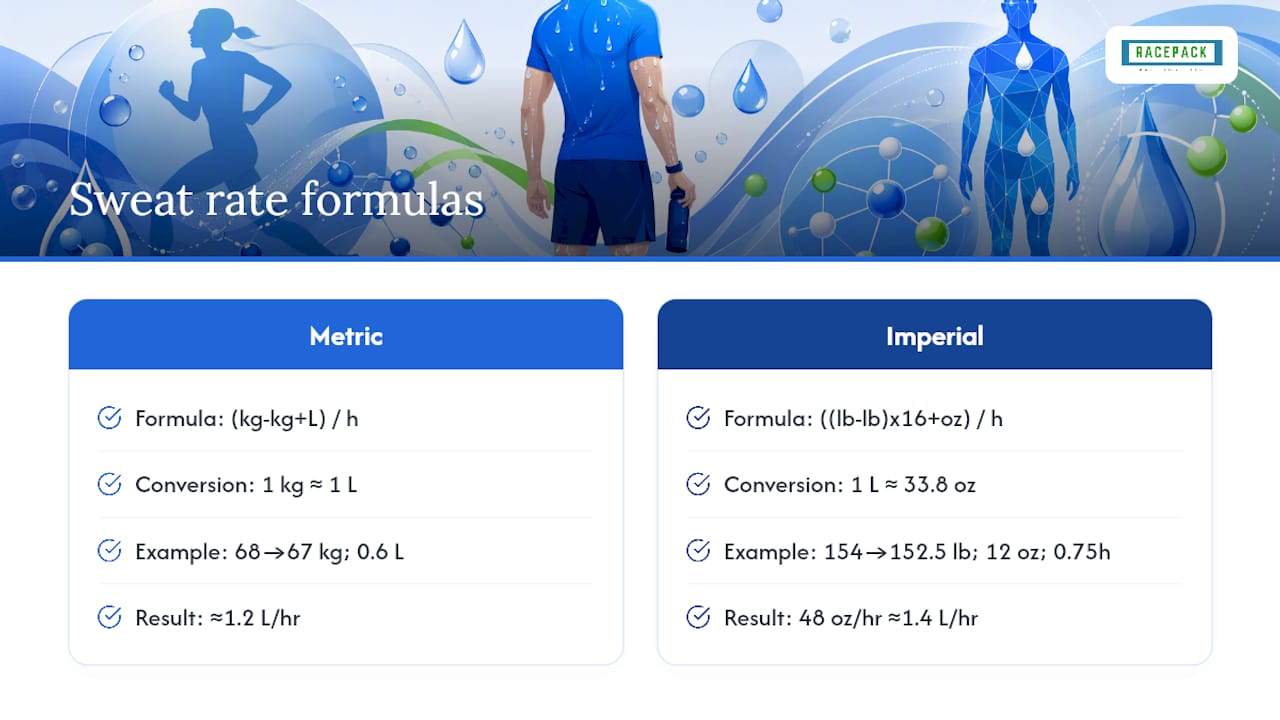
Metric example: An example with pre-weight around 68 kg, post-weight near 67 kg, fluid consumed about 0.6 L, and exercise duration just over one hour yields a net loss some proportionally calculated to about 1.2 L/hr.
Imperial example: Pre-weight 154 lb, post-weight 152.5 lb, fluid consumed 12 oz, duration 45 minutes (0.75 hr). That’s 1.5 lb lost, roughly 24 oz, plus 12 oz consumed, for 36 oz total. Divide by 0.75 hours: 48 oz/hr, or about 1.4 L/hr.
Round to one decimal place. Chasing more precision than that just creates false confidence in a number that already carries some natural noise.
What Your Sweat Rate Number Actually Means
A single test result is a data point, not a permanent label. Sweat rate shifts with temperature, pace, and how acclimated you are to heat, so treat your number as a working estimate rather than a fixed trait.
That said, the practical ranges hold up well across most endurance sports:
- Low sweaters: 0.5 to 0.8 L/hr, often smaller athletes or those training in cooler climates.
- Moderate: 0.8 to 1.4 L/hr, the most common range for club-level runners and cyclists.
- Heavy: 1.4 to 2.0 L/hr, typical of bigger athletes or anyone racing in heat and humidity.
- Very heavy: above 2.0 L/hr, seen in elite-intensity efforts or extreme heat.
Sport matters too. Runners tend to sweat more than cyclists at a comparable effort, partly because airflow over a moving bike helps evaporative cooling. Heat acclimation over 10 to 14 days tends to push your rate higher while your sweat sodium concentration often drops, so retest after a week or two of training in new conditions, and again once the weather shifts. Averaging two or three tests across different temperatures gives you a far more useful race-day range than any single number.
Common Mistakes That Skew Your Sweat Test Results
Small procedural slips create big errors in your final number. Wet clothing at the finish but dry clothing at the start, for instance, can add several hundred grams of false “sweat loss” that never actually left your body.
Watch for these confounders:
- Weighing in dry clothes but out in soaked ones (or vice versa).
- Skipping the towel dry before your post-weigh.
- Using two different scales for pre- and post-weight.
- Forgetting to log a bathroom break, which inflates your apparent sweat loss.
- Testing past two hours, where glycogen and fuel weight start interfering with the result.
Here’s the part athletes often miss: this test only measures volume, not sodium concentration. Sweat sodium and sweat volume are independent variables, meaning a high sweat rate doesn’t automatically mean high sodium loss, or vice versa. If you’re seeing visible white salt stains on your kit, dealing with recurrent cramping, or racing events longer than two hours, that’s your signal to look into lab or patch-based sodium testing rather than guessing.
Pro Tip: Repeat your test at least twice in different conditions before you trust the number for race planning. One hot, humid session and one cool, dry session will show you the real spread you need to plan around.
Turning Your L/hr Result Into a Hydration Plan
Your number only matters once it becomes a drinking schedule. A conservative approach is to replace 70 to 90 percent of your measured hourly loss rather than 100 percent, since overdrinking carries its own risks.
- If your rate is 1.0 L/hr, target roughly 0.7 to 0.9 L/hr of intake.
- If your rate is 2.0 L/hr, target roughly 1.4 to 1.8 L/hr of intake.
- Split that hourly target into 15 to 20 minute intervals so you’re sipping steadily rather than gulping once an hour.
For a 1.0 L/hr target, that’s roughly 200 to 250 mL every 15 minutes, which fits neatly into most standard bottle sizes or a couple of solid pulls at an aid station.
Sodium planning gets trickier without lab data. Visible salt crusting on your hat or shirt, a history of cramping, and a naturally salty sweat taste are rough proxies for higher sodium loss, but they’re not precise. If you’re training for anything over two hours, pairing your fluid plan with an electrolyte strategy matters more than chasing exact milligram targets. Athletes with a history of hyponatremia symptoms, or anyone unsure about safe fluid limits, should check with a sports medicine physician before finalizing a race-day plan.
A Coach’s Note on Testing Before Race Day
Repeat testing beats a single “perfect” number every time. Conditions change, fitness changes, and one 60-minute session in mild weather won’t tell you what you need for a hot afternoon race.
Always trial your hydration plan on a long training day first, then adjust based on gut comfort and how hard the effort felt. Race day is the wrong place to discover your stomach disagrees with your math.
Put Your Sweat Rate Number to Work
Once you know your hourly loss, matching the right products makes the plan easy to execute instead of just theoretical. Runners in the moderate range often do well with a measured 750 mL bottle paired with electrolyte tablets, giving you both volume control and sodium replacement in one setup. If your test came back heavy or very heavy, stacking electrolyte sachets like HIGH5 ZERO+ Multivitamins/Ultra Electrolytes alongside your fluid target helps close that bigger gap.
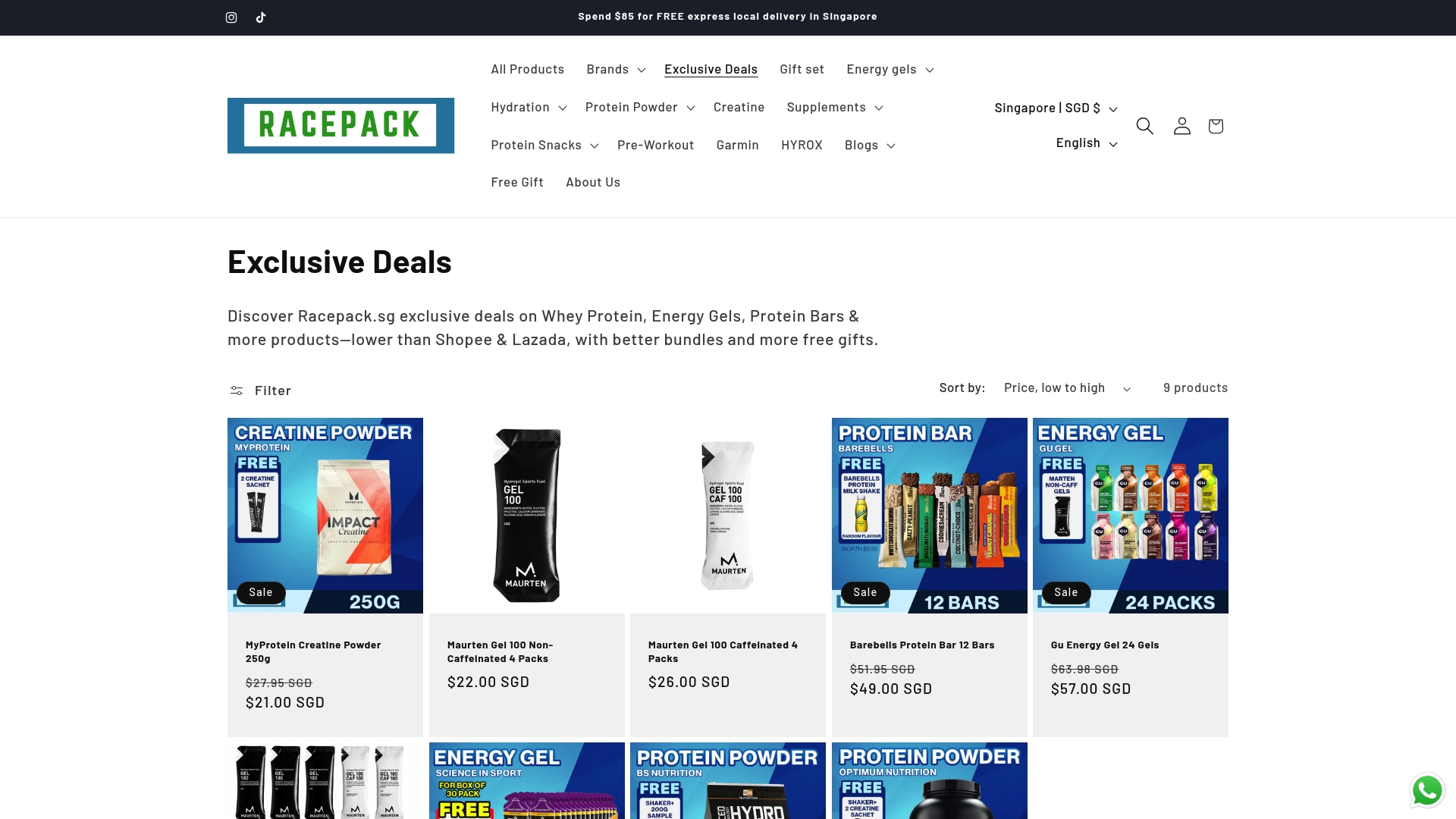
For sessions where you need carbohydrate on top of fluid, RacepackSingapore stocks GU Energy Gels in bulk and smaller trial packs so you can test fueling and hydration together before committing to a race-day combo. If you’re logging session duration and conditions to build your sweat-rate profile over time, a Garmin Forerunner 165 tracks the exact data you need for consistent retesting. This is product guidance based on common sweat-rate outcomes, not medical advice, so trial anything new on a training day well before race week. Browse the full sports nutrition range to build your kit.
Sources
Beyond a scale and stopwatch, a few tools speed up the math. The GSSI Fluid Loss Calculator takes your weight change and optional urine or food inputs and outputs your rate directly in L/hr or oz/hr.
For a printable field worksheet, the Korey Stringer Institute’s Sweat Rate Calculator walks through the same formula in a format you can bring to the track or pool deck. If you want the physiology behind why sodium and volume behave independently, the PMC review on sweating rate and sweat sodium is the most thorough primary source available. For how weather changes your numbers session to session, RacepackSingapore’s guide on humid weather and running performance is worth a read.
This article is general information, not a substitute for advice from a qualified doctor. Consult a qualified healthcare professional about your own circumstances before acting on anything here.
- Sweating rate and sweat sodium concentration review (PMC)
- Calculate Your Sweat Rate at Home (Even Splits Lab)
FAQ
How do I test my sweat rate at home?
Weigh yourself right before and after a 45 to 90 minute workout, track any fluid you drink during it, then apply the formula (pre-weight − post-weight + fluid consumed) ÷ hours to get your L/hr.
What is a good sweat rate?
There’s no single “good” number. Most athletes fall between 0.5 and 2.0 L/hr, with 0.8 to 1.4 L/hr considered moderate and typical for club-level runners and cyclists.
Why is my sweat rate so low?
A low reading, under 0.8 L/hr, often reflects testing in cool conditions, a lower exercise intensity, or genuine individual variation. Retest in warmer conditions or at race pace before assuming your true rate is that low.
What does a sweat test indicate?
A field sweat test indicates fluid volume lost per hour, which you use to set a drinking target. It does not indicate sweat sodium concentration, which requires separate lab or patch testing.
How often should I retest my sweat rate?
Retest whenever conditions change meaningfully, such as a new season, a move to a hotter climate, or after two weeks of heat acclimation, and aim to average results from at least two different temperature conditions.
Can I use a 30-minute test instead of a full hour?
Yes, but double your net loss to estimate the hourly rate, and understand the result carries a wider margin of error than a full 45 to 90 minute session.
Does sweat rate differ between running and cycling?
Yes. Runners tend to post higher sweat rates than cyclists at a similar effort level, partly because a bike’s airflow assists evaporative cooling.
Do I need to test my sweat sodium separately?
Yes, sweat rate and sweat sodium are independent measurements. If you notice heavy salt staining on your gear or have a history of cramping, a lab or patch-based sodium test gives you the mg/L data a home test can’t.
How much fluid should I drink based on my sweat rate?
Replace roughly 70 to 90 percent of your hourly sweat loss rather than 100 percent, split into small amounts every 15 to 20 minutes, to avoid both dehydration and overdrinking.
What equipment do I need for a sweat rate test?
An accurate scale (0.1 kg or 0.2 lb precision), a bottle with clear volume markings, a stopwatch, a towel, and consistent minimal clothing between weigh-ins.
Can Racepack products help me act on my sweat rate result?
Yes. RacepackSingapore stocks measured hydration bottles, electrolyte sachets, and energy gels you can pair directly to your calculated L/hr target, along with GPS watches for tracking session conditions during retests.
Ready to build your hydration plan around real numbers?
Run your test, calculate your L/hr, and shop RacepackSingapore’s hydration and nutrition range to put that number into practice on your next long session.