

Why Humid Weather Makes Running So Much Harder
Humid weather makes running harder because it prevents sweat from evaporating, collapsing your body’s primary cooling system and forcing your heart to work harder to compensate. That single mechanism explains nearly every struggle you feel on a muggy summer morning.
Three pieces of evidence back this up immediately:
- Evaporative cooling fails. A controlled study published in the Scandinavian Journal of Medicine & Science in Sports found that elevated humidity reduces sweat evaporative efficiency (Seff) and maximum evaporative capacity (Emax), causing performance losses of roughly 5% in high humidity and 16% in very high humidity, even when sweat rates stayed similar.
- Your heart rate climbs without extra speed. As skin temperature rises and stroke volume drops, heart rate drifts upward to maintain cardiac output, a process called cardiovascular drift. Your perceived effort spikes even if your pace stays flat.
- Dew point predicts this better than relative humidity. Coaching research consistently shows that dew point above 70°F signals conditions where chasing pace targets becomes unsafe. Run by effort, not the clock.
Key Takeaways
Humid weather impairs running performance primarily by blocking sweat evaporation, triggering cardiovascular drift, and raising perceived exertion, and the best response is to run by effort, using dew point as your guide.
| Point | Details |
|---|---|
| Evaporation is the core problem | High absolute humidity narrows the Psk,sat–Pa gradient, cutting Emax and causing sweat to drip rather than cool. |
| Performance loss is measurable | Studies show roughly 0.3–0.4% performance loss per degree WBGT outside the optimal window, with up to 16% loss in very high humidity. |
| Dew point beats relative humidity | Dew point stays constant across the day and directly predicts evaporative capacity; above 70°F, avoid hard sessions entirely. |
| Drinking alone does not restore cooling | Fluid ingestion did not improve time to exhaustion in warm-humid trials; prioritize external cooling and pacing over extra drinking. |
| RacepackSingapore supports every humid run | HIGH5 electrolyte products, GU Energy Gels, and the Garmin Forerunner 165 give you the nutrition and monitoring to train safely in heat and humidity. |
Table of Contents
- Why humid weather affects runners at the physiological level
- Which weather numbers should you actually track?
- How much does humidity actually slow you down?
- Concrete steps for every humid run: pre, during, and post
- How to acclimate safely to hot-humid conditions
- Why drinking more water alone will not save you in humidity
- What recent research adds: it is not just about core temperature
- The trade-offs you actually face when training in humid climates
- Gear and nutrition that support your humid-weather runs
- Sources
- FAQ
Why humid weather affects runners at the physiological level
Your body cools itself almost entirely through sweat evaporation during sustained running. The physics depend on a pressure gradient between the water vapor at your skin surface (Psk,sat) and the water vapor already in the air (Pa). When that gap narrows, evaporation slows. High absolute humidity raises Pa, shrinking the Psk,sat–Pa gradient and cutting your maximum evaporative capacity (Emax).
The result: sweat accumulates on your skin, coalesces into droplets, and drips off without cooling you. You are producing the sweat, but the work is wasted.
What happens next follows a predictable chain:
- Skin temperature rises because heat cannot leave the body efficiently.
- Core temperature climbs in response.
- Your cardiovascular system redirects more blood to the skin in a last-ditch attempt to offload heat, competing directly with the muscles that need oxygen.
- Stroke volume drops as blood pools peripherally.
- Heart rate increases to maintain cardiac output, even though pace has not changed.
This is cardiovascular drift, and research on the physiological demands of humid heat describes it as a double burden: the heart must simultaneously supply working muscles and push large volumes of blood to the skin. That dual demand accelerates fatigue far faster than dry heat at the same air temperature.
Heat flow in humid conditions: Working muscle generates heat → heat transfers to core → blood carries it to skin → sweat secreted → evaporation fails → skin and core temperature rise → cardiovascular strain escalates.
One controlled study found that hot-humid conditions reduced time-to-exhaustion by about one quarter in elite athletes, with skin-temperature changes and perceptual responses identified as primary drivers, not just core temperature alone.
Which weather numbers should you actually track?
Relative humidity (RH) is the number most runners check, and it is also the least useful one. RH tells you how saturated the air is relative to its current temperature, so it swings widely across the day even when the actual moisture content stays constant.
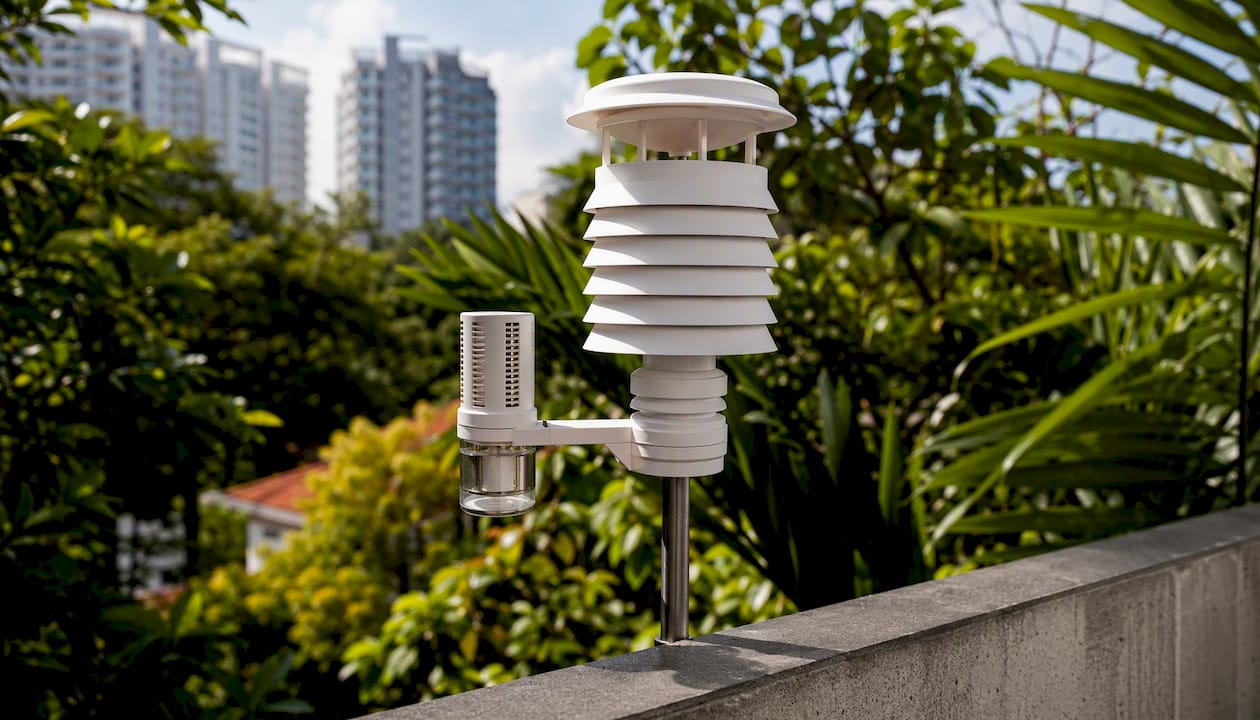
Dew point is the temperature at which air becomes fully saturated. It stays nearly constant across the day and directly reflects absolute moisture content, which is what determines your evaporative capacity. Dew point is the single best number for runners to track because it does not fluctuate with air temperature.
Wet-Bulb Globe Temperature (WBGT) goes further by combining air temperature, humidity, radiant heat, and wind speed into one index. It is the standard used in organized road races and military training. A large analysis of 1,258 endurance races confirmed that WBGT predicts performance better than air temperature alone.
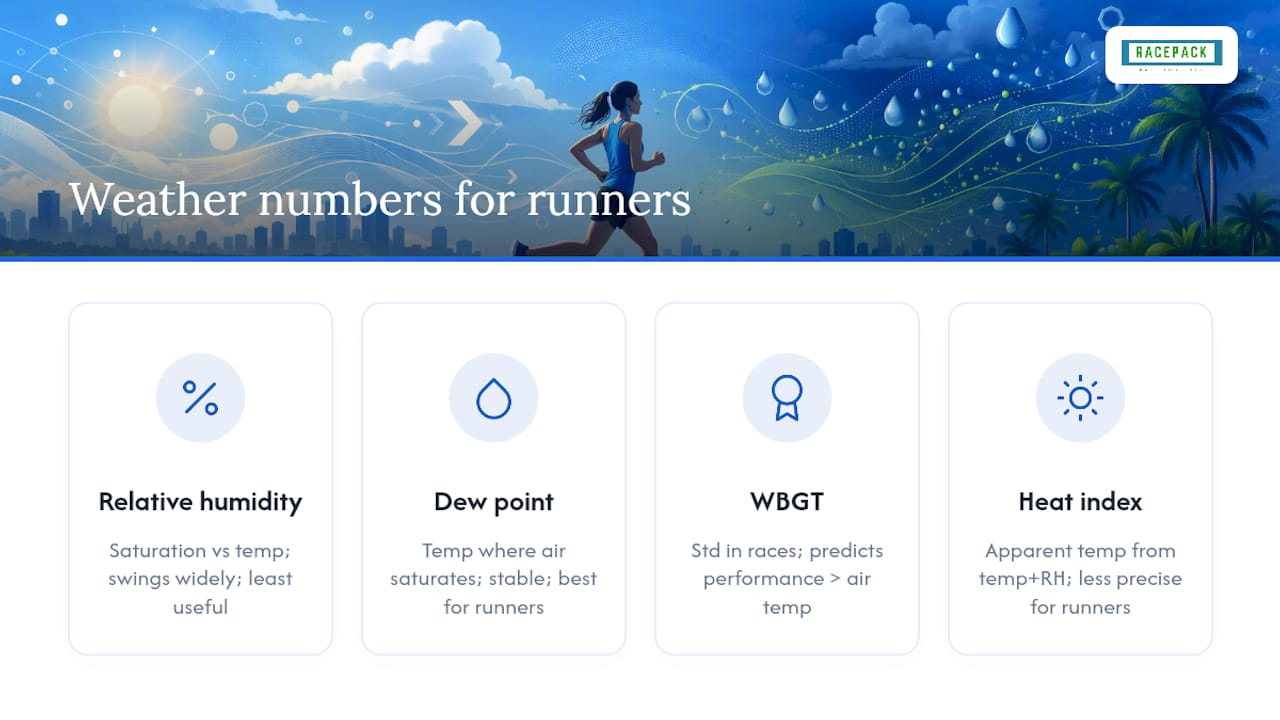
Heat index, published by the National Weather Service, blends air temperature and relative humidity into an “apparent temperature.” It is useful for general public safety guidance but less precise for runners than dew point or WBGT.
Dew point pacing guide
| Dew Point (°F) | Conditions | Recommended Approach |
|---|---|---|
| Below 55 | Comfortable | Normal pace and effort targets |
| 55–60 | Slightly humid | Minor effort adjustment; watch heart rate |
| 60–65 | Humid | Reduce pace 5–10%; prioritize effort |
| 65–70 | Very humid | Run by effort only; skip hard sessions |
| Above 70 | Oppressive | Avoid intense workouts; consider indoors |
Practical tips for tracking these numbers:
- Check dew point on Weather.gov, Weather Underground, or your phone’s weather app (look for “dewpoint” in the detailed hourly forecast).
- WBGT calculators are available through the Korey Stringer Institute and several race-day apps.
- Check conditions the night before, not just the morning of, to plan your session type.
How much does humidity actually slow you down?
The performance hit is real and measurable. The large-scale race analysis cited above estimated a performance decrement of roughly 0.3–0.4% per degree WBGT outside the optimal thermal window. That sounds small, but it compounds quickly.
For a runner targeting a 4-hour marathon, a WBGT that is 10°C above the optimal range translates to roughly 7–10 minutes of added finish time, before accounting for pacing errors or heat illness risk. At very high humidity, the controlled trial data showing ~16% performance loss suggest the impact can be far larger for athletes who ignore conditions and push their normal pace.
Fitness level matters too. Well-trained runners with higher plasma volumes and earlier sweat onset handle humid heat better than recreational runners, but no one is immune. Event length amplifies the effect: a 5K in humidity is uncomfortable; a marathon in the same conditions is genuinely dangerous. Individual variability is wide, which is why effort-based pacing and heart-rate monitoring beat fixed pace targets on humid days.
Reading a WBGT performance map: These charts plot finishing time or percent performance loss on the Y-axis against WBGT on the X-axis. Look for the “knee” of the curve, the point where the line bends steeply upward. That bend typically appears around WBGT 18–20°C (roughly 65–68°F). Above it, each additional degree costs you more than the one before.
Concrete steps for every humid run: pre, during, and post
Before you head out
- Check dew point and WBGT the night before. If dew point exceeds 65°F, plan an effort-based run, not a pace-based one.
- Shift your start time to early morning or after sunset when dew point is typically at its lowest.
- Choose shaded routes near water where possible; avoid exposed asphalt that radiates heat.
- Set a heart-rate ceiling instead of a pace target. A common guideline is keeping heart rate 5–10 beats below your normal aerobic ceiling.
- Wear light-colored, moisture-wicking fabrics that allow airflow; avoid cotton entirely.
- Pre-cool with a cold towel on the neck and wrists, or consume a cold beverage 10–15 minutes before starting.
During the run
- Pace by effort, not GPS. If your heart rate drifts above your ceiling, slow down immediately.
- Drink to thirst rather than on a rigid schedule; see the hydration section below for why over-drinking does not fix cooling.
- Pour water over your head and neck at aid stations. Skin cooling reduces cardiovascular strain even when core temperature is unchanged.
- Carry HIGH5 Zero+ electrolyte sachets or a HIGH5 hydration bottle to replace sodium lost in sweat.
- Fuel with a GU Energy Gel every 45 minutes on runs over 75 minutes; heat suppresses appetite but your muscles still need carbohydrates.
Red flags that require you to stop immediately:
- Cessation of sweating despite feeling hot
- Confusion, disorientation, or slurred speech
- Nausea or vomiting
- Skin that is hot and dry (classic heat stroke sign)
- Dizziness or near-fainting
If any of these appear: stop, move to shade, apply ice or cold water to neck, armpits, and groin, and call for help. Heat stroke is a medical emergency.
After the run
- Weigh yourself before and after to estimate fluid loss (1 lb lost ≈ 16 oz of fluid).
- Rehydrate with a sodium-containing drink, not plain water alone, to support fluid retention.
- Log conditions, heart rate, and perceived effort to track your acclimation progress over time.
- Check for anti-chafing care after humid runs; wet skin increases friction injury risk significantly.
Pro Tip: Freeze a damp bandana the night before a long humid run. Wrap it around your neck at the start and re-wet it at aid stations. This simple pre-cooling trick can delay cardiovascular drift by several minutes.
How to acclimate safely to hot-humid conditions
Heat acclimation works. Over 7–14 days of progressive exposure, your body increases plasma volume, lowers the core temperature threshold at which sweating begins, and improves sweat distribution across the skin. These adaptations reduce heart-rate drift and lower perceived exertion at the same pace.
Humid heat requires a slightly longer adaptation window than dry heat because the evaporative ceiling is lower throughout the process. Expect 10–14 days for meaningful adaptation, with the largest gains in the first week.
A progressive 14-day acclimation plan:
- Days 1–3: 20–30 minutes at easy effort (60–65% max HR) in the heat. Focus on completing the time, not pace.
- Days 4–7: Extend to 40–45 minutes at the same easy effort. Add one moderate-effort interval session of 20 minutes.
- Days 8–11: Build to 50–60 minutes. Introduce one tempo effort at 70–75% max HR, but cut it short if heart rate spikes.
- Days 12–14: Full training duration at normal effort. Assess heart-rate response versus your pre-acclimation baseline.
Signs that adaptation is working:
- Heart rate at the same pace drops by 5–10 beats compared to Day 1.
- Sweating begins earlier in the run.
- Perceived exertion at a given pace feels lower.
Safety checklist — pause the program if you notice:
- Resting heart rate elevated by more than 5–7 beats above your normal baseline
- Persistent headache or nausea after a session
- Urine that is dark amber (dehydration signal)
- Any of the red-flag heat illness signs listed above
Why drinking more water alone will not save you in humidity
This is one of the most important things to understand about running in humid conditions, and most runners get it wrong. Drinking more fluid does not restore evaporative cooling. The problem is not that you are short on water; it is that the air cannot accept the water vapor your sweat is trying to release.
A randomized controlled trial published in Frontiers in Physiology found that fluid ingestion in warm-humid conditions did not attenuate hyperthermia or extend time to exhaustion. Participants who drank during the humid trial performed no better than those who did not. The same trial showed a different result in warm-dry conditions, where drinking did help, confirming that the mechanism is environment-specific.
The concept of “ineffective sweat” explains why. In high humidity, sweat accumulates on the skin and drips off without evaporating. You are still losing fluid and electrolytes, but you are getting no cooling benefit from that loss. This means you can become both dehydrated and overheated simultaneously, which is a dangerous combination.
Practical hydration rules for humid runs:
- Estimate your sweat rate with a simple field check: weigh yourself (without clothing) before and after a 60-minute run. Each pound lost equals approximately 16 oz of fluid.
- For runs over 90 minutes, aim to replace 75–80% of sweat losses, not 100%, to avoid overdrinking.
- Sodium replacement matters more in humid conditions because sweat volume is high. A product like HIGH5 Zero+ electrolyte sachets or HIGH5 Energy Drink 2:1 Fructose provides both carbohydrates and electrolytes in one step.
- Prioritize external cooling (ice, water dousing, shade) over drinking when conditions are extreme. Cooling reduces cardiovascular strain directly; drinking does not.
For a deeper look at sodium and electrolyte strategy, the electrolyte balance guide for marathon runners covers the math in detail. If you are prone to cramping in the heat, the marathon cramp prevention guide is worth reading alongside this article.
Quick sweat-rate example: You weigh 160 lbs before a 60-minute run and 158.5 lbs after. That is 1.5 lbs lost, or roughly 24 oz of fluid. In a 2-hour run at the same rate, you would lose about 48 oz. Aim to drink 36–38 oz across that run, and supplement with sodium to retain what you drink.
What recent research adds: it is not just about core temperature
The traditional view of heat-related performance loss focused almost entirely on rising core temperature. Recent peer-reviewed work has shifted that picture considerably.
The experimental study on hot-humid conditions in elite athletes found that performance impairments were linked to skin-temperature–mediated cardiovascular strain and altered perception even when differences in core temperature between conditions were relatively modest. Skin temperature, not just core temperature, drives the cardiovascular response because it determines how aggressively blood is redirected to the periphery.
Practical implications from this research:
- Monitoring heart-rate drift is more actionable than trying to estimate core temperature in the field. A Garmin Forerunner 165 GPS Smartwatch gives you real-time heart-rate data so you can catch drift before it becomes dangerous.
- Perceived exertion is a legitimate physiological signal in humid conditions, not just a mental barrier. If it feels harder than the pace warrants, it probably is.
- Skin-cooling strategies (ice packs on the neck, cold water on the arms) work partly by reducing the cardiovascular demand to offload heat, not just by lowering skin temperature locally.
- Individual responses vary widely. Two runners at the same fitness level can have meaningfully different cardiovascular responses to the same WBGT. Individualized testing in training, not just race-day guessing, is the only way to know your personal threshold.
Pro Tip: Use your GPS watch’s heart-rate trend screen during a humid run. If heart rate climbs more than 10 beats above your expected zone at a given pace within the first 20 minutes, treat that as a confirmed cardiovascular drift signal and drop pace immediately, not after the next mile.
Weather also affects performance across other sports in similar ways. If you want a plain-language primer on how atmospheric conditions alter athletic output more broadly, this guide on weather and athletic performance covers the underlying principles clearly.
The trade-offs you actually face when training in humid climates
There is a tension that most training plans do not acknowledge honestly: in humid climates, you cannot always train at the quality your fitness level demands. The conditions impose a ceiling, and fighting that ceiling is how runners end up in the emergency room.
The smarter trade-off is to preserve training volume while accepting reduced intensity on humid days. A 10-mile easy run in 70°F dew point builds aerobic base. A 10-mile tempo run in the same conditions builds heat illness risk. The fitness adaptation you want from a tempo run is not happening when your cardiovascular system is already overwhelmed managing skin blood flow.
Move quality sessions indoors or to the coolest part of the day. Save your hard efforts for days when dew point drops below 60°F. Use humid days deliberately for easy aerobic work and acclimation, not for chasing pace targets. That approach lets you build heat tolerance progressively while protecting the quality sessions that actually drive fitness gains.
A GPS watch that tracks heart-rate trends across sessions, combined with electrolyte products that keep sodium levels stable, gives you the monitoring and support to make these trade-offs confidently rather than guessing. The trail running nutrition guide from RacepackSingapore covers fueling strategies that apply equally well to road running in humid conditions.
Gear and nutrition that support your humid-weather runs
RacepackSingapore stocks the exact products that make humid running safer and more manageable, all with guaranteed authenticity and next-day delivery in Singapore.
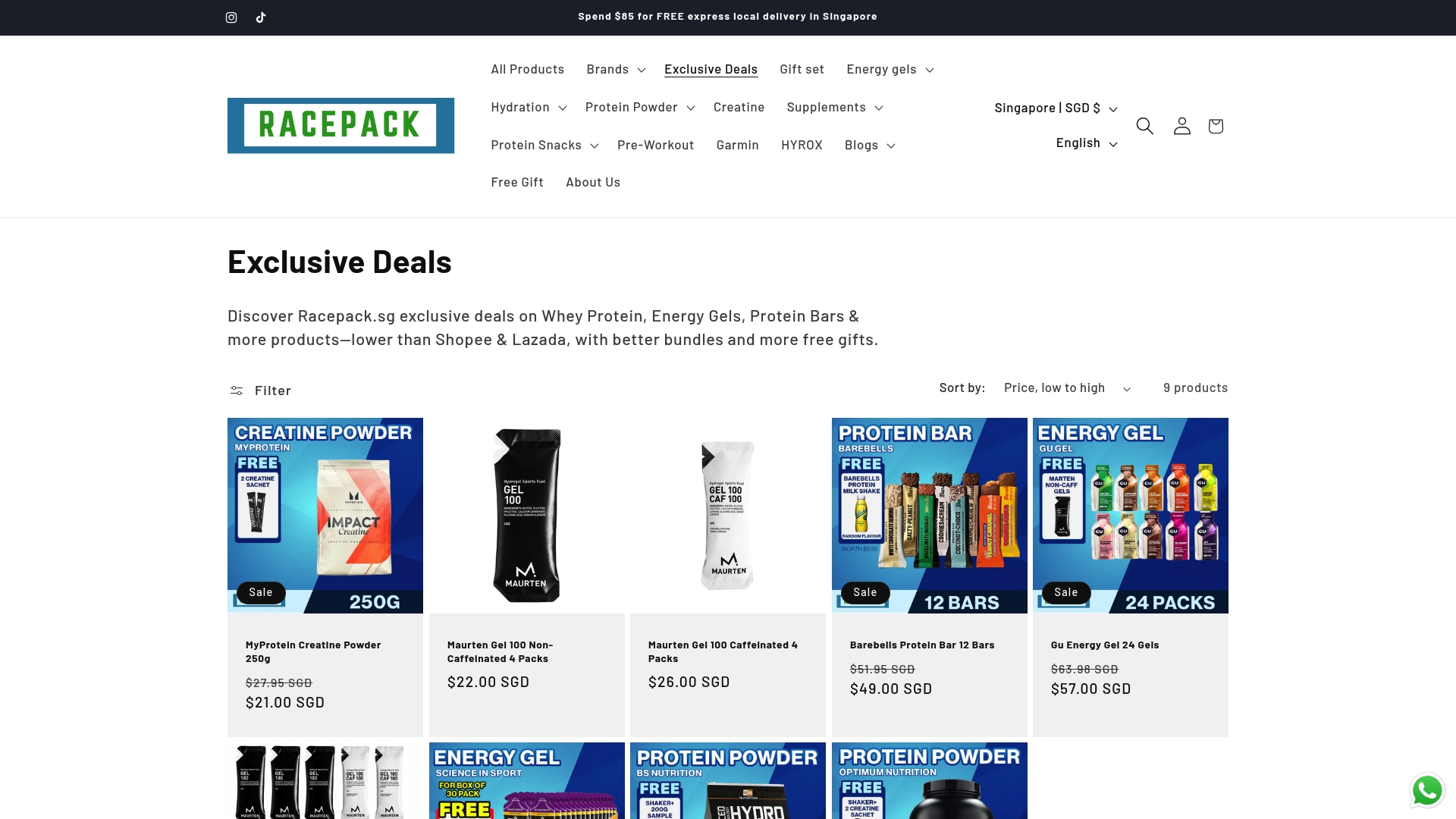
For electrolyte replenishment, HIGH5 ZERO+ Multivitamins/Ultra Electrolytes 16 Sachets and the HIGH5 750ml Bottle With 10 Zero Hydration Tablets are practical, portable options for replacing sodium on long runs. For sustained energy when heat suppresses appetite, GU Energy Gel 24 Gels delivers clean carbohydrates in a format that is easy to carry and consume mid-run. The Garmin Forerunner 165 GPS Smartwatch lets you monitor heart-rate drift in real time, the single most actionable data point for pacing safely in humidity. Browse the full range of sports nutrition products at RacepackSingapore and get everything you need for your next humid-weather run.
Buy Now at RacepackSingapore
Sources
- Hot-humid conditions impair exercise performance in elite para- and AB athletes (PMC article)
- Elevated humidity impairs evaporative heat loss and performance in self-paced exercise (Scandinavian Journal of Medicine & Science in Sports)
- Efficacy of fluid ingestion on thermoregulatory responses in warm-dry and warm-humid conditions (Frontiers in Physiology)
This article is general information, not a substitute for advice from a qualified doctor. Consult a qualified healthcare professional about your own circumstances before acting on anything here.
FAQ
Why is humidity bad for running?
High humidity reduces sweat evaporation, your body’s primary cooling mechanism, which causes skin and core temperature to rise, heart rate to drift upward, and perceived effort to spike even at a steady pace.
Is humid weather good for running at any level?
Mild humidity (dew point below 55°F) has minimal impact on performance. Above that threshold, humid conditions consistently impair performance, and above 70°F dew point they become genuinely dangerous for hard efforts.
Is it hard to run in 70% relative humidity?
It depends on the air temperature. Check dew point rather than relative humidity for a more accurate read.
Does 80% humidity make you sweat more?
Yes, but the sweat is less effective. High humidity reduces sweat evaporative efficiency (Seff), so sweat accumulates and drips off rather than cooling you. You lose more fluid and electrolytes while gaining less cooling benefit.
How much slower should I run in humidity?
What is the best weather metric for runners to track?
Dew point is the most useful single number because it stays constant across the day and directly reflects the air’s capacity to accept evaporated sweat. WBGT is more complete but requires a calculator or app.
Can heat acclimation reduce the impact of humidity on running?
Yes. A 10–14 day progressive acclimation program increases plasma volume and lowers the core temperature threshold for sweating, reducing heart-rate drift and perceived exertion at the same pace in humid conditions.
What are the warning signs of heat illness during a run?
Stop immediately if you experience cessation of sweating while still feeling hot, confusion, nausea, vomiting, hot and dry skin, or dizziness. Move to shade, apply ice to the neck and armpits, and seek emergency help for heat stroke symptoms.
Does drinking more water fix the problem of running in humidity?
No. A randomized trial found that fluid ingestion in warm-humid conditions did not attenuate hyperthermia or extend time to exhaustion. Prioritize external cooling and pacing adjustments; use electrolyte products like HIGH5 ZERO+ to replace what you lose in sweat.
How do I check dew point before a run?
Check Weather.gov or Weather Underground for the hourly dew point forecast. Most smartphone weather apps also display dew point in the detailed hourly view. Check the night before to plan your session type, not just the morning of.
Why does running in humidity feel so much harder than the temperature suggests?
Because relative humidity and air temperature together do not capture the full thermal stress. High absolute moisture content blocks evaporative cooling even at moderate temperatures, causing cardiovascular strain that feels disproportionate to the thermometer reading. Dew point captures this effect; raw temperature does not.