

Singapore’s heat and humidity make marathon hydration a plan you build and rehearse, not something you work out on race morning. Water alone covers part of the job. The rest comes from carbohydrate in gels and sodium from electrolytes, in amounts matched to your own sweat rate and practised in training. At Racepack we stock the electrolytes and gels runners use for this, so you can build your plan from one catalog and get it with next-day delivery within Singapore.
TL;DR
- Plan your drinking for a hot race: in Singapore’s humidity, sweat evaporates poorly and fluid losses add up fast.
- Test your own sweat rate in a long training run, then keep intake below that rate. Over-drinking is a real risk too.
- Aim for 30 to 60 g of carbohydrate per hour, up to 90 g per hour for events longer than 2.5 hours, and take gels with small, regular sips of fluid.
- Add sodium (electrolytes) for sessions over an hour, especially if you are a heavy or salty sweater.
- Heat acclimatisation over 1 to 2 weeks does more for you than any single product.
Table of Contents
- Why Singapore’s heat changes the maths
- Start with heat acclimatisation
- Water: how much is enough
- Find your own number: a sweat-rate test
- Gels: when to take them and how
- Electrolytes: when sodium earns its place
- A sample hot-race framework
- Know the warning signs
- Our perspective
- Get your race-day kit sorted
- FAQ
- Sources
Why Singapore’s heat changes the maths
A marathon here is rarely run in cool air. A study of 12 elite runners in a tropical Singapore marathon recorded 27.9°C and 79% humidity on average. The runners lost 2.5 kg of body mass on average, or 4.6%, and still finished without medical complications. Elite runners drink on the move at pace, and most of us run for longer, so we have more hours of sweating to cover.
The risk is not abstract. A review of Singapore Marathon casualty data from 2013 to 2016 found the heat index rose from 29° to 35° across the period, and each one-unit increase was associated with a 22% rise in severe casualties. The authors recommend heat acclimatisation, sensible pacing, hydration and consideration of electrolyte drinks.
The Singapore Sports Medicine Association names tropical heat and humidity as a particular challenge for staying well hydrated. It lists drink amount, carbohydrate and electrolyte content, and drink temperature as the practical levers. That is the structure of this guide: how much, what is in it, and when.
For how Singapore conditions shape the whole race, our guide to what makes fueling in Singapore different goes further.
Start with heat acclimatisation
Before choosing a product, give your body time to adapt. The 2015 British Journal of Sports Medicine heat-training consensus calls heat acclimatisation, built through repeated exercise-heat exposures over 1 to 2 weeks, the most important intervention for reducing strain and optimizing performance in heat. A Singapore Medical Journal guideline suggests 10 to 14 days for people exercising under high heat stress.
If you live in Singapore, you are partly acclimatised already, but only if you train outdoors at similar times of day to your race. Runners who do most of their mileage in air-conditioned gyms or at 5 a.m. arrive at a late-morning or humid race with less adaptation than they think. Our heat practice and training-run notes show how to rehearse race conditions, and our guide to running in Singapore heat covers the everyday habits.
Water: how much is enough
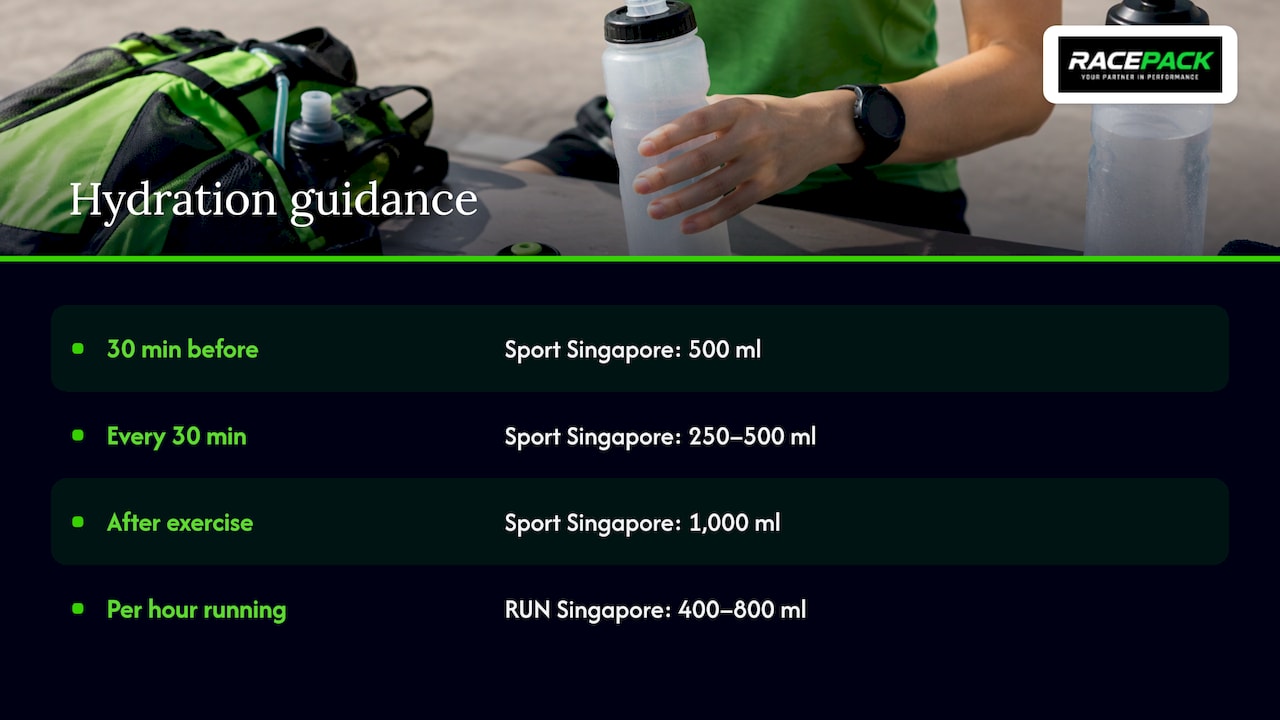
There is no single number, and that is the point. Public guidance gives a starting range. Sport Singapore’s safety page suggests about 500 ml of water 30 minutes before exercise, 250 to 500 ml every half hour during exercise, and 1,000 ml afterward. It recommends isotonic or sports drinks for activity lasting more than an hour. These are broad precautions for sport in general, so treat them as a starting point for a marathon, not a prescription.
For running specifically, RUN Singapore gives a range of 400 to 800 ml per hour depending on sweat rate, taken in small, frequent sips. Small sips matter: gulping at aid stations leaves fluid sloshing in your stomach.
Drinking too much is also a risk
More is not better. World Athletics’ Beat the Heat guide warns that overhydration can cause hyponatremia (dangerously low blood sodium), which can be fatal. A 2021 review of endurance rehydration advises that athletes should not gain weight during a long effort. It also suggests keeping intake below 700 ml per hour to reduce hyponatremia risk. The same guide says planned drinking helps most in events over 90 minutes, in heat, at high intensity, so for a marathon in Singapore a plan is justified. Just keep it in proportion to what you sweat.
Find your own number: a sweat-rate test
The 2021 rehydration review describes how to personalize intake with a sweat-rate test. Here is a simple version:
- Choose a representative session: a steady run of about an hour at marathon effort, in similar heat and humidity to race day.
- Weigh yourself before the run, after a toilet stop and wearing minimal clothing.
- Note exactly how much you drink during the run.
- Weigh yourself again right after, towel-dried, and note any urine passed.
- Your fluid loss is the weight difference plus what you drank, minus any urine. Each kilogram lost is roughly a litre of sweat.
- Plan to drink an amount below that sweat rate per hour, never enough to gain weight.
Repeat it on a hotter day and on a cooler one. World Athletics also notes that body mass before and after exercise helps estimate fluid losses, and that you should settle your personal drinking strategy in training, before competition.
A quick everyday check: Sport Singapore identifies clear or light-coloured urine as a sign of adequate hydration. It also advises avoiding strong coffee or alcohol around exercise because they can contribute to dehydration.
For a wider look at what to drink day to day, see our running hydration guide for Singapore.
Gels: when to take them and how
Gels solve a different problem from water. They deliver carbohydrate so your legs keep working in the second half of the race. The BJSM consensus suggests 30 to 60 g of carbohydrate per hour for exercise longer than an hour, rising to as much as 90 g per hour for events beyond 2.5 hours. World Athletics gives the same bands. Check the carbohydrate content on your gel’s label and do the sum for your target pace.
A workable approach for a hot marathon:
- Start early. Take your first gel within the first 30 to 45 minutes, before you feel you need it.
- Space them evenly. Regular small doses sit better in a stomach under heat stress than a few big ones late.
- Pair with fluid. Sip water with each gel, within your per-hour fluid budget from the sweat-rate test. Gels count towards your intake plan, not outside it.
- Train the gut. Practise the exact brand and timing on long runs. Heat reduces tolerance, so what works in cool weather may not work at 80% humidity.
Our full marathon fueling guide lays out a gel schedule across the 42.2 km, and the full marathon fueling plan section shows the race-day version. Browse the energy gels range when you are ready to pick the ones you will rehearse with.
Electrolytes: when sodium earns its place
Sweat carries sodium out of your body. Over a marathon that adds up, and plain water does not put it back. World Athletics recommends sodium supplementation in exercise lasting longer than an hour for heavy or salty sweaters. The BJSM consensus suggests a drink containing 0.5 to 0.7 g/L sodium alongside the carbohydrate, and notes that sweat rates vary widely between people.
How do you know if you are a salty sweater? White streaks or a gritty film on your cap and shirt after a run are a common sign. Combine that with your sweat-rate result: the more you lose per hour, the more sodium you lose.
Three formats cover most needs:
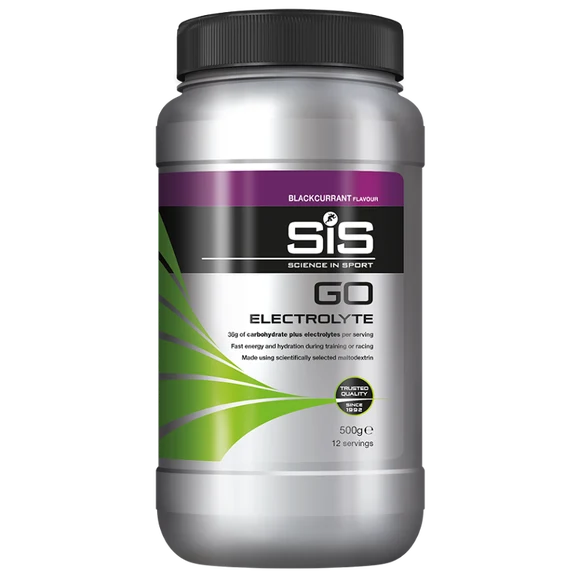
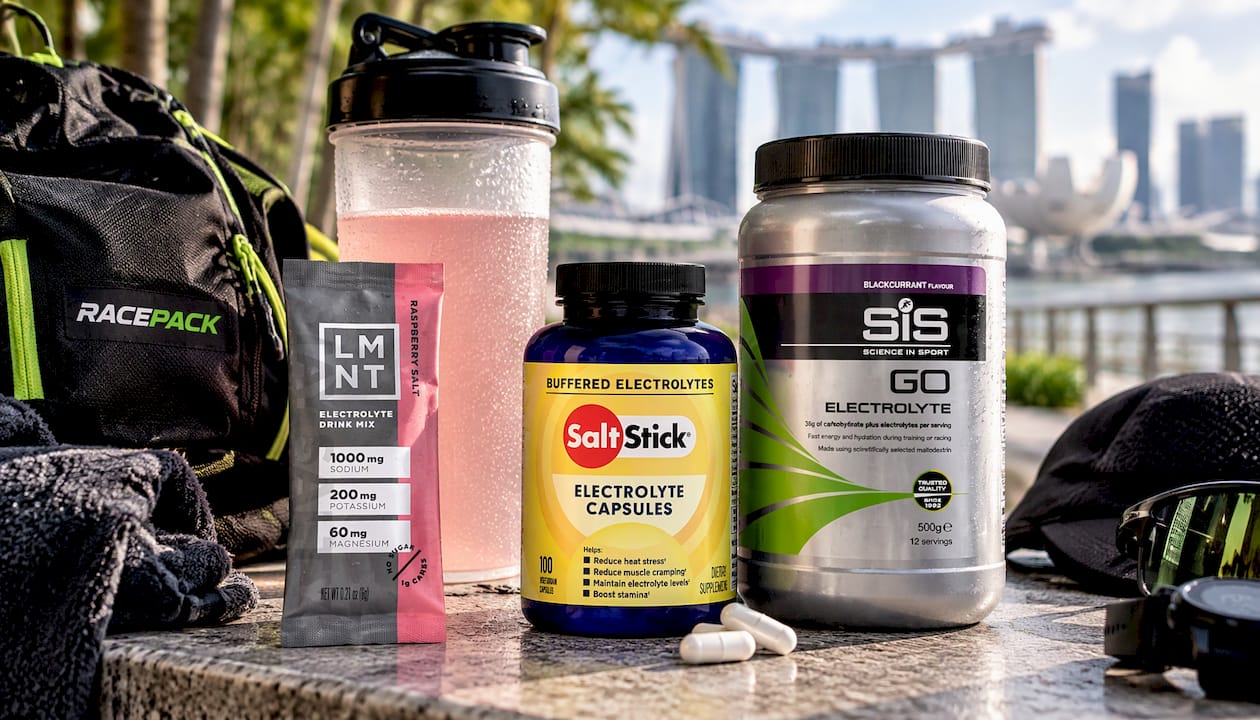
- Drink mixes in your bottle. SiS GO Electrolyte Powder is made for running and endurance, so it combines fluid and carbohydrate in one bottle. LMNT Zero-Sugar Electrolyte Drink Mix is a zero-sugar option for runners who get their carbohydrate from gels and want the electrolytes separate.
- Capsules. SaltStick Electrolyte Caps are made for training and race day. They are easy to carry in a pocket or belt and let you adjust sodium without changing what you drink.
- Race-provided drinks. Check what is on the course in advance, and train with the same drink if you plan to use it.
Our fluids and sodium in the heat section covers how to combine these on race day. All of our hydration products are in one place.
A sample hot-race framework
Use this as a template, then replace the numbers with your own test results.
| Stage | What to do |
|---|---|
| Night before and morning | Drink normally through the day, aim for light-coloured urine, add electrolytes to your pre-race drink if you are a salty sweater |
| About 30 minutes before the start | Roughly 500 ml of water, in line with Sport Singapore’s guidance |
| First 45 minutes | Small sips at each aid station, first gel |
| Every 30 to 45 minutes | A gel plus sips, working towards your carbohydrate target per hour |
| Hour 2 onward | Keep fluids within your sweat-rate budget, add sodium if you are a heavy sweater |
| After the finish | Rehydrate and refuel in the first hour |
For the last row, see our notes on recovery that starts in the first hour, and our recovery powders and protein powders.
Know the warning signs
A good plan lowers risk but does not remove it. HealthXchange lists weakness, exhaustion, headache, dizziness, profuse sweating and raised body temperature as signs of heat exhaustion. Confusion, aggression, collapse, and sweating that lessens or stops are emergency warning signs of heat stroke.
If you or someone near you shows these signs, stop. The Singapore Medical Journal guideline says to move the person to a cool, shaded place and cool them immediately. If they do not improve quickly, they need to go to an emergency department. On race day, flag down a marshal or medical point straight away. Severe or worsening symptoms mean emergency care, not carrying on.
The opposite problem has its own signs. World Athletics warns that hyponatremia from overhydration can be more serious than dehydration. That is why your plan should have a ceiling as well as a floor. If you have a heart, kidney or other medical condition, or take medication, speak to your doctor before finalizing a sodium or fluid strategy.
Our perspective
Most race-day problems we hear about come from runners who changed something on the day: a new gel, a stronger drink, an extra bottle at every aid station. Singapore’s heat punishes surprises.
Our view is simple. Treat hydration as three separate jobs: fluid for volume, carbohydrate for energy, sodium for balance. Give each its own product and its own line in your plan, so you can adjust one without upsetting the others. Gels, electrolyte powders and capsules let you do exactly that.
That is how we choose and organize our range. As an official retailer for major brands, we focus on authentic products that athletes can rehearse with in training and rely on on race day, with next-day delivery within Singapore, so you can restock the week before your long runs.
Jason John
Get your race-day kit sorted
Racepack.sg is a Singapore store for sports nutrition from international brands, with guaranteed product authenticity and next-day delivery within Singapore. For this plan, start with an electrolyte you can mix or carry, then add the gels you will rehearse with.
Browse energy gels, hydration and more on our homepage, or go straight to the electrolytes above. If you also train with a watch, our Garmin collection is there for pacing your long runs. Cyclists training in the same heat can read our cycling hydration strategy.
FAQ
How much water should I drink during a marathon in Singapore?
A common range is 400 to 800 ml per hour, in small sips, according to RUN Singapore. Your exact number depends on your sweat rate. Keep it below what you lose, and do not gain weight over a long run.
How do I measure my sweat rate?
Weigh yourself before and after a one-hour run at race effort, and note what you drank. The weight lost plus the fluid consumed gives your hourly sweat loss. The 2021 rehydration review describes this method.
When should I take my first energy gel?
Take it early, within the first 30 to 45 minutes, then space the rest evenly. Aim for 30 to 60 g of carbohydrate per hour, up to 90 g for events beyond 2.5 hours, as set out by the BJSM consensus. Practise the timing in training.
Should I drink water with every gel?
Sip water or your drink alongside each gel, and follow the instructions on the pack. Count that fluid in your hourly intake so you stay within your sweat-rate budget.
Do I need electrolytes for a marathon in Singapore?
For efforts over an hour, World Athletics recommends sodium for heavy or salty sweaters. Given a marathon takes most runners well beyond that, many choose a powder such as SiS GO Electrolyte Powder or capsules such as SaltStick Caps.
What is the difference between an electrolyte drink mix and electrolyte capsules?
A drink mix puts sodium and other minerals in your bottle, while capsules let you take sodium separately from your fluid. Capsules are easy to carry and adjust. Many runners rehearse one format in training and stick to it.
How long does it take to acclimatise to Singapore’s heat?
The BJSM consensus points to 1 to 2 weeks of repeated exercise in the heat. The Singapore Medical Journal guideline suggests 10 to 14 days. Train outdoors at race-like times to get the full benefit.
Can I drink too much water in a marathon?
Yes. Overhydration can cause hyponatremia, which World Athletics says can be fatal. Keep your intake below your sweat rate, and seek medical help if you feel confused, nauseous with swelling, or very unwell.
Where can I buy electrolytes and gels in Singapore with fast delivery?
We stock electrolytes, gels and other race nutrition from international brands, with guaranteed authenticity and next-day delivery within Singapore. Start at the Racepack.sg homepage.
Ready to build your race-day plan? Buy Now and get your electrolytes and gels delivered next day within Singapore.
Sources
- Assessment of dehydration using body mass changes of elite runners in a tropical marathon
- Casualties During Marathon Events and Implications for Heat Risk
- Heat training consensus statement, British Journal of Sports Medicine
- Singapore Sports Medicine Association: hydration and supplements in sport
- Sport Singapore: sports safety and health check
- Singapore Medical Journal practice guidelines on heat injury
- Rehydration during Endurance Exercise: Challenges and Solutions
- World Athletics: Beat the Heat
- RUN Singapore: Fuel Smart, Run Strong
- HealthXchange: Overheating During Exercise


