

For a 4:30 a.m. start, the best plan is to move most of your fueling to the day before: a carbohydrate-rich dinner early in the evening, a small, practised breakfast around 2:00 a.m., steady fluids with sodium, and one gel just before the gun. You cannot eat a full breakfast three or four hours ahead without waking at midnight, so the evening meal does the heavy lifting. We at Racepack stock the energy gels, hydration products and bars that fill the gaps in this plan, so you can have everything tested and in your bag well before race week.
TL;DR
- Eat a normal, carb-focused dinner by about 7:00 p.m., then sleep early. A bigger dinner lets you keep race-morning food small.
- Wake around 2:00 a.m. and eat a light, low-fat, low-fibre meal, such as toast with jam and a banana, about 2 to 2.5 hours before the start.
- Sip fluids from waking, and add sodium: Singapore’s pre-dawn air is hot and humid.
- Take one gel with water 10 to 15 minutes before the start, only if you have used it in training.
- Practise the whole routine in at least one long run before race day.
Table of Contents
- Why a 4:30 a.m. start changes the rules
- The day before: carb-load without overdoing it
- The night before: dinner timing matters
- Race morning: the 2 a.m. breakfast
- Hydration in Singapore’s pre-dawn heat
- The final top-up: gel and caffeine
- Train your gut before race day
- Race morning checklist
- Get your race-morning kit sorted
- Our perspective
- FAQ
- Sources
Why a 4:30 a.m. start changes the rules
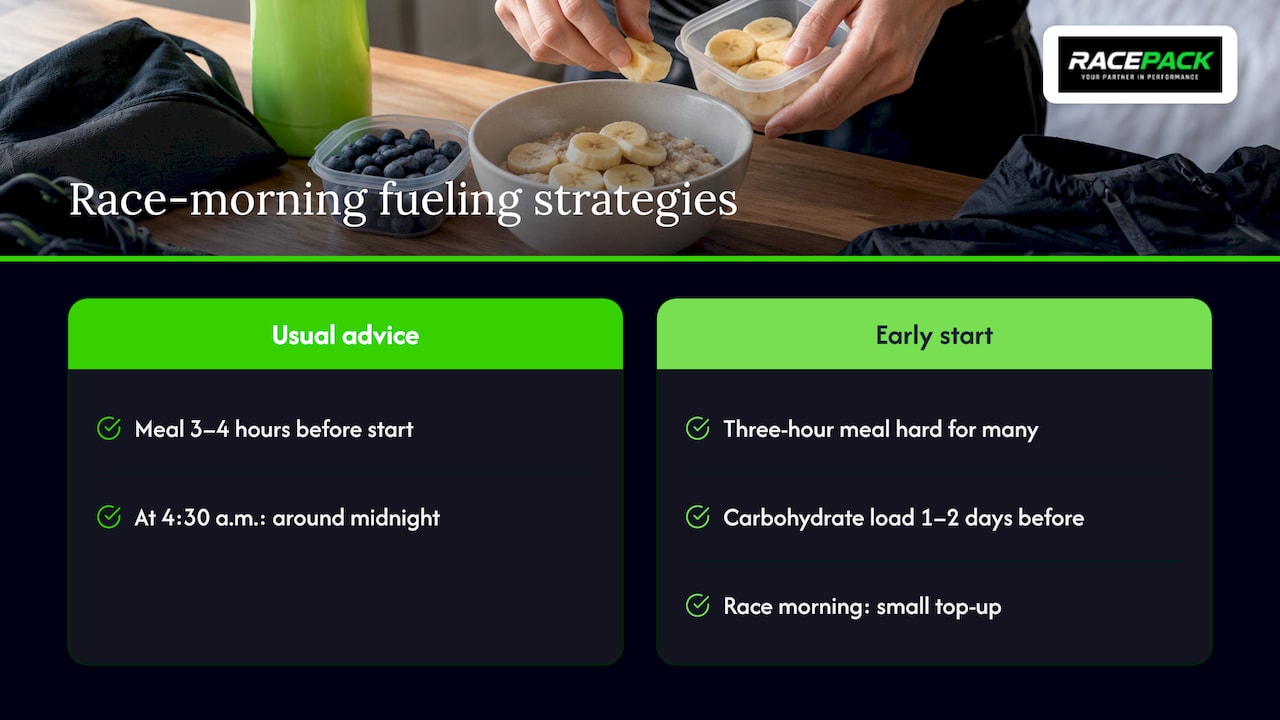
Most advice assumes you eat three to four hours before the start. The Gatorade Sports Science Institute toolkit explains why breakfast matters: liver glycogen, the carbohydrate your body stores in the liver, drops by about 50% overnight, and the pre-race meal tops it back up. The goal is to reach the start line with full stores but a light stomach.
With a 4:30 a.m. flag-off, that 3 to 4 hour window falls around midnight. A Victorian Institute of Sport dietitian notes that many marathons start before 7 a.m., which makes a three-hour-prior meal hard for recreational runners. Her answer is to load carbohydrate in the one or two days before the event, rather than leaving it to race morning.
That is the logic of this whole article: the day before is the big meal, race morning is a small top-up.
The day before: carb-load without overdoing it
The GSSI toolkit suggests starting carbohydrate loading 36 to 48 hours out, at 8 to 10 g of carbohydrate per kg of body weight per day. It favors simple, higher-glycemic carbohydrates and less high-fat, high-fibre food. For a 70 kg runner, that is 560 to 700 g of carbohydrate a day.
If you want the full two-day schedule built for humid races, read our coach’s 36 to 48 hour plan for Singapore and our guide to the benefits of carb loading.
Good choices for the final day in Singapore:
- White rice, noodles or plain pasta
- White bread, toast, bagels
- Bananas and other low-fibre fruit
- Potatoes or sweet potatoes
- A small portion of lean protein, such as chicken or fish
The night before: dinner timing matters
The Singapore Marathon fueling guide from Mavr recommends a normal carb-rich dinner by about 7:00 p.m., then an early bed. A bigger dinner means you can keep breakfast small.
Cleveland Clinic suggests a simple dinner such as white pasta with marinara, or rice with a little lean protein. It advises avoiding high-fibre, high-fat and spicy foods and dairy that may cause cramping. The GSSI toolkit adds that overeating carbohydrate at this dinner raises the risk of stomach distress during the run, so aim for a full but comfortable plate, not a pile.
If dinner ends up early and you feel empty by bedtime, Runner’s World suggests topping off with something easy to digest, such as low-fat pudding or applesauce.
A sample dinner
- 1.5 to 2 cups of cooked white rice
- Steamed chicken or fish, a modest portion
- A little soy-based sauce for sodium
- Skip chili-heavy gravies and rich curries that night
Race morning: the 2 a.m. breakfast
The Mavr guide says to wake around 2:00 a.m. and eat a small, practised meal 2 to 2.5 hours before the start, about 1 to 2 g of carbohydrate per kg. RUN Singapore agrees that the breakfast should be light, easily digested and carb-focused, listing white bread with jam, bananas, smoothies, porridge, pancakes and breakfast cereal. Keep fat limited and fibre low.
A Singapore Marathon course review likewise points to toast with jam at 2:00 to 2:30 a.m. to give the stomach time to settle.
What 1 to 2 g per kg looks like
| Runner weight | Carbs at 1 g/kg | Carbs at 2 g/kg | Example |
|---|---|---|---|
| 55 kg | 55 g | 110 g | 2 slices white toast with jam plus a banana |
| 70 kg | 70 g | 140 g | 3 slices toast with jam plus a banana |
| 85 kg | 85 g | 170 g | Large bowl of porridge with honey plus a banana |
These are simple estimates from the per-kg range above. Start at the lower end if you are nervous in the morning.
If you cannot face solid food at 2 a.m.
The UW Medicine sports physician says that after a small meal 2 to 3 hours may be enough, and that if you want to stay in bed as long as possible, you should pick something lighter such as a banana or an energy bar. UPMC adds that smoothies, shakes or 100% fruit juice work when eating early is hard. Our Protein Bars & Snacks range and energy gels are easy to pack for this.
If you want to keep your pre-race eating relaxed and unhurried when the alarm goes off at 2 a.m., a guide to eating well when you’re busy can help you pace a small meal calmly.
Hydration in Singapore’s pre-dawn heat
The heat does not wait for sunrise. Run SEA reports that at the 4:30 a.m. start in 2025, Changi recorded 26 °C with 84% humidity, and readings stayed there until 8:30 a.m. Sweat evaporates slowly in air like that.
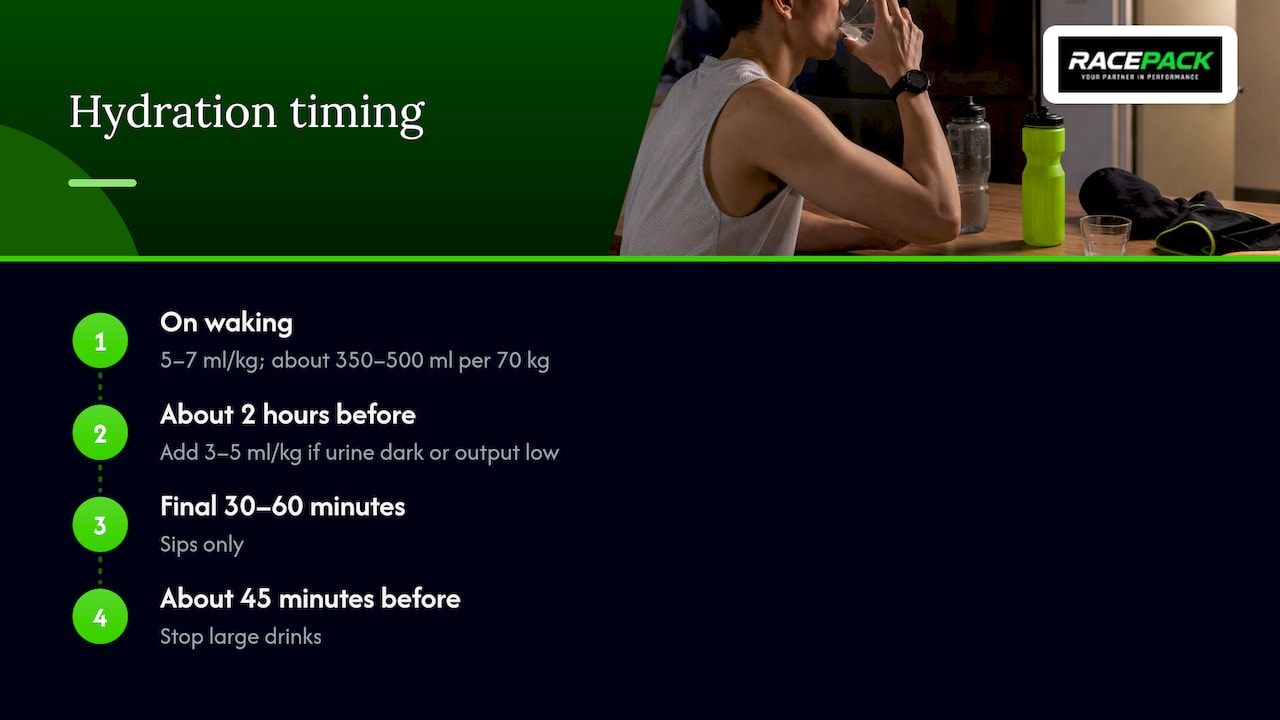
The Mavr guide recommends about 5 to 7 ml per kg of fluid on waking, roughly 350 to 500 ml for a 70 kg runner. If your urine is dark or you pass little, add 3 to 5 ml per kg about two hours before. The GSSI toolkit gives the same ranges. RUN Singapore suggests sips only in the last 30 to 60 minutes, so you start hydrated but not bloated.
Sodium matters in this humidity. Mavr notes that salty sweaters should carry a tested salt product or electrolyte drink. Browse our hydration range and choose an electrolyte drink you have already used on long runs.
Stop large drinks about 45 minutes before the start, as the Mavr pre-race guide advises, so you have time for a last toilet stop.
The final top-up: gel and caffeine
The Mavr pre-race guide gives a simple race-morning timeline:
| Time before start | What to take |
|---|---|
| 2 to 2.5 hours | Small, practised breakfast with 5 to 7 ml/kg fluid |
| 45 to 60 minutes | Optional coffee, about 3 mg/kg caffeine (about 210 mg for 70 kg) |
| 10 to 15 minutes | One gel with water, or 200 to 300 ml sports drink (20 to 30 g carbs) |
That gel counts as your first dose of race fueling. Only use caffeine if you have trained with it. Two cups of filter coffee is roughly the 210 mg figure in that guide. If caffeine is new to you, skip it.
Compare options in our energy gels category. For a ready set to trial across your long runs, the GU Half Marathon Endurance Fuel Bundle and the SiS Half Marathon Endurance Fuel Bundle are both listed on our site.
Train your gut before race day
The Victorian Institute of Sport dietitian stresses that gut problems tend to appear when runners have not practised the carbohydrate they plan to use on race day. Simulate the full routine on a long run: same dinner, same 2 a.m. wake-up, same breakfast, same gel. Two or three rehearsals make race morning feel familiar.
Two of our guides walk you through it: how to train your gut for energy gels and gut training tips for marathon runners.
Race morning checklist
- Dinner finished by about 7:00 p.m., in bed soon after.
- Wake around 2:00 a.m., sip 350 to 500 ml of fluid (70 kg runner).
- Eat a small, practised, low-fat, low-fibre breakfast.
- Optional coffee 45 to 60 minutes before the start.
- Last toilet stop, then stop large drinks.
- One gel with water 10 to 15 minutes before the gun.
- Carry gels and electrolytes for the course.
For the course itself, see our BYD Singapore Marathon fueling guide and the full marathon fueling guide for Singapore runners. Mavr reports that in the last edition water was available about every 2 to 3 km, with 100PLUS at eight stations, so plan your own carbohydrate and sodium on top of that.
Get your race-morning kit sorted
We carry energy gels, hydration, protein bars and snacks, and recovery powders from brands including Maurten, SIS and GU, with next-day delivery within Singapore and guaranteed authenticity. Order your gels and electrolytes early so you can rehearse with them on your long runs.
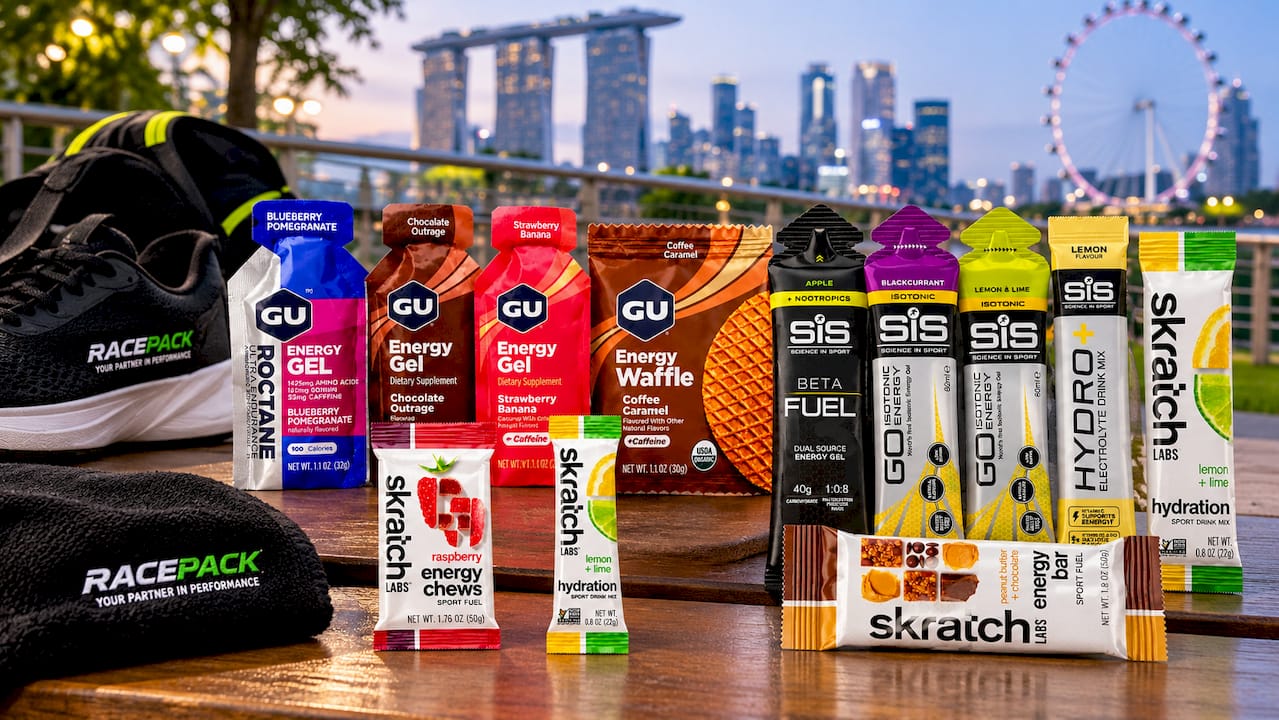
Start with the Racepack store, then add Recovery Powders for after the finish line.
Our perspective
Early starts reward the runners who decide everything in advance. At 4:30 a.m. nobody wants to improvise at 2:00 in the morning, so we tell runners to build the plan around the evening before and keep race morning boring: the same breakfast, the same drink, the same gel you used in training.
We built Racepack to make that easy. Official retailer status for major brands, guaranteed authenticity and next-day delivery within Singapore mean you can buy your gels and hydration products weeks ahead, rehearse them, and arrive at the start line with nothing new in your bag.
Jason John
FAQ
What should I eat the night before a 4:30 a.m. marathon?
Have a normal carb-rich dinner by about 7:00 p.m., such as white rice or pasta with a little lean protein. Keep fibre, fat and spice low. A bigger dinner lets you keep breakfast small.
What time should I wake up to eat before a 4:30 a.m. start?
Around 2:00 a.m. is the timing suggested for a small meal 2 to 2.5 hours before the start. Choose something you have already eaten before long runs.
Can I skip breakfast and just have a gel?
Overnight your liver glycogen falls by about 50%, so a small carb-based breakfast helps top it up. If you are very nervous, go lighter, such as a banana or an energy bar, then take a gel 10 to 15 minutes before the start.
How much should I drink before the race?
About 5 to 7 ml per kg on waking, roughly 350 to 500 ml for a 70 kg runner. If your urine is dark, add 3 to 5 ml per kg around two hours before. Stop large drinks about 45 minutes before the start.
Do I need electrolytes before a Singapore marathon?
The pre-dawn air is hot and humid, so sodium matters, especially if you sweat heavily. Use an electrolyte drink or salt product you have already tested in training.
Is coffee a good idea before an early marathon?
Some runners take about 3 mg of caffeine per kg 45 to 60 minutes before the start, roughly 210 mg for a 70 kg runner. Use it only if you have trained with it.
Sources
- Singapore Marathon 2026 Fueling Guide: Heat, Water, Gels
- What to Eat Before a Marathon: 3 Days Out to Race Morning
- GSSI Marathon Race Day Toolkit
- Fuelling for Endurance Events, Victorian Institute of Sport
- What To Eat Before a Marathon, Cleveland Clinic
- Carbo-loading Rules to Run By, Runner’s World
- Fuel Smart, Run Strong, RUN Singapore
- Singapore Marathon 2025 Course Review
- 4 Tips for the Perfect Pre-Race Meal, UW Medicine
- Marathon Nutrition Tips, UPMC HealthBeat
- Singapore Marathon Review: Course, Heat, Cut-offs
Ready to fuel your race? Buy Now at Racepack.sg


