

Yes, for most marathon runners a gel shortly before the start is a smart move, as long as you have practiced it in training. The sweet spot is about 10 to 15 minutes before the gun, taken with a few sips of water or sports drink. It tops up the carbohydrate you burned overnight and starts your fuel supply before your first kilometer. In Singapore’s early-morning starts, that matters even more. We stock gels from brands such as GU, High5 and Applied Nutrition, so you can find the one that suits your stomach and rehearse with it well before race day.
TL;DR
- Take one gel (about 20 to 25 g of carbohydrate) 10 to 15 minutes before the start, with 300 to 400 ml of water or sports drink.
- Eat your main pre-race meal at least 2 to 3 hours before the start. Avoid carbohydrate snacks 30 to 60 minutes out.
- Count the pre-start gel as part of your fueling plan, then aim for 60 g of carbohydrate per hour once you are running.
- Never try a new gel on race day. Rehearse it on long runs for several weeks.
- Plan your fluids by sweat rate, not by habit, because Singapore’s humidity makes a full stomach feel worse.
Table of Contents
- Why a gel before the start makes sense
- The timing window: why 10 to 15 minutes
- What the pre-start gel does for your pace
- Treat the pre-start gel as part of the race
- How the start gel fits the full race plan
- Water with your gel in Singapore’s climate
- Rehearse it before race day
- Race-day carry list
- Our view
- Stock up for race day
- FAQ
- Sources
Why a gel before the start makes sense
After a night without food, your liver glycogen (the carbohydrate store that keeps your blood sugar steady) is low. The World Athletics nutrition position paper by Burke, Jeukendrup, Jones and Mooses says a small carbohydrate-rich snack such as a sports gel or drink during the warm-up is particularly useful for morning events. It restores liver glycogen after the overnight fast and gives you a continuing carbohydrate supply from the gut.
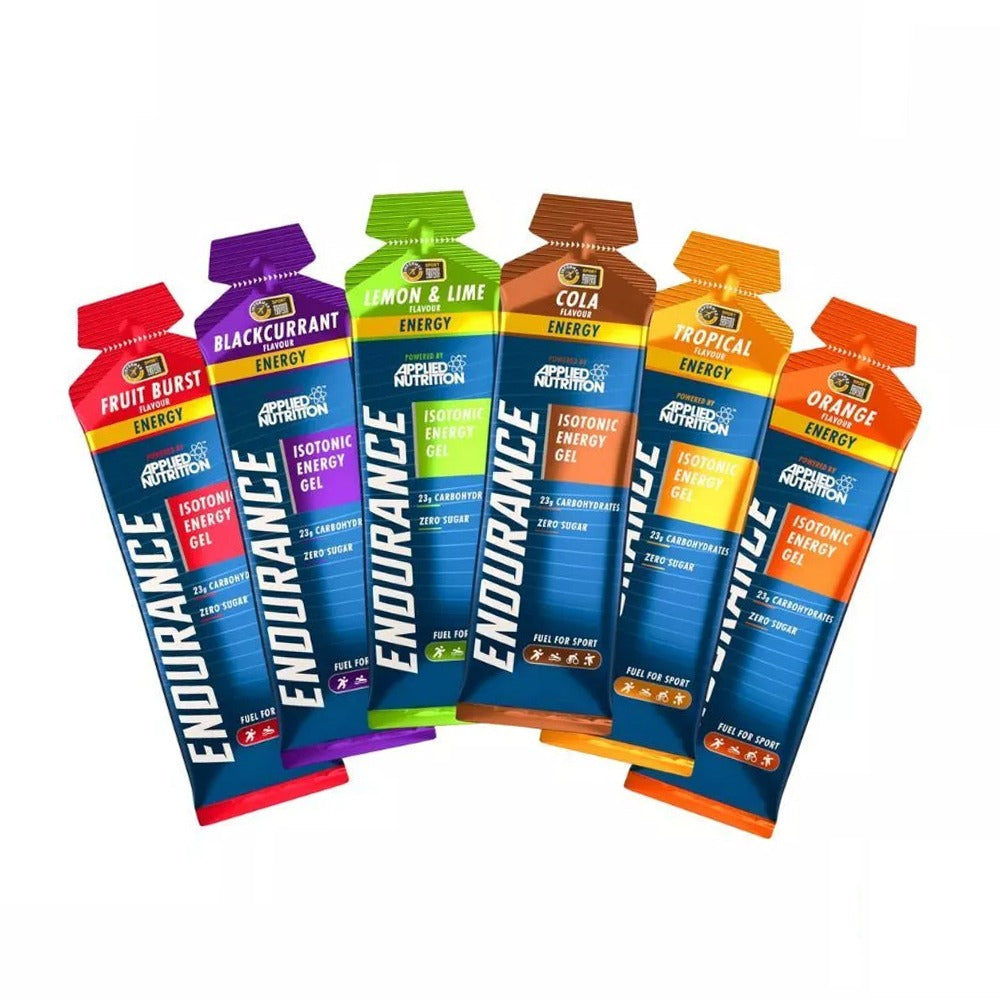
That describes most Singapore marathons, which start in the dark hours of the morning. RUN Singapore’s race guide recommends a gel with 300 to 400 ml of sports drink or water about 15 minutes before the start. It also suggests sipping only water in the 30 to 60 minutes before that, so you start hydrated rather than bloated.
The Australian Sports Commission describes gels as a low-fibre, compact carbohydrate source. That suits athletes who cannot face regular food and fluids close to the start, which is common when nerves hit at 3 am.
The timing window: why 10 to 15 minutes
The timing matters because of reactive hypoglycemia, a dip in blood sugar that can follow a carbohydrate hit taken too early. A 2025 review in Performance Nutrition found it in about 8% of endurance events, with peak risk when pre-exercise food was eaten around 60 minutes before the start. The authors recommend a pre-race meal at least 2 to 3 hours out. If you want fast-acting carbohydrate close to the race, they suggest a gel just before the start, with further feeding once you are moving.
The same review notes that symptoms, not glucose numbers alone, should guide whether you change your timing. If you feel fine, you are fine.
A practical timeline for a 5:00 am start:
| Time before start | What to do |
|---|---|
| 3 to 4 hours | Main breakfast, familiar and low in fiber |
| 60 to 30 minutes | Water only, small sips |
| 15 to 10 minutes | One gel with 300 to 400 ml water or sports drink |
| Gun | Settle into pace, plan the first in-race gel |
Runner’s World, citing Mayo Clinic guidance, lists 2 to 4 g of carbohydrate per kg of body weight two to four hours before the race, then a couple of dates or a gel 15 minutes before the start. For a 65 kg runner, that is roughly 130 to 260 g of carbohydrate at breakfast. If you need help with the days before, our guide to carb loading without the stomach trouble walks through it.
What the pre-start gel does for your pace
A 2013 study in the Journal of the International Society of Sports Nutrition followed 28 non-elite marathon runners. They ran about 5% faster on a planned strategy than on a freely chosen one. The plan was two 20 g glucose gels with 200 ml water 10 to 15 minutes before the start, then a gel every 20 minutes with 750 ml of water per hour, around 60 g of glucose per hour.
You do not need to copy that exact protocol. The lesson is that a planned start-to-finish fueling schedule beats improvising. One gel is a reasonable starting point for most runners, and you can test whether a second suits you.
Treat the pre-start gel as part of the race
Sports scientist Asker Jeukendrup points out that anything you take shortly before the start is effectively in-race nutrition. Food sits in the stomach for several minutes and even fast carbohydrates take time to absorb. So the gel you take at 4:45 am is already feeding your first kilometers, and it needs to have been rehearsed.
How the start gel fits the full race plan
Once you are running, most guidance points to 30 to 60 g of carbohydrate per hour for typical marathon times, rising to 60 to 90 g per hour for slower events running beyond 2.5 hours. The Australian Sports Commission notes that glucose-based carbohydrate above about 60 g per hour can cause gut discomfort unless you have trained for it.
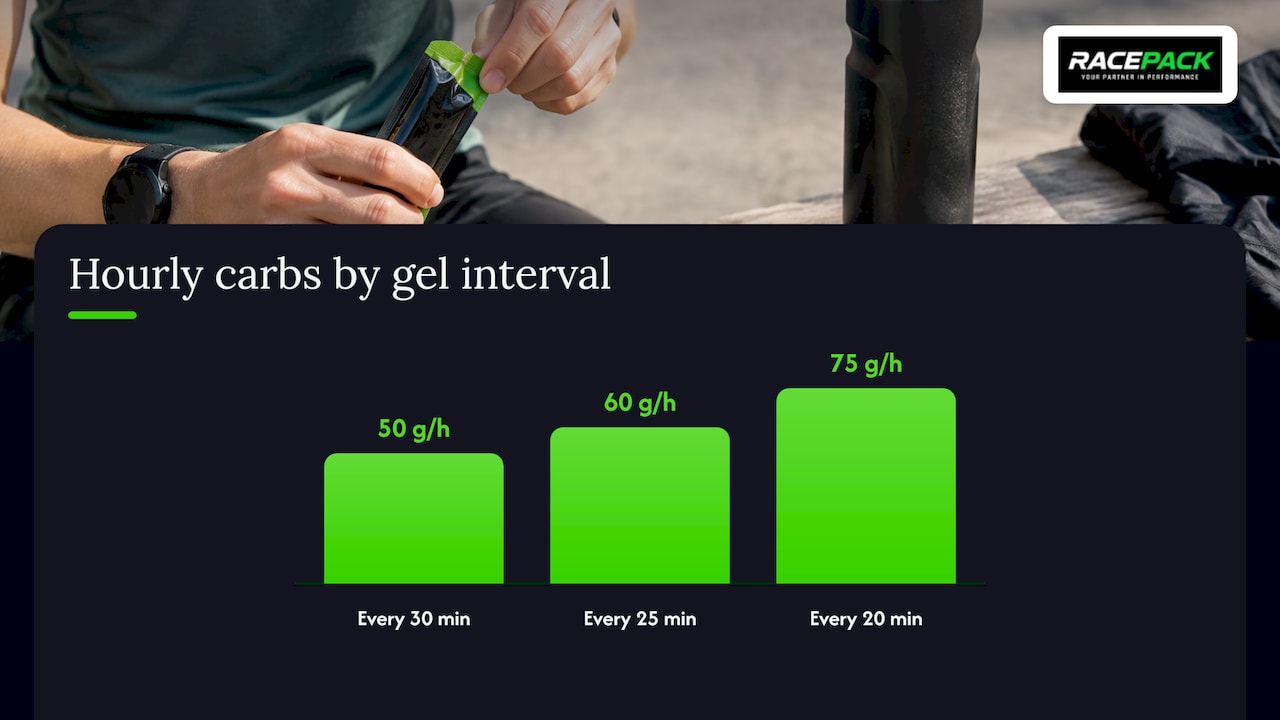
With a typical 25 g gel, the maths from a Singapore fueling guide is simple: one every 30 minutes gives 50 g per hour, every 25 minutes gives 60 g, every 20 minutes gives 75 g. A 2025 Seville Marathon survey reported by a running coach found 160 runners averaging only 35 g per hour, well below the 60 to 90 g target. Many runners under-fuel, so the pre-start gel is a good habit that sets up the rest.
For a full timing plan, see our guide to when to take energy gels during a marathon, and for quantities, how many gels you need for a full marathon.
Water with your gel in Singapore’s climate
A gel is concentrated, so it works best with fluid. The pre-start 300 to 400 ml is a good guide, and during the race a few sips of water with each gel helps absorption. Singapore’s December averages run from a 24.3 °C low to a 30.5 °C high, with humidity usually above 90% before sunrise. The early start is near the coolest part of the day, but the air is still thick.
Sweat rates of 1.0 to 1.5 litres per hour are common in hot environments, and the main electrolyte lost is sodium. The same review suggests a drink with 0.5 to 0.7 g/L of sodium for exercise over an hour, and warns recreational marathoners against overhydration, with risk factors including race times above 4 hours. So do not drink more than you sweat.
To find your number, weigh yourself before and after a humid long run, add what you drank, and divide by hours. One kilogram lost is about one litre of sweat. Aim to keep total body mass loss under 2%, and finish no heavier than you started. Our Singapore-specific fueling notes cover heat and humidity in more detail. Our hydration range includes electrolyte drinks to help replace sodium.
Rehearse it before race day
The rule that matters most: nothing new on race day. Her World Singapore advises practicing your race-day breakfast, gels, sports drinks and hydration strategy in training, starting several weeks before competition and building carbohydrate intake gradually.
Gut training works like this, based on the GSSI marathon toolkit: raise your intake from 15 to 20 g per hour toward 60 to 90 g per hour over successive long runs, using a mix of glucose and fructose.
A simple rehearsal routine:
- Pick your race-morning breakfast and eat it 3 hours before every key long run.
- Take one gel 10 to 15 minutes before the start of the run with 300 to 400 ml of water.
- Run at goal pace and take gels at even intervals, such as every 25 to 30 minutes.
- Note how you feel at kilometers 5, 15 and 30: energy, stomach, any dizziness.
- Adjust the brand, flavor or interval, then repeat on the next long run.
Try a few textures and flavors. Our GU Half Marathon Endurance Fuel Bundle comes in assorted flavors, which makes it a handy way to find what you like in training. The Applied Nutrition Isotonic Energy Gel and High5 Energy Gel are other options to rehearse with. Our heat practice and rehearsal notes add more to the routine.
Race-day carry list
- Pre-start gel plus a spare, in a pocket you can reach.
- In-race gels counted out for your pace, with a few extra.
- Water or electrolyte drink for the first 5 km, since aid stations are placed at intervals.
- A bib belt or pocketed shorts that fit everything without bouncing.
If you are ordering a running shirt for the event too, this planning guide to running event shirts helps you sort out the apparel side.
Our view
We built Racepack for athletes who want to arrive at the start line with nothing left to chance. A pre-start gel is a small habit, but it is the first step of a fueling plan that you have rehearsed.
Our advice is simple. Choose your gels early, test them on long runs, and settle on the brand and flavor that sit well with you. We carry gels from international brands, and we offer next-day delivery within Singapore, so you can restock between training blocks without losing a long-run weekend.
Your plan should be personal: your breakfast, your sweat rate, your pace. The research gives the framework, and your training fills in the details.
Jason John
Stock up for race day
We offer energy gels, hydration drinks and more from international brands, all in one place. Browse the energy gel and hydration range and put together a rehearsal kit and a race-day kit. Training with a Garmin? Our Garmin smart watches can help you keep pace and time your gels.
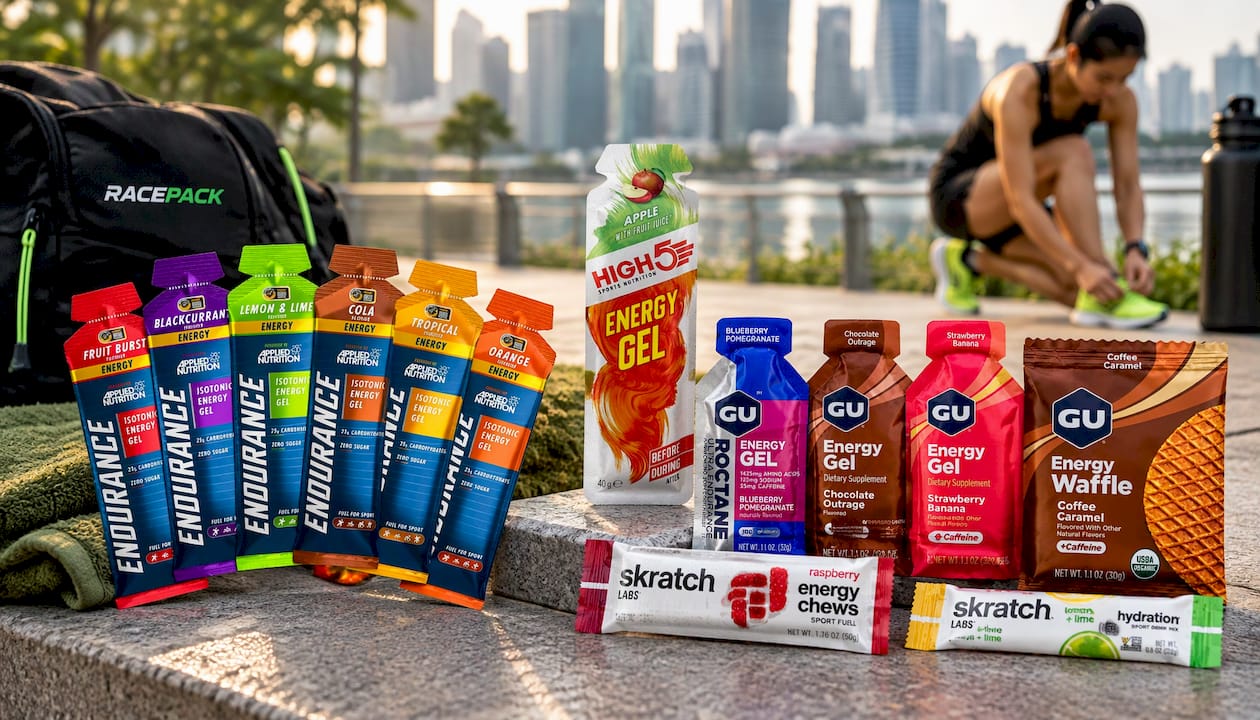
After the finish, our recovery powders and protein powders are there for the first hour, which our guide on recovery after the finish explains.
FAQ
Should I take an energy gel before a marathon?
Yes, most runners benefit from one about 10 to 15 minutes before the start, especially for a morning race after an overnight fast. Take it with 300 to 400 ml of water or sports drink, and practice it in training first.
How long before a marathon should I take a gel?
Aim for 10 to 15 minutes before the start. Research reported in a Racecast analysis points to the 30 to 90 minute pre-exercise window as the risk zone for blood sugar dips, which makes the last 10 to 15 minutes the practical choice.
Can I take a gel instead of breakfast?
A gel is a top-up, not a replacement for your main meal. Eat a familiar, low-fiber breakfast 2 to 3 hours before the start, then use the gel just before the gun. If nerves make eating hard, a gel is a compact option.
How many gels should I take in total during a marathon?
Most gels hold about 25 g of carbohydrate. Two to three gels per hour covers most runners, and you can build toward higher intakes in training if your race runs long.
Do I need water with my gel?
Yes. Take about 150 to 200 ml of water with each gel during the race, and 300 to 400 ml before the start, adjusting to your sweat rate and avoiding overdrinking.
Sources
- Fuel Smart, Run Strong, RUN Singapore
- Contemporary Nutrition Strategies to Optimize Performance in Distance Runners and Race Walkers, World Athletics
- How and when do I use it? Australian Sports Commission
- Application potential of continuous glucose monitoring, Performance Nutrition 2025
- How to Fuel a Race, Runner’s World
- Freely chosen vs. scientifically based strategy, JISSN 2013
- How to fuel for a marathon, Asker Jeukendrup
- Singapore Marathon 2026 Fueling Guide
- How Many Carbs Per Hour for a Marathon?
- Hydration review, British Journal of Sports Medicine
- Race day nutrition guide, Her World Singapore
- GSSI Marathon Race Day Toolkit
- What Runners Got Wrong About Race Day Nutrition Timing
- Race Day Strategy for Your Marathon
Buy Now: shop energy gels at Racepack


