

Why Sleep Matters for Marathon Training: Race Faster
Sleep is the single highest-leverage recovery tool in marathon training, and most runners underestimate it. A retrospective study of 943 London Marathon participants found that a notable portion reported sleep difficulties significant enough for clinical follow-up, and those same runners showed slower finish times. A single night of severely restricted sleep can reduce time-to-exhaustion at submaximal intensities, meaning one bad week of sleep can undo a month of solid training. The practical rule: aim for 7–9 hours nightly, push to 9–10 hours during peak volume weeks, and add targeted naps when your schedule demands it.
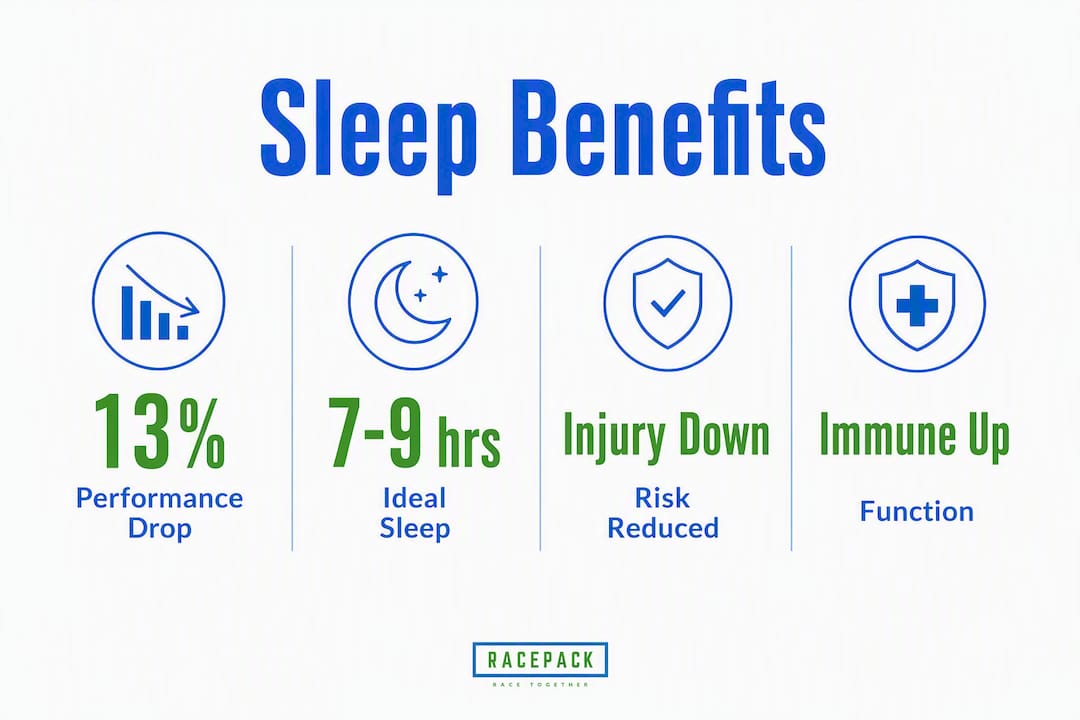
Sleep directly affects four outcomes every marathoner cares about:
- Recovery: Growth hormone releases primarily during slow-wave sleep, driving muscle repair, protein synthesis, and glycogen replenishment.
- Performance: Time-to-exhaustion, reaction time, and running economy all decline measurably after sleep loss.
- Injury risk: Sleep deprivation degrades running form and impairs tissue repair, accelerating overuse injuries.
- Illness risk: Chronic sleep restriction suppresses immune function, raising infection risk during high-volume blocks.
Table of Contents
- How much sleep do marathon runners actually need?
- What your body actually does during sleep to support training
- How sleep loss changes your running performance
- How poor sleep raises your injury risk and weakens immunity
- Practical sleep strategies for training and race week
- Can your wearable actually measure sleep quality?
- How to build sleep into your training schedule
- When to see a doctor about your sleep
- Key Takeaways
- Sleep is the training variable most runners skip
- Fuel your recovery with the right products
- Useful sources
- FAQ
How much sleep do marathon runners actually need?
Experts recommend 7–9 hours of quality sleep per night for runners, with high-volume athletes needing 9–10 hours during intense training blocks to offset elevated cortisol and systemic inflammation. Think of 7 hours as the floor, not the target.
Habitual sleep under 6 hours is a risk threshold. Below it, recovery stalls, injury probability climbs, and perceived effort during workouts rises noticeably. The goal is consistent nightly duration, not occasional long sleeps on weekends.
Practical rules for hitting your targets:
- Move your bedtime 30 minutes earlier during peak weeks rather than trying to sleep in later.
- Schedule a 20-minute nap after long runs or hard afternoon sessions when night sleep will be short.
- On recovery days, allow yourself an extra 30–60 minutes in bed without an alarm.
- During taper week, add 15–60 minutes nightly in the three days before race day to buffer against travel disruption and pre-race anxiety.
Pro Tip: Set a consistent bedtime alarm, not just a wake-up alarm. Going to bed at the same time within a 30-minute window every night stabilizes your circadian rhythm faster than any supplement.
What your body actually does during sleep to support training
Most of the physical adaptation from a hard training session happens not during the run itself, but in the hours of sleep that follow. Slow-wave sleep (deep sleep, stages 3 and 4) triggers the largest pulses of growth hormone, which drives muscle protein synthesis and repairs the micro-damage from long runs and speed work. This is also when your body replenishes muscle glycogen stores most efficiently, setting you up for the next session.
Beyond muscle repair, sleep regulates inflammatory markers. Without adequate slow-wave sleep, the inflammatory response from hard training doesn’t resolve cleanly, and cumulative fatigue compounds across the week. The connection between sleep and post-workout protein synthesis is direct: the anabolic window you hear about in nutrition isn’t just about eating protein after a run; it requires sleep to complete the process.
REM sleep handles a different but equally important function. Motor learning, pacing judgment, and mental resilience all consolidate during REM. Runners who cut REM short by waking too early often report that workouts feel mentally harder, even when their legs feel fine. That’s not imagination; it’s a measurable cognitive effect.
Key mechanism: Growth hormone, which drives muscle repair and adaptation, is released almost entirely during slow-wave sleep. Cutting sleep short doesn’t just make you tired; it literally reduces the anabolic signal your body sends after every hard session.
How sleep loss changes your running performance
One treadmill study found that a single night of no sleep reduced time-to-exhaustion by 13.2% and altered both cadence and foot contact time. That’s a significant biomechanical shift from one bad night, not a week of poor sleep. Cadence disruption alone raises injury risk because it changes load distribution across the foot, knee, and hip.
The effects on perceived exertion are just as important. Meta-analytic evidence consistently links sleep restriction to higher RPE at the same absolute pace, meaning a 7:30/mile effort feels harder after poor sleep even though your cardiovascular output is unchanged. Runners often interpret this as fitness loss and push harder, which compounds fatigue rather than resolving it.
Key performance effects of sleep restriction:
- Reduced time-to-exhaustion at threshold and submaximal intensities.
- Higher perceived exertion at identical paces.
- Degraded running economy and altered foot-strike mechanics.
- Slower reaction time and impaired pacing decisions during races.
The good news: acute sleep debt from one or two poor nights is largely reversible. One solid night of recovery sleep restores most of the acute performance deficit. Chronic restriction, meaning consistently sleeping under 6 hours for weeks, is a different problem and requires deliberate intervention, not just one early bedtime.
How poor sleep raises your injury risk and weakens immunity
Sleep deprivation doesn’t just make you slower; it makes you more fragile. When you’re under-slept, running form degrades subtly. Stride mechanics shift, hip stability decreases, and the neuromuscular control that keeps your foot strike consistent starts to break down. Over a 16-week marathon build, those small form deviations accumulate into overuse injuries: stress fractures, IT band syndrome, and plantar fasciitis are all more common in runners with chronic sleep deficits.

Chronic sleep restriction suppresses immune function by reducing cytokine production, directly increasing infection risk for high-volume endurance athletes. A respiratory infection during peak training can cost you two weeks of fitness. For endurance athletes, prioritizing sleep is the single most effective method to reduce illness risk during heavy training blocks.
Pro Tip: After three or more consecutive nights of poor sleep, reduce your next hard session by 20–30% in intensity or volume. This isn’t weakness; it’s protecting your injury-free streak. Pair it with extra electrolyte replenishment to support recovery.
Red flags that suggest cumulative sleep deficit is affecting your injury risk:
- Persistent soreness that doesn’t resolve after 48 hours.
- Unusual joint stiffness in the morning that lasts more than 20 minutes.
- Elevated resting heart rate for three or more consecutive days.
- Increased frequency of minor muscle strains or pulls.
For a broader look at injury-prevention habits that complement sleep, this guide on injury prevention for tactical athletes covers complementary strategies worth reviewing.
Practical sleep strategies for training and race week
Good sleep hygiene isn’t complicated, but it does require consistency. The habits with the strongest evidence are straightforward:
- Keep your sleep and wake times within a 30-minute window every day, including weekends.
- Cut caffeine at least 8 hours before your target bedtime.
- Get bright natural light within 30 minutes of waking to anchor your circadian rhythm.
- Keep your bedroom cool, around 64°F (18°C).
- Avoid screens in bed; the association between your bed and wakefulness is a learned behavior that takes weeks to undo.
Napping has its own rules. A 20-minute power nap improves alertness and motor skill without causing sleep inertia on waking. Naps in the 40–60 minute range risk leaving you groggy. A 90-minute nap covers a full sleep cycle and works as a genuine recovery tool, but only if it doesn’t push your bedtime later.
For race week specifically: the two nights before race day matter more than the night immediately before the race. Pre-race anxiety almost always disrupts that final night’s sleep, and that’s normal. Runners who have slept well across the preceding five to seven days perform well even after a restless final night. Pack earplugs, a sleep mask, and your usual pillow if you’re traveling to a race.
Pro Tip: During a high-load training week, add your extra sleep at the front of the night (earlier bedtime) rather than the back (sleeping in). Morning light exposure is a key circadian anchor; disrupting it by sleeping until 9 AM can shift your rhythm and make the next night harder.
Can your wearable actually measure sleep quality?
Wearables like the Garmin Forerunner 165 give you useful long-term sleep data, but they have real limitations worth understanding. The metrics that matter most are total sleep time, timing consistency, and multi-week averages of sleep-stage trends. Single-night scores are far less reliable.
What trackers can’t do well: accurately measure exact sleep-stage durations on any given night. The algorithms estimate stages from heart rate and movement, and those estimates carry meaningful error. Research on the London Marathon cohort found that tracker users sometimes report worse subjective sleep satisfaction, a phenomenon called orthosomnia, where anxiety about device scores actively worsens sleep quality.
Practical rules for using wearable sleep data:
- Use 7–14 day rolling averages to spot genuine deficits, not nightly pass/fail scores.
- If your tracker consistently shows low sleep scores and you feel fine, trust your body.
- If you notice your sleep score is causing pre-bed anxiety, remove the tracker for one to two weeks.
- Focus on total sleep time and consistency; ignore single-night deep-sleep percentages.
Pro Tip: Browse the Garmin smartwatch range for devices that track long-term sleep trends alongside training load. The combination of HRV trends and sleep duration averages gives you a more complete recovery picture than either metric alone.
How to build sleep into your training schedule
Sleep isn’t passive; it’s a training variable you can schedule. During peak volume weeks, add 30–90 minutes of nightly sleep by moving your bedtime earlier. After long runs, a 20-minute nap in the early afternoon accelerates recovery without disrupting night sleep. Before a key workout, prioritize the preceding night’s sleep over any other recovery strategy.
A simple 7-day microcycle example:
- Monday (recovery run): Standard 7–8 hours; no nap needed.
- Tuesday (speed work): Target 8 hours; move bedtime 30 minutes earlier.
- Wednesday (easy run): Standard 7–8 hours.
- Thursday (tempo run): Target 8–9 hours; 20-minute nap if afternoon session.
- Friday (rest or easy): Standard 7–8 hours; no alarm if possible.
- Saturday (long run): Target 8–9 hours the night before; 20-minute nap post-run.
- Sunday (recovery): Allow natural wake time; aim for 8+ hours.
Do/don’t decisions for integrating sleep into your training plan phases:
- Do add extra sleep during peak weeks by adjusting bedtime, not wake time.
- Do schedule naps after long runs as a deliberate recovery tool.
- Don’t chase sleep debt with erratic weekend oversleeping that shifts your circadian timing.
- Don’t sacrifice sleep for an extra easy run; the sleep delivers more adaptation.
When to see a doctor about your sleep
Sleep hygiene fixes work for most runners, but some sleep problems require clinical evaluation. See your primary care physician or a sleep specialist if you experience:
- Excessive daytime sleepiness despite spending 7+ hours in bed consistently.
- Loud, chronic snoring with witnessed pauses in breathing (a key sign of sleep apnea).
- Restless legs or an irresistible urge to move your legs at night.
- Falling asleep unintentionally during the day in low-stimulation settings.
- Consistently sleeping under 6 hours despite genuine attempts to change your schedule.
Persistent orthosomnia, where tracker anxiety is driving poor sleep, may benefit from a few sessions with a cognitive behavioral therapist trained in insomnia (CBT-I), which has strong evidence as a first-line treatment. Clinicians commonly use overnight pulse oximetry, the ASSQ sleep screening questionnaire, or polysomnography (a full overnight sleep study) to diagnose disorders like sleep apnea or restless leg syndrome. If you’re training with a full-time job and sleep is consistently under 6 hours, that’s a clinical conversation worth having before your next training block.
Key Takeaways
Sleep is the highest-leverage recovery tool in marathon training, and runners who consistently hit 7–9 hours nightly adapt faster, stay healthier, and race stronger than those who treat rest as optional.
| Point | Details |
|---|---|
| Target sleep duration | Aim for 7–9 hours nightly; increase to 9–10 hours during peak volume weeks. |
| Single-night impact | One night of no sleep reduced time-to-exhaustion significantly in a controlled treadmill study. |
| Immune protection | Chronic sleep restriction suppresses cytokine production, which can raise infection risk during high-volume training blocks. |
| Wearable use | Track 7–14 day rolling averages; avoid nightly pass/fail scores that can trigger orthosomnia. |
| RacepackSingapore | Supports recovery with GU Energy Gels, HIGH5 electrolytes, and Garmin sleep-tracking wearables. |
Sleep is the training variable most runners skip
Here’s what I see consistently in marathon training plans: runners will obsess over pace zones, long-run mileage, and race-day nutrition, then casually mention they’re sleeping five or six hours because of work. That’s not a minor variable. Based on the evidence in this article, that’s the single biggest limiter on their adaptation.
The physiology is clear. Growth hormone, protein synthesis, glycogen replenishment, immune maintenance, motor learning — all of it happens during sleep, not during the run. The run is the stimulus; sleep is where the adaptation actually occurs. Cutting sleep to fit in an extra easy run is a net negative trade every time.
What I find underappreciated is the cognitive side. Runners talk about mental toughness as if it’s a fixed trait, but pacing judgment, pain tolerance, and decision-making in the final miles of a marathon are all measurably worse after sleep restriction. You can train your legs for 26.2 miles and still fall apart at mile 20 because your brain wasn’t recovered.
For runners balancing jobs, families, and training, the practical answer isn’t perfection. It’s prioritization. Protect the two nights before your long run. Add 30 minutes to your bedtime during peak weeks. Use a 20-minute nap strategically. And pair your sleep routine with solid marathon recovery nutrition so the anabolic window sleep opens actually gets filled.
Fuel your recovery with the right products
RacepackSingapore stocks the nutrition and tracking tools that work alongside your sleep routine to maximize every training adaptation.

For race fueling and long runs, GU Energy Gels deliver clean, fast-absorbing carbohydrate energy when you need it most. Stock up with the GU Energy Gel 6/12/24 Pack for training blocks, or try the GU Energy Gel Single Pack to test flavors before committing. Post-run rehydration matters as much as sleep itself: HIGH5 ZERO+ Multivitamins and Ultra Electrolytes and the HIGH5 750ml Bottle with Hydration Tablets make daily electrolyte replenishment simple. For high-exertion sessions, HIGH5 Energy Drink 2:1 Fructose supports sustained carbohydrate delivery. Track your sleep trends and training load with the Garmin Forerunner 165, a reliable GPS smartwatch with a 2-year warranty. Browse the full range and buy now at RacepackSingapore.
Useful sources
- Sleep Health, Individual Characteristics, Lifestyle Factors, and Marathon Completion Time (MDPI, 2023) — London Marathon retrospective (n=943) linking sleep difficulty scores to slower finish times and pre-bed device use to longer sleep onset.
- Sleep And Running Performance: The Highest-Leverage Recovery Tool (MarathonHandbook) — Practical synthesis of sleep hygiene evidence and acute sleep-restriction effects on endurance performance.
- The Minimum Amount of Sleep Runners Need (Runner’s World) — Expert-backed guidance on the 7–9 hour recommendation and the 9–10 hour threshold for high-volume athletes.
- One Night With No Sleep Affects Cadence and Running Economy (Runner’s World) — Treadmill study showing a 13.2% reduction in time-to-exhaustion and measurable biomechanical changes after one sleepless night.
- Sleep and Immune Function: Frontiers in Neurology Review — Peer-reviewed review on how chronic sleep restriction suppresses cytokine production and raises infection risk in endurance athletes.
- Importance of Sleep for a Runner’s Heart and Health (Minneapolis Heart Institute) — Clinician-authored overview of cardiovascular and systemic health benefits of adequate sleep for runners.
FAQ
How much sleep do marathon runners need per night?
Most runners need 7–9 hours nightly. During peak training blocks or high-volume weeks, 9–10 hours is recommended to offset elevated cortisol and support full recovery.
Why does sleep matter so much for marathon training?
Sleep is when growth hormone is released, driving muscle repair, protein synthesis, and glycogen replenishment. Without adequate sleep, the physical adaptations from training are incomplete.
What happens to running performance after one bad night?
One night of no sleep reduced time-to-exhaustion by 13.2% in a treadmill study and altered cadence and foot contact time. Perceived exertion also rises at the same pace.
How does sleep affect injury risk for runners?
Poor sleep degrades running form, impairs tissue repair, and raises perceived effort, all of which increase overuse injury risk over a long training block.
Can sleep deprivation make you sick during marathon training?
Yes. Chronic sleep restriction suppresses cytokine production, weakening immune function and raising infection risk, particularly during high-volume endurance training.
What is orthosomnia and should runners worry about it?
Orthosomnia is anxiety about wearable sleep scores that actively worsens sleep quality. Use 7–14 day rolling averages from your tracker rather than nightly pass/fail scores.
Is one poor night of sleep before a race a problem?
Pre-race sleep disruption is common and usually less damaging than runners fear. Consistent sleep across the five to seven days before race day matters more than the final night alone.
How long should a nap be during marathon training?
A 20-minute power nap improves alertness without grogginess. A 90-minute nap covers a full sleep cycle. Avoid 40–60 minute naps, which risk sleep inertia on waking.
What sleep hygiene habits have the strongest evidence for runners?
Consistent sleep and wake times within a 30-minute window, caffeine cutoff 8+ hours before bed, morning bright light exposure, and a cool bedroom around 64°F (18°C).
Which Garmin watch tracks sleep for marathon runners?
The Garmin Forerunner 165 tracks sleep duration, sleep stages, and HRV trends, giving you the long-term data most useful for training decisions. RacepackSingapore carries it with a 2-year warranty.
When should a runner see a doctor about sleep problems?
See a clinician if you experience excessive daytime sleepiness despite 7+ hours in bed, chronic loud snoring with breathing pauses, restless legs, or consistently sleeping under 6 hours despite trying to change.
Does nutrition affect sleep quality for marathon runners?
Yes. Post-run electrolyte replenishment and protein intake support the recovery processes that happen during sleep. Products like HIGH5 ZERO+ electrolytes help restore mineral balance after long runs, which supports better sleep quality.