

Leucine and Protein Synthesis: How It Triggers Muscle Growth
Leucine directly triggers muscle protein synthesis by activating a cell-signaling protein called mTORC1, but its real-world value depends on total protein intake, resistance training, and who is eating it. That’s the bottom line backed by decades of exercise biochemistry: leucine acts as both a signal and a building block, flipping on the machinery that builds new muscle tissue while also supplying part of the raw material for it.
Three facts matter more than the rest. First, most research points to roughly 2 to 3 grams of leucine per meal as the practical threshold for triggering a strong signaling response, based on the dose-response pattern seen in systematic reviews of older adults. Second, leucine doesn’t work in isolation. It needs insulin and the other essential amino acids in the room to finish the job. Third, your age changes the math substantially. Older adults face what researchers call anabolic resistance, meaning they typically need more leucine per meal than a 25-year-old to get the same anabolic response.
Quick takeaways:
- Leucine activates mTORC1, the master switch for muscle protein synthesis, working through leucyl-tRNA synthetase and Rag GTPase sensors.
- Aim for a leucine-rich protein source at each meal (whey, meat, eggs, or a leucine-enriched EAA blend) rather than one giant dose per day.
- Resistance training amplifies the leucine signal. Without it, extra leucine has limited effect on long-term muscle growth.
- Older adults and people managing muscle loss from illness often need higher per-meal leucine doses than younger, healthy adults to overcome anabolic resistance.
Bottom line: if you’re training for performance or trying to preserve muscle as you age, prioritize a quality protein source at each meal and pair it with resistance exercise. That combination, not a supplement alone, is what moves the needle.
Key Takeaways
Leucine triggers muscle protein synthesis by activating mTORC1, but the size and durability of that effect depend on total protein intake, resistance training, and age-related anabolic resistance.
| Point | Details |
|---|---|
| Leucine activates mTORC1 | Leucyl-tRNA synthetase and Rag GTPases sense leucine and switch on the pathway that starts muscle protein synthesis. |
| Aim for 2 to 3 grams per meal | This per-meal leucine range is a practical signaling heuristic supported by systematic review data in older adults. |
| Pair leucine with insulin and training | Carbohydrate-driven insulin release and resistance exercise both amplify leucine’s anabolic signal substantially. |
| Older adults need more | Anabolic resistance means older adults often require higher per-meal leucine doses to match a younger adult’s response. |
| Leucine alone has limits | Without adequate total protein and resistance training, leucine supplementation rarely builds meaningful long-term muscle. |
| RacepackSingapore supplies verified sources | RacepackSingapore offers authenticity-guaranteed whey, EAA, and plant protein options with next-day delivery in Singapore. |
Table of Contents
- The Role of Leucine in Protein Synthesis: The Mechanism Explained
- How Leucine Metabolism in Muscles Works: From Plate to Cell
- What Human Studies Show About Leucine and Muscle Growth
- How Much Leucine Do You Need, and Where Do You Get It?
- Timing, Training, and Turning the Science Into a Routine
- What Leucine Doesn’t Do: Risks and Realistic Limits
- Where the Science Agrees and Where It’s Still Catching Up
- The Insulin Connection: Why Energy Signals Matter Too
- Does Leucine Affect Muscle Protein Breakdown Too?
- Leucine Versus Other Branched-Chain Amino Acids
- A Practical, Evidence-Based Take on Leucine Supplementation
- Where to Buy Leucine-Rich Protein and Recovery Products You Can Trust
- Sources
- FAQ
The Role of Leucine in Protein Synthesis: The Mechanism Explained
Leucine turns on muscle protein synthesis by activating mTORC1, a protein complex that functions like a foreman on a construction site, deciding when the crew starts building. Unlike most amino acids, which mainly serve as passive building blocks, leucine doubles as an active signal. It tells the cell that enough raw material has arrived to justify starting a new round of protein construction.
The pathway runs through a fairly specific chain of events. Leucine is first detected by intracellular sensors, most notably an enzyme called leucyl-tRNA synthetase, which moonlights as a leucine sensor in addition to its normal job of loading leucine onto transfer RNA. This detection step activates a family of proteins called Rag GTPases, which act like a shuttle service, physically relocating mTORC1 to the lysosomal surface inside the cell. Once there, mTORC1 gets switched on, particularly when growth factors and insulin have already activated a parallel route through the TSC/Rheb pathway. Both routes need to be active for full-strength signaling, which is why leucine alone, without any insulin or energy signal present, produces a weaker response than leucine eaten as part of a real meal.
Here’s the stepwise version, laid out the way a biochemist would sketch it on a whiteboard:
- Step 1: Leucine enters the muscle cell after digestion and absorption.
- Step 2: Leucyl-tRNA synthetase and related sensors detect intracellular leucine concentration.
- Step 3: Rag GTPases activate and recruit mTORC1 to the lysosome.
- Step 4: Insulin and growth factors independently activate the TSC/Rheb arm, reinforcing mTORC1 activation.
- Step 5: Active mTORC1 phosphorylates S6K1 and 4E-BP1, two proteins that control the machinery of mRNA translation.
- Step 6: Ribosomes ramp up, translation initiation ramps up, and myofibrillar protein synthesis rises within hours.
Leucine’s activation of mTORC1 doesn’t just nudge protein synthesis, it phosphorylates S6K1 and releases 4E-BP1’s grip on translation initiation factors, effectively opening the gate for ribosomes to start building new muscle protein. That’s the molecular event behind the “muscle full” feeling some lifters describe after a big protein meal.
Once S6K1 and 4E-BP1 are activated, translation initiation speeds up, ribosome production increases over time, and myofibrillar protein synthesis (the specific type responsible for contractile muscle tissue) climbs measurably within an hour or two of eating. This is a short-term spike, not a permanent switch. The signal fades as amino acid levels drop and needs to be re-triggered at the next meal.
There’s an important catch here that most fitness content skips entirely: plasma leucine levels, the amount circulating in your blood, are an imperfect stand-in for what’s actually happening inside the muscle cell. Research on postprandial muscle protein synthesis has found a real dissociation between ingested leucine dose, plasma leucine concentration, and the magnitude of the MPS response. In plain terms, two people can show identical blood leucine spikes and still have meaningfully different muscle-building responses, because digestion speed, meal composition, and intracellular transport all shape the outcome as much as the dose itself. This is one reason a fasted leucine pill and a leucine-rich steak dinner don’t behave identically, even when the gram counts match on paper.
How Leucine Metabolism in Muscles Works: From Plate to Cell
Leucine gets absorbed intact through the gut and mostly bypasses first-pass liver metabolism, a quirk that sets it apart from many other amino acids and lets it reach peripheral muscle tissue at higher concentrations. The liver processes most dietary amino acids heavily before they ever reach circulation, but branched-chain amino acids, leucine included, largely skip that filtering step because the liver expresses relatively low levels of the enzyme needed to break them down. That difference is a big part of why leucine shows up fast and strong in the bloodstream after a protein-rich meal.
Getting leucine from blood into the muscle cell requires dedicated transporters. The main one, a system called SLC7A5/SLC3A2, imports leucine in exchange for glutamine leaving the cell, a swap arrangement that keeps intracellular amino acid pools balanced. A related transporter, SLC1A5, helps manage glutamine traffic on the other side of that exchange. Without functioning transporters, leucine can sit in the bloodstream at high concentrations and still fail to reach the intracellular sensors that trigger mTORC1, another reason blood leucine numbers alone don’t tell the whole story.
Once inside the muscle cell, leucine faces two possible fates:
- Signaling route: It gets sensed by leucyl-tRNA synthetase and related machinery, triggering the mTORC1 cascade described above.
- Metabolic route: It gets transaminated by an enzyme called BCAT (branched-chain aminotransferase), then oxidized by the branched-chain alpha-ketoacid dehydrogenase complex (regulated by BCKDK) for energy or further metabolic processing.
One notable metabolite worth knowing: HMB (beta-hydroxy beta-methylbutyrate), a downstream breakdown product of leucine that researchers have studied on its own as a supplement, particularly in clinical and older-adult populations dealing with muscle wasting. HMB shows up far less frequently in muscle-building conversations than leucine itself, but it’s worth recognizing if you see it listed on a supplement label.
The full flow, start to finish, looks like this: you eat protein, digestion breaks it into free amino acids, leucine gets absorbed and largely skips liver processing, plasma leucine rises, muscle transporters pull it into the cell, and once inside, it either triggers mTORC1 signaling or gets oxidized for fuel. Both outcomes matter, but for muscle growth, it’s the signaling route that does the heavy lifting.
What Human Studies Show About Leucine and Muscle Growth
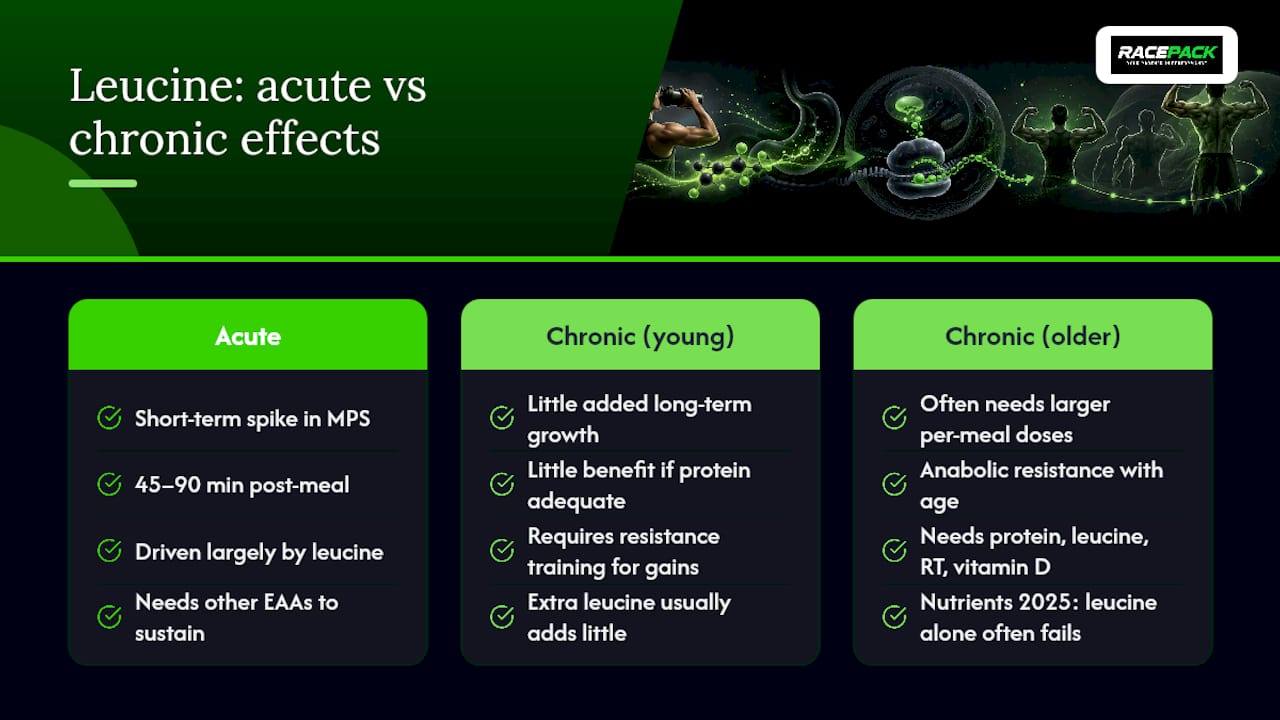
Leucine-rich protein reliably triggers a short-term spike in muscle protein synthesis in nearly every human trial that’s measured it, but whether that spike translates into long-term muscle growth depends heavily on training status, total protein intake, and age. That distinction, acute signaling versus chronic adaptation, is where a lot of supplement marketing quietly overstates what the science actually shows.
On the acute side, the evidence is consistent. Multiple studies tracking myofibrillar protein synthesis after a protein-rich meal find measurable increases within roughly 45 to 90 minutes of ingestion, driven largely by the leucine content of that meal. This is a well-replicated, short-window effect. The complication is that sustaining that elevated synthesis rate requires a continued supply of the other essential amino acids, not leucine on its own. Leucine can pull the trigger, but it can’t finish building the wall by itself.
The chronic picture is messier and more population-dependent. In healthy young adults who are already eating adequate total protein, adding extra leucine on top generally produces little additional benefit for long-term muscle growth. The picture changes for older adults. Because aging muscle develops anabolic resistance, a blunted response to a given protein dose, older adults often need larger per-meal doses of leucine or protein to achieve the same synthesis response younger muscle gets from a smaller amount.
A 2025 review in Nutrients found that in older, sarcopenic adults, leucine supplementation without accompanying resistance training and adequate co-nutrients like vitamin D often failed to produce meaningful gains in muscle mass or strength. Leucine alone isn’t a substitute for the mechanical stimulus of resistance exercise.
Some athletic performance research adds a more specific data point. A 2025 study published in PLOS ONE reported improved sprint performance in a leucine-supplemented group compared to control (P = 0.034), though results like this vary considerably by sport, training background, and study design, so it’s better read as a promising signal than a settled conclusion.
The honest limitations worth flagging: trial doses, durations, and protein sources vary widely across this research, which makes clean comparisons difficult. Some studies use isolated leucine, others use leucine-enriched whey, and others use whole-food protein matrices, all of which behave differently in digestion speed and amino acid delivery. Very few studies measure intracellular leucine directly, relying instead on plasma markers that, as covered above, don’t perfectly track the muscle-level response. Read any single leucine study with that caveat in mind.
How Much Leucine Do You Need, and Where Do You Get It?
Aim for roughly 2 to 3 grams of leucine per protein-containing meal as a practical signaling target, while making sure you’re also getting enough total essential amino acids to sustain the synthesis response once it starts. That figure comes from dose-response patterns observed in systematic review data on older adults, and while no single universal number has been confirmed across every population, it’s a workable heuristic for most healthy adults.
Whole foods remain a reliable way to get there. Leucine is abundant across both animal and plant protein sources, which makes food-first strategies genuinely practical rather than restrictive:
- Whey protein and dairy sources (very fast-digesting, high leucine density per serving)
- Chicken breast and lean beef
- Eggs
- Soy protein and lentils (solid plant-based options, though typically requiring a slightly larger serving to hit the same leucine target)
- Fish
For readers who prefer supplement formats or need a fast, convenient option around training, here’s how the main categories stack up:
- Whey protein powders digest quickly and carry naturally high leucine content, making them a strong post-workout choice. RacepackSingapore’s whey protein guide for muscle repair breaks down how digestion speed affects the timing of the anabolic response.
- Leucine-enriched EAA powders, like MyProtein’s EAA Powder, deliver the full slate of essential amino acids alongside a leucine boost, which matters because leucine alone without the other EAAs can’t sustain synthesis past the initial trigger.
- Plant-based protein isolates, such as MyProtein Pea Protein Isolate, work well for readers avoiding dairy, though pairing them with a slightly larger serving helps close the natural leucine gap compared to whey.
- HMB supplements are worth knowing about mainly in clinical or older-adult contexts dealing with muscle wasting, where they’ve drawn specific research interest as a leucine metabolite rather than a mainstream athletic supplement.
Dosing needs shift by group. Younger, healthy adults training regularly usually hit their leucine targets easily through normal meals without needing to supplement at all. Older adults, due to anabolic resistance, often benefit from a higher per-meal leucine dose or a leucine-enriched protein source specifically at meals where total protein is lower. Clinical populations dealing with illness-related muscle loss are a separate case entirely and should work with a healthcare provider rather than self-dosing off general guidance. In every group, more leucine doesn’t mean more benefit once you’ve cleared the signaling threshold. It’s not a substitute for adequate total protein across the day, and it’s definitely not a substitute for training.
Timing, Training, and Turning the Science Into a Routine
Combine a leucine-containing meal or supplement with resistance exercise, and ideally some carbohydrate, to get the strongest anabolic response your body is capable of producing. Leucine sets off the signal, insulin from carbohydrate intake reinforces it, and mechanical tension from lifting gives the muscle a reason to actually use that signal to build tissue rather than just burn it for fuel.
Here’s a practical sequence to follow:
- Spread protein across the day in three to four meals rather than loading it all into one sitting, so you’re re-triggering the mTORC1 signal repeatedly instead of once.
- Include 20 to 40 grams of high-quality protein after resistance training, ideally within a couple of hours, when muscle is most receptive to the signal. RacepackSingapore’s guide on the post-workout anabolic window covers this timing in more depth.
- Make sure total daily calories and carbohydrate intake are adequate, since training in a steep energy deficit blunts the anabolic signal even when leucine and protein targets are met.
A few sample meal and snack ideas that hit a solid leucine dose without any guesswork: a whey shake blended with a banana, grilled chicken breast with quinoa, Greek yogurt with a scoop of EAA powder stirred in, or eggs with lentils for a plant-leaning option. For a fast, no-prep choice around training sessions, a small leucine-enriched EAA serving covers the gap when a full meal isn’t practical.
Pro Tip: Time a rapidly digesting, leucine-rich protein, whey or an EAA blend, within the first two hours after resistance training. That’s the window when muscle protein synthesis is most responsive to the leucine signal, and a fast-digesting source gets amino acids into circulation before that sensitivity starts to taper off.
What Leucine Doesn’t Do: Risks and Realistic Limits
Leucine is not a weight-loss shortcut, and it’s not a replacement for adequate total protein or actual resistance training, no matter how the label copy reads. Its proven value is narrower and more specific than marketing tends to suggest: it preserves and optimizes muscle tissue, not much more.
Real limitations to keep in mind:
- Taking leucine alone, without matching total protein and training, produces little to no long-term hypertrophy in most studied populations.
- Chronically overconsuming leucine in isolation, disconnected from balanced total protein, risks creating an amino acid imbalance rather than a benefit.
- There’s a theoretical concern around leucine’s crosstalk with insulin-signaling pathways in states of chronic nutrient excess, though this is a mechanistic caution rather than an established real-world risk at normal dietary intakes.
- People managing metabolic disease, kidney disease, or taking medications that interact with amino acid metabolism should get individualized guidance rather than following generic dosing heuristics.
Medical reviewers note that leucine’s primary, well-supported clinical value lies in preserving and supporting muscle tissue, and that claims about it driving meaningful weight loss or appetite suppression aren’t backed by strong evidence.
If you have an existing kidney condition, diabetes, or you’re on medication affecting amino acid or glucose metabolism, talk to a doctor or dietitian before adding a concentrated leucine or EAA supplement to your routine. General dosing advice in an article like this one isn’t a substitute for guidance tailored to your specific health situation.
Where the Science Agrees and Where It’s Still Catching Up
Researchers broadly agree that leucine is a key modulator of translation initiation through mTORC1, and that it’s one of the most potent individual amino acid triggers for muscle protein synthesis known. What they don’t fully agree on, or haven’t nailed down yet, is exactly how well any single blood or dietary marker predicts the size of that response in a given person.
Settled ground includes: mTORC1’s central role in the pathway, leucine’s outsized signaling potency relative to other amino acids, and the requirement for adequate total essential amino acids to sustain the synthesis response once triggered.
Open questions include:
- How intramuscular leucine kinetics, as opposed to plasma levels, actually track with the size of the MPS response
- Whether optimal per-meal leucine dosing should scale with body mass or lean mass rather than using a flat gram target
- How leucine’s effects differ across sex, metabolic health status, and long-term training history
- How leucine behaves differently when eaten as part of a whole-food matrix versus an isolated supplement
Future research using intramuscular tracer techniques, longer trial durations, and more diverse study populations should help close these gaps. For now, treat the 2 to 3 gram per-meal figure as a useful planning tool, not a precise biological law.
The Insulin Connection: Why Energy Signals Matter Too
Leucine can’t drive a full anabolic response by itself. It needs insulin, or at least an insulin-like energy signal, working alongside it, because muscle protein synthesis requires the cell to sense both “amino acids are available” and “energy is available” before committing resources to building new tissue.
Insulin and leucine activate mTORC1 through partially separate but converging routes: leucine signals substrate availability through the Rag GTPase pathway, while insulin signals energy sufficiency through the TSC/Rheb pathway. Research on insulin and amino-acid signaling describes this as a genuinely synergistic relationship rather than two independent effects added together. That’s the biological reason a protein shake taken alongside carbohydrate, rather than protein alone in a fasted state, tends to produce a more robust muscle-building signal.
Practically, this is why pairing your post-workout protein with a source of fast carbohydrate isn’t just about refilling glycogen. A gel like the GU Energy Gel alongside your recovery protein gives your body both signals at once: amino acids present, energy present, go ahead and build. Skipping the carbohydrate side entirely doesn’t shut the process down, but it does leave part of the signaling pathway running below its full capacity.
Does Leucine Affect Muscle Protein Breakdown Too?
Leucine’s reputation centers on building muscle, but it also plays a secondary role in slowing muscle protein breakdown, working on the opposite side of the same equation. Net muscle growth depends on the balance between synthesis and breakdown, and leucine’s insulin-supported signaling appears to tip that balance favorably on both sides at once.
The mechanism here is less studied than the synthesis pathway, but the general pattern in the research is that adequate leucine and insulin availability suppresses the rate of protein breakdown following a meal, likely through insulin’s independent inhibitory effect on breakdown pathways rather than a direct leucine mechanism. In a fasted or energy-deprived state, protein breakdown tends to dominate. After a leucine-rich meal with adequate carbohydrate, that balance shifts toward net synthesis.
This matters practically for anyone managing muscle loss during a calorie deficit, whether that’s an athlete cutting weight or an older adult recovering from illness. Getting a leucine-rich protein source at regular intervals throughout the day doesn’t just add fuel for new construction. It also helps put the brakes on the ongoing breakdown that happens between meals, which is part of why spacing protein intake across the day tends to outperform loading it all into one sitting for preserving lean tissue over time.
Leucine Versus Other Branched-Chain Amino Acids
Leucine is meaningfully more potent than the other two branched-chain amino acids, isoleucine and valine, at triggering muscle protein synthesis, which is why it gets singled out in nearly every serious discussion of anabolic signaling rather than being lumped in as “just another BCAA.” All three share a branched molecular structure and some overlapping metabolic pathways, but only leucine reliably activates mTORC1 signaling on its own at typical dietary doses.
Isoleucine and valine do play supporting roles. Isoleucine appears to support glucose uptake and metabolic regulation, while valine contributes more to general amino acid pool maintenance than to direct anabolic signaling. Neither comes close to replicating leucine’s signaling strength, which is part of why supplement formulations that isolate all three BCAAs in equal ratios have fallen out of favor with a lot of sports nutrition researchers in recent years, in favor of leucine-forward EAA blends that still include the full amino acid profile.
This is also why a complete essential amino acid product, rather than a straight BCAA blend, tends to make more practical sense for most goals. Leucine pulls the trigger, but sustained protein synthesis needs the full set of essential amino acids as raw material, something a leucine-heavy EAA formula like MyProtein’s EAA Powder is built to deliver in one serving.
A Practical, Evidence-Based Take on Leucine Supplementation
The evidence points toward one conservative, defensible strategy: prioritize whole protein sources with a naturally strong leucine profile at each meal, and treat isolated leucine or EAA supplements as a convenience tool for the moments whole food isn’t practical, not as a replacement for it. Whole-food protein matrices bring along other nutrients and a slower, more sustained amino acid release that isolated leucine alone can’t replicate.
Two cautions worth repeating. Don’t let an isolated leucine supplement become your long-term substitute for balanced total protein intake, since the research consistently shows leucine’s benefit depends on adequate EAA and training context around it. And when you do buy a leucine or EAA product, verify you’re getting an authentic, properly dosed formulation. Underdosed or mislabeled supplements are a real problem in this category, which is one reason working with a source that guarantees authenticity, like RacepackSingapore, matters more than people initially assume.
Where to Buy Leucine-Rich Protein and Recovery Products You Can Trust
Getting the biochemistry right only matters if the protein and amino acid products you’re actually using are genuine, correctly dosed, and delivered before your next training block starts. RacepackSingapore carries verified, authentic sports nutrition from established international brands, with next-day delivery across Singapore, so you’re not gambling on a gray-market supplement to hit your leucine targets.
If you’re building a leucine strategy around whole protein plus targeted supplementation, a few specific products cover the bases well. MyProtein’s EAA Powder delivers a complete essential amino acid profile with a leucine-forward ratio, ideal for the post-training window this article covers. For plant-based readers, MyProtein Pea Protein Isolate comes bundled with a shaker and creatine sachet, a practical starting kit rather than a single-purpose tub. And if your training sessions run long, pairing your recovery protein with a GU Energy Gel supplies the carbohydrate side of the insulin-leucine partnership covered earlier. Keep your supplement shelf organized with a MyProtein Supplement Storage Box so dosing stays consistent day to day.
Ready to put this into practice? Shop RacepackSingapore’s protein and amino acid range now and get authentic, next-day-delivered nutrition built for exactly the leucine strategy this article lays out.
Sources
- Reviewing the Effects of l-Leucine Supplementation in the Regulation of Food Intake, Energy Balance, and Glucose Homeostasis
- Nutrients article (2025) on leucine and muscle outcomes
- 10 Foods High in Leucine & Its Benefits (Cleveland Clinic)
- ScienceDirect article on insulin and amino-acid signaling (exact title from source)
- Effectiveness of leucine on muscle protein synthesis, lean body mass and leg lean mass accretion in older people: a systematic review and meta-analysis
FAQ
What is the role of leucine in protein synthesis?
Leucine activates mTORC1, the signaling complex that switches on mRNA translation and starts building new muscle protein, while also serving as one of the raw amino acid building blocks used in that construction.
Is leucine needed for protein synthesis?
Yes. Leucine is one of the most potent known triggers for activating mTORC1, and without adequate leucine intake, the anabolic signal that starts muscle protein synthesis is significantly weaker.
What happens if you lack leucine?
Insufficient leucine intake blunts the mTORC1 signaling response, which can reduce the rate of muscle protein synthesis even if total protein and other amino acids are otherwise adequate.
Which food is highest in leucine?
Whey protein, chicken, beef, and eggs rank among the highest natural leucine sources per serving, with soy and lentils offering solid plant-based options at slightly larger portions.
How much leucine do I need per meal to build muscle?
Most research points to roughly 2 to 3 grams of leucine per meal as a practical signaling target, based on dose-response data from systematic reviews, though no single number applies universally to everyone.
Does leucine work without resistance training?
Leucine alone, without resistance training, produces only a short-term signaling spike and rarely leads to meaningful long-term muscle growth, especially in older or sarcopenic adults.
Is leucine the same as BCAAs?
No. Leucine is one of three branched-chain amino acids, alongside isoleucine and valine, but leucine is by far the most potent at directly triggering muscle protein synthesis.
Can older adults benefit more from leucine supplementation?
Yes. Because aging muscle develops anabolic resistance, older adults often need higher per-meal leucine doses than younger adults to achieve a comparable synthesis response.
Does leucine help with fat loss?
Leucine’s well-supported role is preserving and supporting muscle tissue, not driving fat loss. Claims about it suppressing appetite or accelerating weight loss lack strong supporting evidence.
What is HMB and how does it relate to leucine?
HMB is a metabolite produced when the body breaks down leucine, and it has been studied separately as a supplement, primarily in older adults and clinical populations managing muscle wasting.
Should I take a leucine or EAA supplement, or just eat more protein?
Whole protein sources should form the foundation of your intake, with a product like MyProtein’s EAA Powder serving as a convenient option around training when a full meal isn’t practical.
Does carbohydrate intake affect how well leucine works?
Yes. Insulin released in response to carbohydrate intake works synergistically with leucine to strengthen mTORC1 activation, which is part of why post-workout nutrition often combines both.
Ready to build your leucine strategy around trusted nutrition? Buy Now at RacepackSingapore and get authentic, next-day-delivered protein, EAA, and recovery products built for real training demands.