

Why Your Breathing Rate Increases When You Run
Your breathing rate rises during running because your body must increase minute ventilation to match rising CO2 production, deliver more oxygen to working muscles, and respond to neural signals that fire even before metabolic demand peaks. This is a normal, tightly regulated response, not a sign that something is wrong.
Three core drivers explain the change:
- Metabolic gas exchange: muscles burn more fuel, producing more CO2 and consuming more O2, so the lungs must move more air per minute.
- Neural feedforward (central command): the brain sends signals to the respiratory centers at the moment you start running, speeding up breathing before blood chemistry even shifts.
- Mechanical effects: footstrike impact and trunk movement physically assist or disrupt airflow, adding to the ventilatory load unique to running.
For most runners, faster breathing during exertion is entirely healthy. If you experience chest pain, sudden severe breathlessness, or symptoms that persist long after you stop, those warrant a conversation with your doctor.
Key Takeaways
Breathing rate increases during running because minute ventilation must rise to match higher CO2 production and oxygen demand, driven by neural, chemical, and mechanical signals working together.
| Point | Details |
|---|---|
| VE rises dramatically | Resting ~12 L/min (~15 breaths/min) climbs to ~100 L/min (~40–60 breaths/min) during hard running. |
| Three control systems | Central command, chemoreceptor feedback, and afferent reflexes all drive faster breathing during exercise. |
| Running vs. walking | Running produces higher VE (73.7 vs. 68.6 L·min⁻¹) and greater dead space ventilation than walking at matched effort. |
| LRC improves efficiency | Timing exhales to footstrike phases speeds ventilatory transitions and reduces work of breathing. |
| RacepackSingapore | Stocks GU Energy Gels, HIGH5 electrolytes, and hydration tools to reduce metabolic stress on long training runs. |
Table of Contents
- Why does breathing rate increase when you run?
- How the body controls breathing during exercise
- Why running makes you breathe harder than walking at the same effort
- How stride–breath coupling helps you run more efficiently
- How regular training reduces breathlessness at the same pace
- Practical breathing techniques to manage your breath rate while running
- When faster breathing is normal and when to see a doctor
- How to monitor your breathing rate and effort during runs
- What most runners get wrong about breathing
- Fuel and hydration that support your training runs
- Sources
- FAQ
Why does breathing rate increase when you run?
The key measurement here is minute ventilation (VE), defined as the volume of air you move in and out of your lungs each minute. According to a clinical review published on PMC, resting VE sits around 12 liters per minute at roughly 15 breaths per minute. During vigorous exercise, VE can climb to approximately 100 liters per minute, with breathing frequency reaching 40–60 breaths per minute.
VE is the product of two variables:
VE = Tidal Volume (VT) × Respiratory Rate (RR)
Tidal volume is the amount of air per breath; respiratory rate is how many breaths you take per minute. At low-to-moderate running intensity, your body preferentially increases tidal volume first, drawing deeper breaths. As pace rises toward threshold and beyond, respiratory rate climbs sharply because there is a physical ceiling on how large each breath can get. Both levers work together, but their relative contribution shifts with intensity.
| Condition | Respiratory Rate (breaths/min) | Approx. Minute Ventilation (L/min) |
|---|---|---|
| Rest | ~15 | ~12 |
| Easy jog | ~20–25 | ~30–40 |
| Moderate run | ~30–40 | ~60–80 |
| Hard effort | ~40–60 | ~100 |
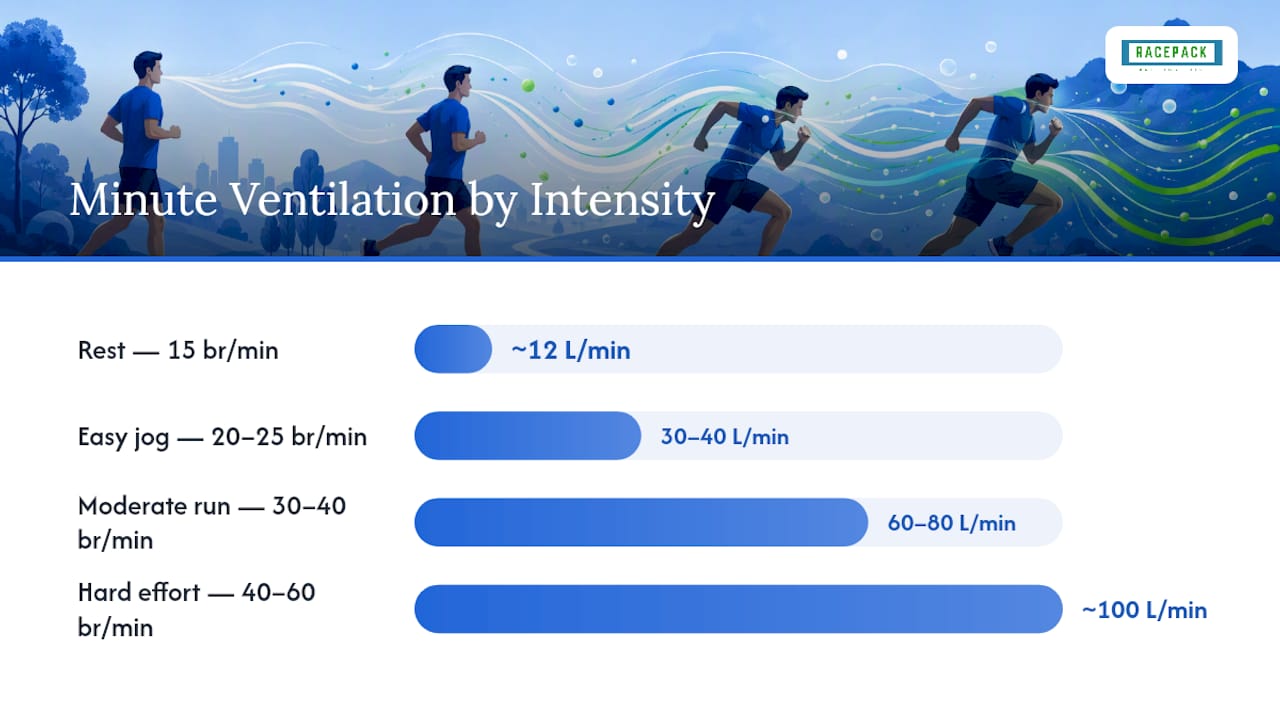
Figures sourced from the PMC clinical review on lungs and exercise.
Understanding VO2 max and aerobic capacity helps explain why these numbers shift with fitness level.
How the body controls breathing during exercise
Three overlapping systems drive the ventilatory response, and they operate on different timescales.
- Central command (feedforward): When your motor cortex fires to move your legs, it simultaneously sends signals to the brainstem’s respiratory centers. Breathing accelerates within the first stride, well before CO2 levels in the blood have changed. This is why you notice faster breathing the instant a race starts, even before you feel physically taxed.
- Chemoreceptor feedback: As exercise continues, muscles produce more CO2, blood pH drops slightly, and arterial CO2 rises. Peripheral chemoreceptors (in the carotid bodies) and central chemoreceptors (in the medulla) detect these shifts and amplify the ventilatory drive. CO2 is the dominant chemical stimulus. A rise in VCO2 of even a few percent triggers a measurable increase in breathing frequency.
- Afferent reflexes and hormonal inputs: Mechanoreceptors in muscles and joints send signals back to the brainstem with each stride. Epinephrine (adrenaline) released from the adrenal glands also stimulates the respiratory centers, adding a hormonal layer to the neural and chemical signals already in play.
A practical example: at the start of a 5K, central command fires immediately and breathing quickens. By kilometer two, rising CO2 and falling pH from lactate production reinforce that drive chemically. By the final sprint, all three systems are running at full output simultaneously.
Why running makes you breathe harder than walking at the same effort
Even when a runner and a walker are burning the same amount of oxygen, the runner breathes more. A PubMed comparative study of trained runners found VE during running averaged 73.7 L·min⁻¹ versus 68.6 L·min⁻¹ during walking at matched VO2 and VCO2. The difference came from a higher respiratory rate and lower tidal volume during running, plus significantly greater dead space ventilation: 13.3 L·min⁻¹ running versus 9.0 L·min⁻¹ walking.
| Metric | Running | Walking |
|---|---|---|
| Minute ventilation (VE) | 73.7 L·min⁻¹ | 68.6 L·min⁻¹ |
| Dead space ventilation | 13.3 L·min⁻¹ | 9.0 L·min⁻¹ |
Dead space ventilation is air that enters the airways but never reaches the gas-exchange surfaces of the lungs. Running increases dead space because higher respiratory rates leave less time for full gas mixing, and because impact-driven trunk motion displaces abdominal contents upward, reducing the efficiency of each breath.
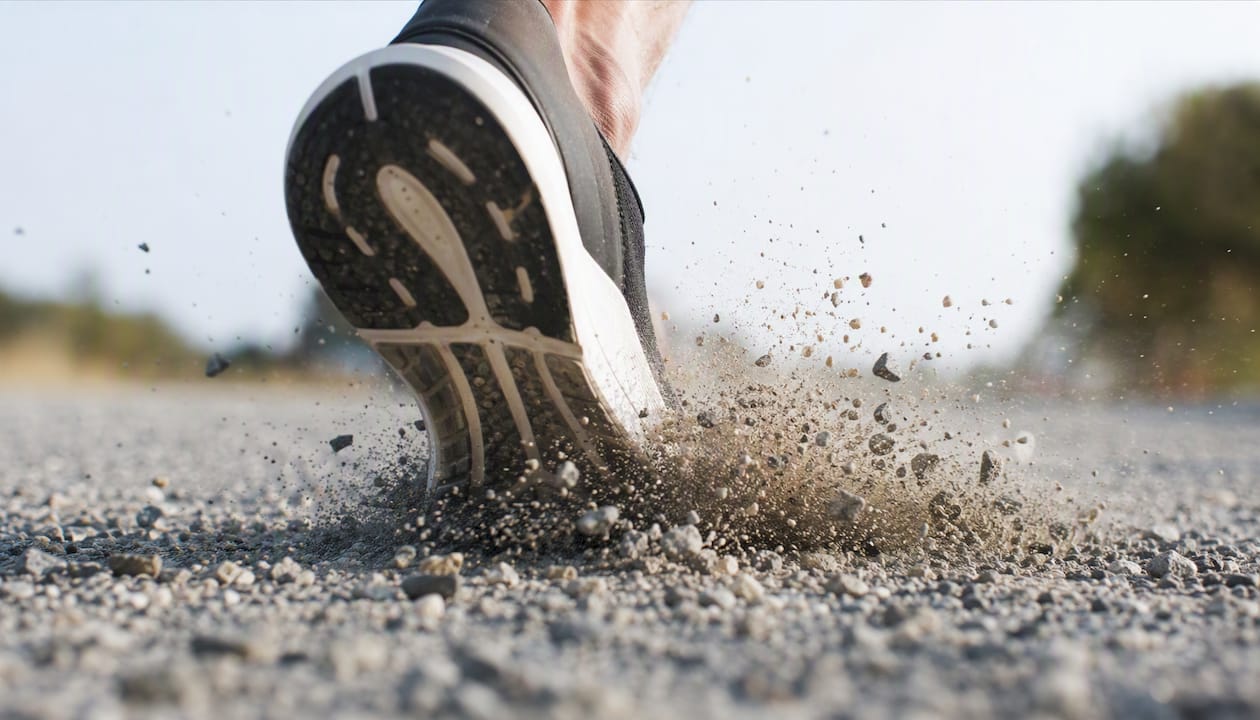
Research published in PLOS One shows that footstrike impact produces ventilatory flows accounting for roughly 10–12% of total ventilatory volume. Those flows can assist or oppose breathing depending on timing, which is exactly why stride–breath coordination matters. Running stride mechanics also affect how the trunk moves; understanding pronation and stride mechanics can help you see how foot and leg position ripple upward into breathing efficiency.
How stride–breath coupling helps you run more efficiently
Locomotor-respiratory coupling (LRC) is the tendency for runners to synchronize their breathing rhythm with their stride cycle. Common entrainment ratios observed in humans include 2:1 (two strides per breath), 3:2, 3:1, and 4:1, with 2:1 being the most frequently reported at moderate-to-fast paces.
The mechanical logic is straightforward. Footstrike compresses the abdomen and generates a pressure wave through the trunk. When a runner times an exhale to coincide with a footstrike, that impact-driven flow assists the breath rather than fighting it. The PLOS One study found that ventilatory transitions initiated in preferred step phases occurred twice as fast as those initiated in avoided phases. Less respiratory muscle work per breath means more energy available for forward motion.
- 2:1 ratio: exhale every two strides — common at faster paces
- 3:2 ratio: inhale for three strides, exhale for two — useful at easy-to-moderate effort
- 3:1 or 4:1 ratio: slower breathing for very easy recovery runs
Pro Tip: On your next easy run, count your steps and try to exhale on alternating feet rather than always on the same foot. This distributes impact stress more evenly and can reduce the side stitch that often comes from always landing on the same foot during an exhale.
How regular training reduces breathlessness at the same pace
With consistent training, the same running speed demands less ventilation. Muscles become more oxidatively efficient, extracting more oxygen per unit of blood flow and producing less CO2 per stride. Cardiovascular adaptations, including increased stroke volume and greater capillarization of muscle tissue, mean the heart delivers oxygen more effectively, reducing the ventilatory drive needed to compensate.
The timeline is gradual. Most runners notice meaningful reductions in breathlessness at a given pace within several weeks of consistent training, with larger gains accumulating over months. There is no fixed promise on timing because individual response varies with training history, intensity, and recovery quality. Building training consistency habits is what drives these adaptations over time. A structured approach, like following marathon training plan phases, helps you build the aerobic base that gradually lowers your ventilatory response at any given speed.
Practical breathing techniques to manage your breath rate while running
The American Lung Association recommends diaphragmatic breathing and rhythmic step–breath patterns as the two most practical techniques for runners.
Core techniques:
- Diaphragmatic (belly) breathing: breathe so your belly expands first, not your chest. This recruits the diaphragm fully, increasing tidal volume and reducing the shallow chest breathing that wastes effort at any pace.
- Rhythmic step–breath patterns: use a 3:2 ratio (inhale three steps, exhale two) at easy-to-moderate effort; shift to 2:1 at threshold pace or faster. This also distributes footstrike impact across both feet during exhales, reducing side-stitch risk.
- Mouth breathing at high intensity: nasal breathing alone limits airflow at hard efforts. Use both nose and mouth, or primarily mouth, when pace demands it.
- Cadence adjustments: a higher step cadence at the same speed shortens ground contact time and can reduce the magnitude of each impact-driven ventilatory disruption.
Dos and don’ts:
- Do practice belly breathing during warm-up, not mid-race.
- Do use easy runs to experiment with 3:2 rhythm before applying it at race pace.
- Don’t force nasal-only breathing at hard efforts — it restricts VE when you need it most.
- Don’t ignore persistent breathlessness at easy paces; it may signal a training load or health issue.
Pro Tip: Spend the first 10–15 minutes of an easy run focusing only on breathing rhythm. Place one hand on your belly and confirm it rises before your chest. Once the pattern feels natural, remove your hand and maintain it by feel. Most runners find the pattern locks in within two or three sessions.
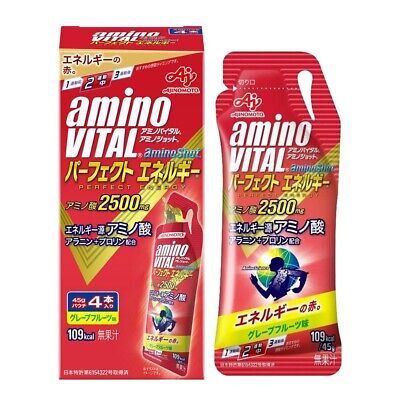
On longer runs where fuel depletion adds metabolic stress and drives ventilation higher, GU Energy Gels taken at regular intervals help maintain blood glucose and reduce the extra ventilatory load that comes with glycogen depletion. Pairing gels with HIGH5 ZERO+ electrolyte sachets keeps electrolyte balance in check, supporting muscle function and reducing the metabolic stress that compounds breathlessness on efforts over 60 minutes.
When faster breathing is normal and when to see a doctor
Breathlessness during running is expected and healthy. The concern is when the pattern falls outside normal ranges or comes with additional symptoms.
Normal ranges:
- Rest: 12–20 breaths per minute
- Easy jog: 20–30 breaths per minute
- Moderate-to-hard running: 30–60 breaths per minute
- Recovery within a few minutes of stopping: return toward resting rate
Red flags that require medical evaluation:
- Chest pain or tightness during or after running
- Fainting or near-fainting
- Breathlessness that is severe and disproportionate to effort, or asymmetric (one-sided)
- Breathing that does not return toward normal within 10 minutes of stopping
- Wheezing or a persistent cough triggered by running
Hyperventilation is a distinct pattern: breathing rate and depth exceed what CO2 production requires, causing CO2 to fall below normal and triggering lightheadedness, tingling, or muscle cramps. It can occur from anxiety at race start or from breathing too fast at easy paces. Slowing the breath and focusing on a rhythmic pattern usually resolves it quickly.
Runners with asthma or COPD should use prescribed inhalers as directed before exercise, warm up gradually over at least 10 minutes, and consult their clinician before adding high-intensity sessions. The American Lung Association’s runner guidance covers safe exercise practices for people with lung conditions in detail.
How to monitor your breathing rate and effort during runs
Breathing rate, heart rate, and rating of perceived exertion (RPE) each capture a different dimension of effort. According to Runner’s World, respiratory metrics are informative for intensity but heart rate remains the more established monitoring metric for most runners. Wearable respiratory sensors are an emerging category with real accuracy limitations.
- Heart rate is the most validated real-time effort marker. It responds to cardiovascular load and is well-correlated with training zones.
- RPE (1–10 or Borg 6–20 scale) is free, always available, and surprisingly accurate once you calibrate it over a few weeks of training.
- Breathing rate adds value as a cross-check: if you can speak in full sentences, you are in an aerobic zone; if you can manage only a few words, you are near threshold; if speech is impossible, you are at high intensity.
- Wearables that report respiratory rate (many modern smartwatches estimate it from heart rate variability) can give useful trend data but should not be treated as precise breath-by-breath counts. A PMC review on wearables and performance notes that short manual checks and RPE remain practical for most runners.
For practical monitoring, a quick mid-run check works well: count breaths for 15 seconds and multiply by four. Do this at the same point in several runs and you will quickly build a personal reference for what each effort zone feels like. Smartwatches and fitness trackers can complement this by logging heart rate trends across sessions.
What most runners get wrong about breathing
Most runners focus on how fast they are breathing and miss the more useful question: how efficiently. Breathing rate is a symptom of ventilatory demand, not the cause of it. Trying to slow your breathing by willpower at high intensity is counterproductive — your body is running the right program. The better intervention is to improve the mechanics of each breath (diaphragmatic depth, stride timing) so that the same ventilatory demand requires less muscular effort.
There is also a tendency to treat breathlessness as a fitness problem when it is often a pacing problem. Runners who start too fast spike CO2 production early, triggering a ventilatory response that feels like they are “out of shape.” Slowing the first kilometer by 15–20 seconds per mile often resolves the breathlessness entirely, without any change in fitness. The physiology is working correctly; the pacing strategy was not.
Fuel and hydration that support your training runs
RacepackSingapore stocks the gels, electrolytes, and hydration tools that endurance runners rely on to keep metabolic stress in check on long efforts.

A GU Energy Gel 24-pack gives you a full training block’s worth of clean, fast-absorbing carbohydrate fuel, timed every 45 minutes on runs over an hour to prevent the glycogen depletion that compounds breathlessness. Pair it with the HIGH5 750ml bottle and Zero hydration tablets for on-the-go electrolyte support that keeps muscle function sharp through the final miles. For recovery after hard sessions, the MyProtein EAA Powder and MyProtein Pea Protein Isolate support muscle repair so your next run starts from a stronger baseline. All products ship with next-day delivery and guaranteed authenticity. Shop the full range at RacepackSingapore and fuel every mile with confidence.
Sources
The physiology in this article draws on five primary sources. The PMC clinical review on lungs and exercise provides the foundational VE, tidal volume, and respiratory rate numbers. The PubMed comparative study on running versus walking ventilation supplies the direct VE and dead space figures. The PLOS One study on locomotor-respiratory coupling covers impact loading, step-driven flows, and entrainment mechanics. The American Lung Association’s runner breathing guide covers practical techniques and lung-condition safety. The Runner’s World analysis of breathing versus heart rate data contextualizes wearable monitoring. All five are peer-reviewed or published by recognized health authorities, making them reliable starting points for deeper reading on running physiology.
This article is general information, not a substitute for advice from a qualified doctor. Consult a qualified healthcare professional about your own circumstances before acting on anything here.
- Your lungs and exercise - PMC
- Impact loading and locomotor-respiratory coordination significantly influence breathing dynamics in running humans - PLOS One
- Increased ventilation in runners during running as compared to walking at similar metabolic rates
- Breathing basics for runners | American Lung Association
- Sports Performance and Breathing Rate: What Is the Connection? (Runner’s World)
FAQ
Why does breathing rate increase when you run?
Your muscles produce more CO2 and consume more O2 during running, so the respiratory system increases minute ventilation to maintain blood gas balance. Neural signals from the brain (central command) also speed breathing from the very first stride, before blood chemistry changes.
What is a good respiration rate while running?
Easy jogging typically produces 20–30 breaths per minute; moderate-to-hard running raises that to 30–60 breaths per minute. If you can speak in short phrases, you are in a sustainable aerobic zone.
Why does my heart rate get so high so quickly when running?
Increased heart rate during running reflects the cardiovascular system’s rapid response to rising oxygen demand. Central command signals the heart simultaneously with the muscles, so both heart rate and breathing rate climb within the first few seconds of effort, even before metabolic byproducts accumulate.
Is running hard on your lungs?
For healthy runners, no. The lungs adapt well to regular aerobic exercise and are rarely the limiting factor in performance. Runners with asthma or COPD should use prescribed inhalers before exercise and warm up gradually; the American Lung Association provides specific guidance for exercising with lung conditions.
What is the 80% rule in running?
Running most miles at low intensity keeps ventilatory demand manageable, builds aerobic base, and reduces injury risk.
Can energy gels reduce breathlessness on long runs?
Yes, indirectly. Glycogen depletion forces the body to rely more on fat oxidation, which produces more CO2 per unit of energy and drives ventilation higher. Taking GU Energy Gels at regular intervals maintains carbohydrate availability, keeping metabolic efficiency high and ventilatory demand lower in the later miles.
How does training reduce breathlessness at the same pace?
Regular training improves muscle oxidative efficiency and cardiovascular output, so muscles extract more oxygen per unit of blood flow and produce less CO2 per stride. Over weeks to months, this lowers the ventilatory drive needed at any given speed.
What is locomotor-respiratory coupling?
Locomotor-respiratory coupling (LRC) is the synchronization of breathing rhythm with stride cycle. Common ratios include 2:1 (two strides per breath) and 3:2. Timing exhales to assistive phases of footstrike reduces respiratory muscle work and speeds ventilatory transitions.
When should faster breathing during running concern me?
Seek medical advice if you experience chest pain, fainting, breathlessness that is severe and disproportionate to effort, or breathing that does not return toward normal within 10 minutes of stopping. These patterns fall outside the normal exertional response.