

How Glycolysis Powers Every Cell: The Complete Energy Guide
Glycolysis converts one glucose molecule into two pyruvates entirely within the cytosol, producing a net gain of 2 ATP and 2 NADH per glucose — no oxygen required. The balanced reaction reads: Glucose + 2 NAD⁺ + 2 ADP + 2 Pᵢ → 2 Pyruvate + 2 NADH + 2 ATP + 2 H₂O. That compact equation is the foundation of the role of glycolysis energy pathway in every living cell, from a sprinting athlete’s muscle fiber to a red blood cell with no mitochondria at all.
This pathway is not a backup system. It runs continuously, supplying pyruvate to mitochondria at rest and ramping up to meet explosive ATP demand during high-intensity exercise. Understanding how it works, how it is regulated, and what its intermediates do beyond ATP production changes how you study metabolism, design experiments, and fuel your training.
Key Takeaways
Glycolysis is the universal, cytosolic energy and biosynthetic pathway that every cell runs continuously, not only under oxygen stress.
| Point | Details |
|---|---|
| Net energetic yield | Glycolysis produces 2 ATP net and 2 NADH per glucose via substrate-level phosphorylation. |
| Three regulatory enzymes | Hexokinase/glucokinase, PFK-1, and pyruvate kinase are the irreversible control points; ATP inhibits all three. |
| Pyruvate fate split | Aerobically, pyruvate enters the TCA cycle via PDH; anaerobically, LDH converts it to lactate to recycle NAD⁺. |
| Biosynthetic hub | Glycolytic intermediates feed the pentose phosphate pathway, hexosamine pathway, serine synthesis, and lipid backbone production. |
| RacepackSingapore | GU Energy Gels and HIGH5 products from RacepackSingapore deliver fast carbohydrates and electrolytes matched to glycolytic training demands, with next-day delivery in Singapore. |
This article is general information, not a substitute for advice from a qualified doctor. Consult a qualified healthcare professional about your own circumstances before acting on anything here.
Table of Contents
- What is the role of glycolysis as an energy pathway?
- How do the 10 enzymes of glycolysis work?
- How does the cell regulate glycolytic flux?
- What happens to pyruvate after glycolysis?
- Glycolysis does more than make ATP
- How glycolysis shapes your fueling and training strategy
- Why glycolysis matters clinically and physiologically
- Glycolysis is more than an emergency fuel system
- Fuel your glycolytic performance with RacepackSingapore
- Sources
- FAQ
What is the role of glycolysis as an energy pathway?
Glycolysis is a 10-step sequence split into two conceptual phases: the investment phase (steps 1–5) and the payoff phase (steps 6–10). According to OpenStax Biology, the investment phase consumes 2 ATP to phosphorylate glucose and prepare it for cleavage, while the payoff phase generates 4 ATP and 2 NADH from the two three-carbon fragments produced.
Investment phase (steps 1–5)
- Step 1: Hexokinase phosphorylates glucose → glucose-6-phosphate (G6P), consuming 1 ATP.
- Step 3: Phosphofructokinase-1 (PFK-1) phosphorylates fructose-6-phosphate → fructose-1,6-bisphosphate, consuming 1 ATP. This is the primary rate-limiting step.
- Step 4: Aldolase cleaves the six-carbon sugar into two three-carbon units (DHAP and glyceraldehyde-3-phosphate).
Payoff phase (steps 6–10)
- Step 6: Glyceraldehyde-3-phosphate dehydrogenase (GAPDH) oxidizes each G3P and reduces NAD⁺ to NADH, producing 1,3-bisphosphoglycerate.
- Steps 7 and 10: Substrate-level phosphorylation events generate 2 ATP per three-carbon unit (4 ATP total across both units).
- Step 10: Pyruvate kinase converts phosphoenolpyruvate → pyruvate, the final irreversible step.
Compare that with mitochondrial oxidative phosphorylation, which can yield significantly more ATP per glucose under aerobic conditions. Glycolysis trades efficiency for speed: substrate-level phosphorylation is nearly instantaneous, making glycolysis the dominant ATP source during the initial moments of intense effort. For athletes and students alike, that speed differential is the single most important practical fact about glycolytic energy production.
Understanding how glycolysis connects to glycogen stores adds another layer. Read our guide on glycogen’s role in running performance to see how the two systems work together.
How do the 10 enzymes of glycolysis work?
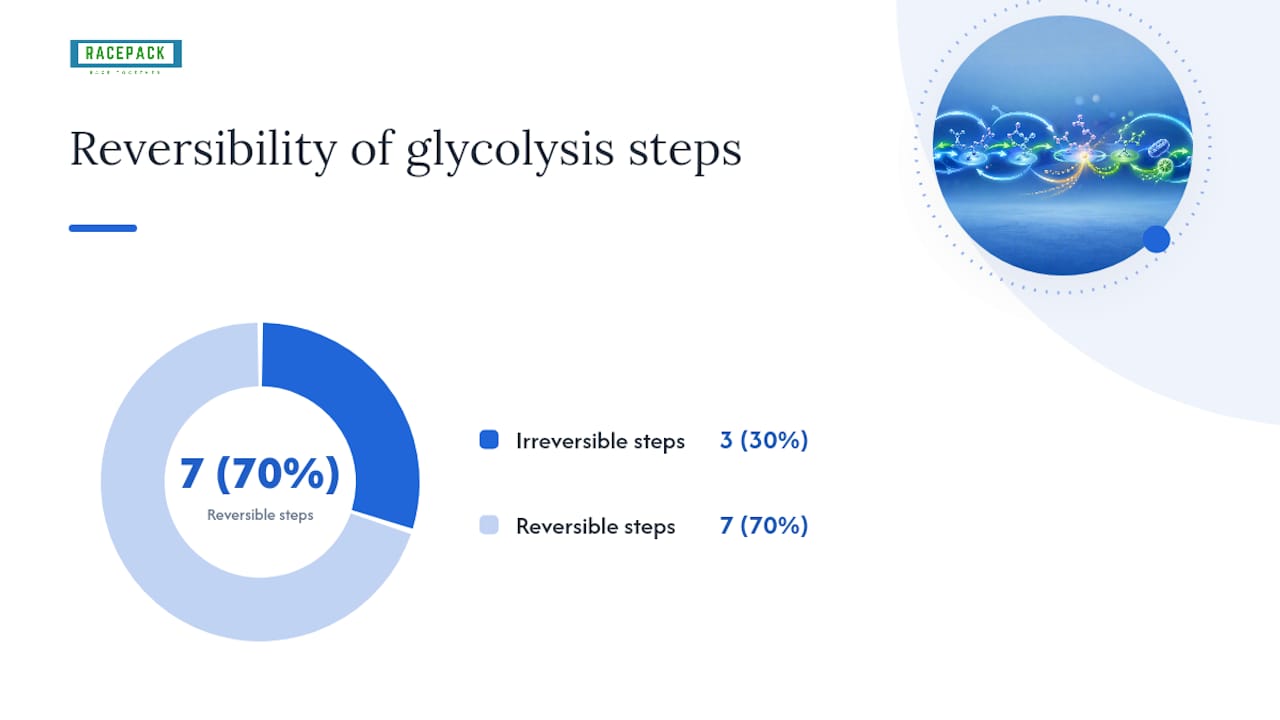
The table below maps each step to its enzyme, the transformation it catalyzes, and key regulatory notes. Steps 1, 3, and 10 are essentially irreversible under physiological conditions (large negative ΔG), making them the primary control points.
| Step | Enzyme | Substrate → Product | Regulation Notes |
|---|---|---|---|
| 1 | Hexokinase (HKI–III) / Glucokinase (HKIV) | Glucose → G6P | Irreversible; HKI–III inhibited by G6P; glucokinase has high Km, not inhibited by G6P |
| 2 | Phosphoglucose isomerase | G6P → F6P | Reversible |
| 3 | Phosphofructokinase-1 (PFK-1) | F6P → F1,6BP | Rate-limiting; irreversible; inhibited by ATP, citrate; activated by AMP, F2,6BP |
| 4 | Aldolase | F1,6BP → DHAP + G3P | Reversible |
| 5 | Triose phosphate isomerase | DHAP → G3P | Reversible |
| 6 | GAPDH | G3P → 1,3-BPG | NAD⁺ → NADH; reversible |
| 7 | Phosphoglycerate kinase | 1,3-BPG → 3-PG | Substrate-level phosphorylation; produces 2 ATP |
| 8 | Phosphoglycerate mutase | 3-PG → 2-PG | Reversible |
| 10 | Enolase | 2-PG → PEP | Reversible |
| 10 | Pyruvate kinase | PEP → Pyruvate | Irreversible; inhibited by ATP, alanine; activated by F1,6BP (feed-forward) |
**
Key points worth memorizing:
- GAPDH at step 6 is where NAD⁺ is reduced to NADH. Without NAD⁺ regeneration, glycolysis stalls.
- Glucokinase (HKIV) in the liver has a high Km for glucose, meaning it only activates when blood glucose is high after a meal. This is physiologically important for buffering postprandial glucose spikes, as detailed in Cold Spring Harbor Perspectives in Biology.
- The three irreversible steps define the pathway’s directionality and are the sites where cells invest regulatory energy.
How does the cell regulate glycolytic flux?
Regulation of glycolysis operates on three levels: allosteric control, hormonal signaling, and feedback from the cell’s energy status. Together, they let the cell match glycolytic output to demand within seconds.
Allosteric regulators
- ATP inhibits both PFK-1 and pyruvate kinase. When energy is abundant, the cell slows glycolysis.
- AMP activates PFK-1, relieving ATP inhibition when the cell is energy-depleted.
- Citrate inhibits PFK-1, signaling that the TCA cycle is well-supplied and glycolytic input should slow.
- Fructose 2,6-bisphosphate (F2,6BP), produced by PFK-2, is the most potent activator of PFK-1. It overrides ATP inhibition and strongly favors glycolysis over gluconeogenesis when biosynthetic demand is high, as documented in PMC research on glycolysis as a signaling hub.
- Fructose 1,6-bisphosphate (F1,6BP) activates pyruvate kinase in a feed-forward loop, accelerating the payoff phase when the investment phase is already running fast.
Hormonal control
Insulin promotes glycolytic flux in liver and muscle by increasing PFK-2 activity, which raises F2,6BP levels and activates PFK-1. Glucagon has the opposite effect in the liver: it activates a kinase that phosphorylates PFK-2, reducing its kinase activity and lowering F2,6BP, thereby slowing glycolysis and favoring gluconeogenesis. Epinephrine similarly shifts liver metabolism toward glucose output during stress.
Energy charge and feedback
The AMP/ATP ratio is the cell’s primary energy sensor. A rising AMP/ATP ratio (low energy charge) simultaneously activates PFK-1 and AMPK, amplifying glycolytic flux. A high ATP/AMP ratio does the reverse.
Pro Tip: *Memorize regulation through the energy charge concept: high AMP = low energy = activate glycolysis; high ATP = high energy = slow it down.
What happens to pyruvate after glycolysis?
Pyruvate’s fate depends entirely on oxygen availability and the tissue’s metabolic state. Two routes exist, and both hinge on the same constraint: NAD⁺ must be regenerated for glycolysis to continue.
- Aerobic fate: Pyruvate enters the mitochondrial matrix, where pyruvate dehydrogenase (PDH) converts it to acetyl-CoA. Acetyl-CoA then enters the TCA cycle, and the resulting NADH and FADH₂ drive oxidative phosphorylation. This route extracts the full energetic value of glucose.
- Anaerobic fate: When oxygen is limited or absent, lactate dehydrogenase (LDH) reduces pyruvate to lactate, simultaneously oxidizing NADH back to NAD⁺. That NAD⁺ recycling is what keeps glycolysis running. Lactate is not a dead-end waste product; it circulates to the liver and heart, where it is oxidized back to pyruvate or used for gluconeogenesis (the lactate shuttle).
Tissues that rely heavily on anaerobic glycolysis include:
- Erythrocytes (red blood cells): They lack mitochondria entirely and depend on glycolysis as their sole ATP source.
- Ocular lens: Low mitochondrial density avoids light scattering, so the lens depends on glycolysis for energy.
- Activated immune cells: Rapidly proliferating lymphocytes shift to aerobic glycolysis to meet biosynthetic demand.
The practical takeaway for athletes: during high-intensity intervals, lactate accumulation reflects NAD⁺ recycling in overdrive, not a failure of metabolism. Lactate is a fuel, not a toxin. How your aerobic capacity handles that lactate is where VO2 max becomes relevant. Our VO2 max guide for athletes explains the connection clearly.
Glycolysis does more than make ATP
The importance of glycolysis pathway extends well beyond the 2 ATP net yield. Glycolytic intermediates branch off into biosynthetic routes that are indispensable for cell growth, division, and signaling, as reviewed in JBC’s analysis of glycolysis as a signaling hub.
Major biosynthetic branches:
- Pentose phosphate pathway (PPP): G6P diverts to produce ribose-5-phosphate (for nucleotide synthesis) and NADPH (for reductive biosynthesis and antioxidant defense).
- Hexosamine pathway: Fructose-6-phosphate feeds into glycoprotein and proteoglycan synthesis, relevant for cell signaling and extracellular matrix assembly.
- Serine synthesis: 3-phosphoglycerate is a precursor for serine, glycine, and cysteine, linking glycolysis to amino acid metabolism.
- Lipid backbone: Dihydroxyacetone phosphate (DHAP) is a precursor for glycerol-3-phosphate, the backbone of phospholipids and triglycerides.
Beyond supplying carbon skeletons, glycolytic flux itself acts as a signaling input. Intermediates and the rate of flux influence transcription factor activity, epigenetic marks, and cell fate decisions. This is why proliferating cells, including cancer cells, maintain high glycolytic rates even when oxygen is plentiful. Glycolysis is evolutionarily ancient and conserved across all domains of life, predating the oxygenation of Earth’s atmosphere. Its persistence alongside oxidative phosphorylation reflects its dual role: rapid ATP and biosynthetic supply.
How glycolysis shapes your fueling and training strategy
Glycolysis dominates ATP supply during short, high-intensity efforts lasting roughly 15 seconds to about 3 minutes. Sprint intervals, HIIT sets, and race-pace surges all rely primarily on glycolytic energy production. That biochemical reality has direct implications for how you fuel before, during, and after those efforts.
Practical fueling tips
- Pre-workout carbohydrate loading: Consume moderate-glycemic carbohydrates 60–90 minutes before high-intensity sessions to top up muscle glycogen, the primary substrate feeding glycolysis.
- Intra-workout quick sugars: During efforts lasting more than 45–60 minutes, fast-absorbing carbohydrates replenish glucose availability and sustain glycolytic flux. Energy gels are purpose-built for this window. Learn how they are absorbed in our energy gel absorption guide.
- Electrolyte replacement: Glycolytic activity generates heat and drives fluid loss. Replacing sodium, potassium, and magnesium maintains muscle contractility and nerve function.
- Post-workout glycogen restoration: Consume carbohydrates within 30–60 minutes after training to restore glycogen stores and prepare for the next session.
- Monitor intensity: Knowing when you are in the glycolytic zone (typically above 80% of max heart rate) lets you time carbohydrate intake precisely. A GPS smartwatch with heart rate monitoring makes that timing practical.
Recommended products from RacepackSingapore
The following products from RacepackSingapore’s catalog are matched to glycolytic fueling needs, with next-day delivery across Singapore:
- GU Energy Gel 24 Gels: A full box of 24 gels gives you race-day and training coverage in one order. Each gel delivers fast-absorbing carbohydrates that feed glycolysis directly during high-intensity efforts.
- GU Energy Gel 6/12/24 Pack: Flexible pack sizes for athletes who want to match their gel supply to their training volume. The 6-pack suits a single race week; the 24-pack covers a full training block.
- GU Energy Gel Single Pack (Min. Order 8): Ideal for testing new flavors or building a mixed-flavor race kit without committing to a full box.
- HIGH5 ZERO+ Multivitamins/Ultra Electrolytes 16 Sachets: Electrolyte sachets that replace what glycolytic effort sweats out, with added micronutrients for recovery support.
- HIGH5 750ml Bottle With 10 Zero Hydration Tablets: A practical hydration kit for training sessions. Pair the tablets with intra-workout carbs to cover both fluid and electrolyte needs simultaneously.
- HIGH5 Energy Drink 2:1 Fructose: The 2:1 glucose-to-fructose ratio uses two separate intestinal transporters, allowing higher carbohydrate absorption rates during prolonged glycolytic efforts. This matters most in sessions exceeding 75 minutes.
- Garmin Forerunner 165 GPS Smartwatch: Heart rate and pace data from the Forerunner 165 let you identify when you are working in the glycolytic intensity zone, so you can time gel intake to match actual metabolic demand rather than guessing.
For more guidance on carbohydrate timing, see our article on intra-workout carbohydrates and performance.
Why glycolysis matters clinically and physiologically
The clinical relevance of glycolysis goes well beyond textbook biochemistry. Two phenomena stand out.
The Warburg effect describes the observation that proliferating cells, including most tumor cells, maintain high glycolytic rates even when oxygen is fully available. Rather than routing pyruvate to the TCA cycle, these cells convert it to lactate. The benefit is not energetic efficiency but biosynthetic supply: rapid glycolytic flux generates the intermediates (ribose-5-phosphate, NADPH, serine, glycerol) needed to build new cells. PET imaging exploits this directly. Tumors with elevated glucose uptake appear as bright spots on FDG-PET scans because they consume far more labeled glucose than surrounding tissue. This makes glycolytic flux a clinically actionable biomarker, as reviewed in JBC’s glycolysis signaling review.
Additional physiological contexts where glycolysis is central:
- Erythrocytes: As noted earlier, red blood cells have no mitochondria. Disruption of glycolytic enzymes in RBCs causes hemolytic anemia, a direct clinical consequence of pathway failure.
- Immune activation: Macrophages and T cells shift sharply toward aerobic glycolysis upon activation, mirroring the Warburg effect. This metabolic reprogramming supports rapid cytokine production and proliferation.
- Hypoxic tissues: In ischemia, cells switch to glycolysis to survive. The resulting lactate accumulation is both a marker of hypoxia and a fuel for recovery once perfusion is restored.
This section is a summary for educational purposes and does not constitute medical advice. Consult a qualified healthcare professional for clinical guidance.
Glycolysis is more than an emergency fuel system
Most textbooks introduce glycolysis as the pathway cells use when oxygen runs out. That framing is misleading, and it shapes poor decisions in both research and training.
Glycolysis runs continuously in every aerobic cell, supplying pyruvate to mitochondria at rest and scaling up during demand.
The more useful mental model is this: glycolysis is the cell’s primary rapid-response energy and biosynthetic system, and oxidative phosphorylation is the high-efficiency extension that follows when oxygen permits. Choosing fueling strategies, experimental conditions, or training protocols without accounting for which system is dominant at a given intensity or oxygen level means you are optimizing for the wrong pathway. That single reframe, supported by the StatPearls biochemistry review, is worth more than memorizing every enzyme name.
Fuel your glycolytic performance with RacepackSingapore
Athletes training at high intensity in Singapore need fast, reliable access to products that match their glycolytic fueling demands. RacepackSingapore stocks authentic GU Energy Gels, HIGH5 hydration and electrolyte products, and Garmin GPS smartwatches, all available with next-day delivery across Singapore.
Whether you are prepping for a race or pushing through interval sessions, the right carbohydrate and hydration products make a measurable difference in how long you can sustain glycolytic output. The GU Energy Gel 24-pack covers a full training block, the HIGH5 Energy Drink 2:1 Fructose supports high-absorption intra-workout fueling, and the Garmin Forerunner 165 keeps you in the right intensity zone to time it all correctly. Browse the full sports nutrition collection at RacepackSingapore and get your order delivered tomorrow.
Sources
- Biochemistry, Glycolysis - StatPearls - NCBI Bookshelf - NIH
- Glycolysis: A multifaceted metabolic pathway and signaling hub (PMC)
- Glycolysis (Cold Spring Harbor Perspectives in Biology)
- 7.2 Glycolysis - OpenStax Biology
FAQ
What is the purpose of the glycolysis pathway?
Glycolysis converts one glucose molecule into two pyruvates, generating 2 ATP and 2 NADH per glucose in the cytosol. It also supplies biosynthetic intermediates for nucleotide, amino acid, and lipid synthesis.
How does glycolysis provide energy without oxygen?
Glycolysis uses substrate-level phosphorylation to produce ATP directly from metabolite transfer, requiring no mitochondria or oxygen. This makes it the only ATP-generating pathway available to cells like red blood cells, which lack mitochondria entirely.
Why are 4 ATP produced but only 2 ATP net in glycolysis?
The investment phase consumes 2 ATP to phosphorylate glucose and prepare it for cleavage. The payoff phase then produces 4 ATP across the two three-carbon fragments, leaving a net gain of 2 ATP per glucose.
What is the role of glycolysis in the human body?
Glycolysis supplies rapid ATP to every cell type, provides pyruvate for aerobic energy production via the TCA cycle, and generates intermediates that feed biosynthetic pathways for growth, repair, and immune function.
What are the three rate-limiting enzymes in glycolysis?
Hexokinase (or glucokinase in the liver), phosphofructokinase-1 (PFK-1), and pyruvate kinase catalyze the three essentially irreversible steps. PFK-1 is the primary rate-limiting enzyme and the main regulatory target.
How does glycolysis connect to cellular respiration?
Glycolysis is the first stage of cellular respiration. Its end product, pyruvate, enters the mitochondria under aerobic conditions and is converted to acetyl-CoA, which drives the TCA cycle and oxidative phosphorylation to yield approximately 30 ATP per glucose.
What is the Warburg effect and why does it matter?
The Warburg effect describes how proliferating cells, including tumor cells, maintain high glycolytic rates even with oxygen present, converting pyruvate to lactate rather than routing it to the TCA cycle. This supports rapid biosynthesis and is exploited clinically in FDG-PET imaging to detect tumors.
How does glycolysis affect high-intensity athletic performance?
Glycolysis is the dominant ATP source during efforts lasting roughly 15 seconds to 3 minutes, such as sprint intervals and HIIT sets. Adequate carbohydrate availability before and during these efforts directly sustains glycolytic flux and delays fatigue.
What foods or supplements support glycolytic energy production?
Fast-absorbing carbohydrates are the primary substrate for glycolysis. Energy gels like GU Energy Gels and carbohydrate drinks like HIGH5 Energy Drink 2:1 Fructose are designed to deliver glucose rapidly during training and racing.
Why do red blood cells depend entirely on glycolysis?
Red blood cells lack mitochondria, so they cannot perform oxidative phosphorylation. Glycolysis is their sole source of ATP, used to maintain ion gradients, membrane integrity, and the shape needed to carry oxygen through capillaries.
How does insulin affect glycolytic flux?
Insulin increases PFK-2 activity in liver and muscle, raising fructose 2,6-bisphosphate levels, which strongly activates PFK-1 and accelerates glycolysis. Glucagon has the opposite effect in the liver, favoring gluconeogenesis over glycolysis.
How can I use a GPS smartwatch to optimize glycolytic fueling?
A device like the Garmin Forerunner 165 tracks heart rate and pace in real time, letting you identify when you are working above 80% of max heart rate, the zone where glycolysis dominates. Timing gel intake to those intensity windows makes carbohydrate supplementation more precise and effective.

Buy Now — Shop GU Energy Gels, HIGH5 Hydration, and Garmin Smartwatches at RacepackSingapore