

IPPT Training for 2.4km: Your 2026 Performance Guide
TL;DR:
- The 2.4km run is the most heavily weighted station in Singapore’s IPPT, accounting for 50 points. An effective 8-week training plan combining base runs, intervals, and tempo runs improves run times and overall scores. Proper pacing, gradual load increase, and practicing full timed runs are essential for optimal performance and injury prevention.
The 2.4km run is the single most heavily weighted station in Singapore’s Individual Physical Proficiency Test (IPPT), worth 50 out of 100 points. That means your run score alone equals the combined value of push-ups and sit-ups. Focused IPPT training for the 2.4km run is the fastest path to a higher score band, a passing grade, or the Gold award that unlocks cash incentives. Whether you are an NSman returning after a break or a pre-enlistee building your base, this guide gives you a structured, evidence-based plan to improve your time.
What are the best training methods to improve your 2.4km run time?
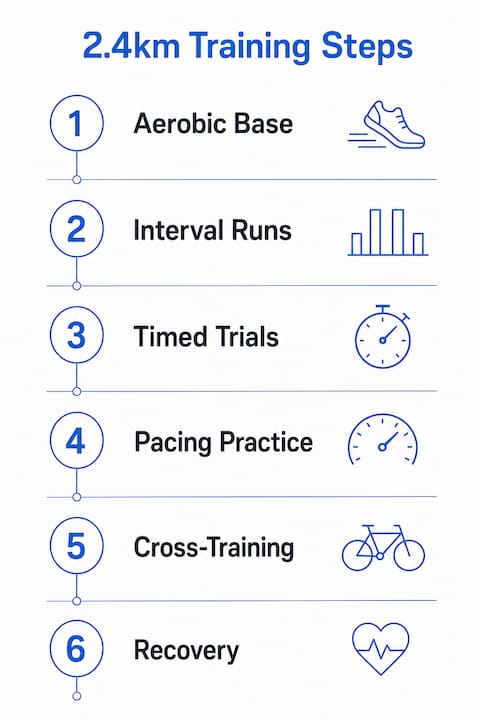
A structured 8-week program, training 3–4 times weekly, is the most effective framework for improving your 2.4km run time. The program combines three run types: aerobic base runs, interval repeats, and tempo runs. Each type targets a different physical system, and together they produce faster race times.
Aerobic base runs are your foundation. Run at a comfortable, conversational pace for 20–30 minutes. These sessions build the cardiovascular engine that sustains you through the full 2.4km. Without a strong aerobic base, speed work produces limited gains.

Interval training is where your pace actually improves. A structured 8-week program uses 4–6 repetitions of 400m at a pace faster than your target race pace, with 90 seconds of jogging or walking recovery between each rep. That recovery period matters. It lets your heart rate drop enough so the next rep is genuinely fast, not just uncomfortable.
Tempo runs sit between base runs and intervals in intensity. Run at a “comfortably hard” pace for 15–20 minutes. Tempo work raises the pace you can sustain for the full 2.4km distance. Think of it as training your body to treat your race pace as normal.
- Run 3–4 days per week. Never skip two consecutive days.
- Week 1–2: focus on base runs only. Build the habit before adding intensity.
- Week 3–5: add one interval session per week alongside two base runs.
- Week 6–7: add one tempo run. Drop one base run to manage total load.
- Week 8: reduce volume by 30% and complete one full timed 2.4km trial.
Performing one full timed 2.4km run weekly from week 4 onward simulates race conditions and tracks your real progress against the IPPT scoring table. Do not skip this. Athletes who only train in pieces often underperform on test day because they have never practiced the full effort.
Pro Tip: Record your 400m interval splits using a GPS watch like the Garmin Forerunner 165. Consistent splits mean you are training at the right intensity. Wildly varying splits mean you are starting too fast.
How to pace your 2.4km run for the best IPPT result?
Pacing is the skill that separates candidates who finish strong from those who fade badly in the final 400m. Starting the first 400m too fast is the single most common mistake in the 2.4km run. It causes early lactic acid buildup that forces you to slow down far more than the time you “saved” at the start.
A controlled first lap is not a weakness. It is a strategy. Here is a reliable pacing approach for the full 2.4km:
- Lap 1 (0–400m): Run at a pace that feels slightly too easy. Your breathing should be controlled. If you are gasping, you are already too fast.
- Lap 2 (400–800m): Settle into your target race pace. Your breathing will deepen but stay rhythmic.
- Lap 3 (800–1,200m): Hold the same pace. This is where mental discipline matters most. Resist the urge to surge.
- Lap 4 (1,200–1,600m): Begin a gradual increase. Your effort should rise, but your pace change should be small.
- Lap 5 and final stretch (1,600–2,400m): Give everything you have. By pacing conservatively early, you will have fuel left here.
Signs you went out too fast include: a burning sensation in your legs before the halfway mark, an uncontrollable urge to walk before lap 4, and a final time that is slower than your training runs. All three are pacing failures, not fitness failures.
Breathing control reinforces pacing. A 2-in, 2-out breathing rhythm (inhale for two footstrikes, exhale for two) works well at moderate pace. When you push in the final 600m, shift to a 2-in, 1-out pattern. This keeps oxygen supply high without disrupting your stride.
Pro Tip: Use split timing during training runs. Check your watch at every 400m mark. If your first split is more than 5 seconds faster than your target lap time, slow down immediately. Catching a pacing error at 400m costs you almost nothing. Catching it at 1,200m costs you everything.
Consistent pacing practice also reduces premature fatigue that derails otherwise well-trained candidates on test day.
How to safely build running stamina and avoid injury during IPPT training?
Building stamina safely requires progressive overload. That means increasing your weekly running volume or intensity by no more than 10% per week. Jumping from two runs per week to five in a single week is the fastest route to a stress fracture or shin splints.
For candidates who are new to running or returning after a long break, a progressive run/walk approach is the right starting point. A 12-week progressive plan builds safely to 30 minutes of continuous running before any speed work begins. This approach reduces injury risk and builds the cardiovascular base that makes interval training productive rather than damaging.
Training at least 3 days per week is the minimum frequency to sustain aerobic adaptations. Training only twice per week may produce initial gains, but the heart and lungs detrain during the gaps between sessions. Three sessions per week maintains cardiac size and aerobic capacity. Four sessions accelerates improvement.
Common running injuries during IPPT preparation and how to prevent them:
- Shin splints: caused by too much volume too soon. Prevent by increasing mileage gradually and running on softer surfaces when possible.
- Runner’s knee: caused by weak hip and glute muscles. Prevent with bodyweight squats and lateral band walks two days per week.
- Plantar fasciitis: caused by tight calves and poor footwear. Prevent with daily calf stretches and replacing worn running shoes.
- IT band syndrome: caused by overstriding and weak hips. Prevent by shortening your stride and adding hip strengthening exercises.
Cross-training on rest days accelerates recovery without adding running stress. Cycling, swimming, and rowing all build cardiovascular fitness while giving your legs a break. For injury prevention during training, prioritize sleep and nutrition equally with your workouts. Adaptation happens during recovery, not during the run itself.
What role do push-ups and sit-ups play alongside 2.4km run training?
The IPPT requires a minimum score in every station to pass. Push-ups and sit-ups each contribute up to 25 points, and the run carries 50 points. That scoring structure means the run is worth as much as both strength stations combined. Improving your run time is the most time-efficient way to jump scoring bands.
That said, neglecting push-ups and sit-ups is a mistake. You must score at least 1 point in every station to pass. A candidate who runs a Gold-level time but fails to complete a single valid push-up still fails the entire test.
| Station | Max Points | Training Method | Test Format |
|---|---|---|---|
| 2.4km run | 50 | Intervals, tempo runs, base runs | Timed continuous run |
| Push-ups | 25 | Timed 1-minute sets | Max reps in 1 minute |
| Sit-ups | 25 | Timed 1-minute sets | Max reps in 1 minute |
Timed 1-minute sets for push-ups and sit-ups directly replicate test conditions. Regular gym sets with rest between reps do not build the specific endurance the test demands. Practice the exact format: start a timer, complete as many clean reps as possible, stop at 60 seconds. This trains your body and your mind for what test day actually feels like.
A balanced weekly schedule dedicates two sessions to running and one session to push-up and sit-up practice. Avoid training push-ups and sit-ups the day before a hard interval run. Fatigued upper body muscles do not affect your legs, but overall fatigue does affect your pace.
Key Takeaways
Consistent, structured IPPT training for the 2.4km run, combining intervals, tempo runs, and conservative pacing, produces the fastest score improvements across all IPPT award bands.
| Point | Details |
|---|---|
| Run carries the most weight | The 2.4km run scores up to 50 points, equal to push-ups and sit-ups combined. |
| 8-week structured plan works | Train 3–4 days weekly using base runs, 400m intervals, and tempo runs. |
| Pace the first lap conservatively | Starting too fast in the first 400m is the top cause of poor finish times. |
| Train all three stations | You must score at least 1 point per station; neglecting any one station risks a fail. |
| Recovery drives adaptation | Training below 3 days per week leads to detraining and lost cardiovascular gains. |
What I’ve learned watching candidates train for the 2.4km
Most candidates I have worked with lose time not because they are unfit, but because they train without a plan and pace without discipline. They run hard every session, never recover properly, and wonder why their time plateaus after week three.
The counterintuitive truth about the 2.4km is that your slowest training runs matter most. Easy base runs build the aerobic engine that makes your fast runs possible. Skipping them to do more intervals is like skipping foundation work on a building. It looks fine until it collapses under load.
Pacing is a skill, not a personality trait. I have seen candidates shave 30 seconds off their time in a single week simply by running the first lap 10 seconds slower. That is not a fitness gain. That is a strategy gain. The fitness was already there. The pacing was the missing piece.
My honest recommendation: use the official IPPT scoring table to set a specific time target before you start training. Vague goals produce vague effort. If you know that running 2.4km in 11 minutes and 30 seconds moves you from a pass to Silver, you have a concrete number to chase every session. That specificity changes how you train.
Finally, do not wait until week 6 to run a full timed 2.4km. Run one in week 2 to establish your baseline. Run one in week 4 to check progress. Run one in week 7 to confirm readiness. Three data points tell you far more than any training log.
— Jason John
Gear and nutrition to support your IPPT training
Training hard requires fueling smart. Singapore’s heat and humidity accelerate fluid loss during every run session, and dehydration directly reduces your pace and endurance.

RacepackSingapore carries the products that keep your training sessions productive. GU Energy Gels deliver clean, fast-absorbing carbohydrates that prevent energy drops during longer training runs. For hydration, HIGH5 Zero hydration tablets replenish electrolytes lost through sweat without adding unnecessary calories. Pair these with a Garmin Forerunner 165 to track your pace, splits, and heart rate every session. All products ship with next-day delivery across Singapore. Buy now and give your training the support it deserves.
FAQ
What is the 2.4km run worth in the IPPT?
The 2.4km run scores up to 50 out of 100 points, making it the highest-weighted station in the IPPT. It equals the combined value of push-ups and sit-ups.
How many days per week should I train for the 2.4km run?
Train at least 3 days per week to maintain aerobic adaptations. Training fewer than 3 days per week leads to cardiovascular detraining between sessions.
What is the best interval session for improving 2.4km run time?
Run 4–6 repetitions of 400m at a pace faster than your target race pace, with 90 seconds of jogging or walking recovery between each rep.
Why do I slow down badly in the last 400m of the 2.4km?
Starting the first lap too fast causes early lactic acid buildup that forces a slowdown in the final stretch. Run the first 400m at a controlled, sustainable pace to fix this.
How do I train push-ups and sit-ups for the IPPT?
Practice timed 1-minute sets that replicate the exact test format. Regular gym sets with rest breaks do not build the specific endurance the IPPT stations demand.
Can beginners complete an 8-week IPPT training plan?
Beginners should start with a 12-week progressive run/walk plan before attempting the 8-week speed-focused program. This builds the cardiovascular base needed for interval training safely.
What should I eat or drink before a 2.4km training run?
Stay well hydrated before every session. For runs under 30 minutes, water and electrolytes are sufficient. For longer training sessions, a small carbohydrate source like a GU Energy Gel 15 minutes before the run prevents energy dips.
Does cross-training help with IPPT 2.4km preparation?
Yes. Cycling, swimming, and rowing build cardiovascular fitness without adding running stress to your legs. Use cross-training on rest days to accelerate recovery and maintain aerobic conditioning.
How do I track my progress during IPPT training?
Run one full timed 2.4km trial in week 2, week 4, and week 7 of your training block. Compare your times against the official IPPT scoring table to measure real progress.
What GPS watch works best for tracking IPPT run training?
The Garmin Forerunner 165 tracks pace, heart rate, and split times per lap, giving you the data needed to correct pacing errors during every training session.
How does hydration affect 2.4km run performance?
Dehydration reduces both pace and endurance. Singapore’s heat accelerates fluid loss, so replenishing electrolytes with products like HIGH5 isotonic drinks before and after training sessions maintains performance across your full training block.
What is the minimum score needed to pass the IPPT?
Candidates must score at least 1 point in every station (push-ups, sit-ups, and the 2.4km run) and reach a total score that meets the passing threshold. Failing any single station results in an overall fail regardless of scores in the other stations.