

Race fueling plans and authentic GU Energy Chews, next day in Singapore
GU Energy Chews are available in Singapore through authentic retailers, including Racepack SG, so sourcing genuine product locally isn’t the obstacle it once was. They deliver fast carbohydrate, sodium, and an amino-acid blend in a chewable format, with caffeine in select flavors. When used within a structured fueling plan rather than eaten randomly mid-run, they serve as a useful tool for training and race day.
TL;DR:
Buying from dedicated sports nutrition retailers like Racepack SG ensures authentic product, verified batch codes, and offers next-day delivery, reducing the risk of counterfeits.
Each GU Energy Chew provides about 22 to 23 grams of carbohydrate and 40 mg of sodium, with caffeine in select flavors like Strawberry, suitable for long endurance efforts.
For events longer than 2.5 hours, most athletes aim for 30 to 60 grams of carbohydrate per hour, often combining chews, gels, and drinks to meet high-energy needs.
Proper storage in a cool, dry place and pre-opening packaging help maintain chew texture and prevent degradation caused by Singapore’s heat and humidity.
Alternating chews with gels improves gastrointestinal tolerance and helps manage palate fatigue during ultra-distance or long-duration training sessions.
Table of Contents
Where To Buy GU Energy Chews in Singapore
Racepack SG stocks GU Energy Chews in single and multi-packs, which matters if you’re building a race kit rather than buying one packet to try. Choosing where to buy comes down to trading convenience for certainty.
-
Dedicated sports nutrition retailers typically show batch dates, offer real customer support, and stand behind returns if a pack arrives damaged.
-
General marketplaces often win on sticker price but rarely disclose storage conditions, and “too good to be true” listings are frequently gray-market stock or expired inventory.
-
Direct brand imports can work but usually mean paying for international shipping and customs handling on something you could get faster locally.
Before you buy anywhere, check the expiry date printed on the wrapper, confirm the seller has a stated return policy, and look at review history rather than just star ratings. If you want to compare cost properly, work out the price per gram of carbohydrate rather than per pack. A pack that looks cheaper can actually cost more per usable gram of fuel once you account for serving size.
What’s Actually in a GU Energy Chew?
Each serving of GU Energy Chews delivers roughly 90 to 100 calories and about 22 to 23 grams of carbohydrate, along with sodium for hydration support and an added amino-acid blend. That carbohydrate figure is the number that matters most when you’re planning intake for a long run or ride, since it’s what you’ll actually be counting on race day.
Nutrition snapshot: A single GU Energy Chews serving carries ~22 to 23 g of carbohydrate and 40 mg of sodium, packed into a chewable format designed to sit easier on the stomach than a thick gel.
Not every flavor is caffeinated. Strawberry contains about 20 mg of caffeine per serving, while other flavors in the range are caffeine-free, allowing you to choose based on whether you want a caffeine boost or just clean fuel. GU also positions chews as a direct alternative to gels with a similar carbohydrate profile in a different texture.
Pack sizes matter more than most runners realize:
-
Single packets work for testing a new flavor before race day.
-
6 or 12 packs suit a training block where you’re dialing in your cadence.
-
24 packs make sense once you know your plan and want to stock a full season.
If the resealable pouch gets fiddly mid-effort, transfer a few chews into a small zip pouch before you head out. It saves you fumbling with packaging when your hands are sweaty and your heart rate is climbing.
How To Use GU Energy Chews for Training and Race Day
Sports-nutrition guidance for events lasting longer than about 2.5 hours points to a carbohydrate intake target of 30 to 90 grams per hour, with some elite research exploring intakes up to 120 g/h. GU Energy Chews give you a simple way to hit a number inside that range without doing complicated math mid-race.
Here’s how that translates into actual chews and packets:
-
Conservative pace (30 to 45 g/h): roughly one and a half to two servings of chews per hour, ideal for easier long runs or moderate-effort rides.
-
Moderate pace (45 to 60 g/h): about two to two and a half servings per hour, which suits most marathon and half-Ironman efforts.
-
High-output pace (60 to 90 g/h): mix chews with gels or a carbohydrate drink, since eating three or more servings of chews an hour gets tough on the jaw and the stomach.
Research on carbohydrate absorption shows fluids, gels, and chews can deliver comparable exogenous carbohydrate oxidation when used correctly, which is the science behind why mixing formats works rather than hurting your fueling. Alternating textures also fights the flat “I can’t eat one more gel” feeling that hits during long ultras.
Pro Tip: Always pair chews with a small sip of water, not a big mouthful. Chewing dry carbohydrate without fluid slows how quickly it clears your stomach and can trigger cramping late in a race.
Practice your planned cadence in training long before race day. What works fine in a 90-minute training run can feel very different at hour four of a marathon.
Chews vs. Gels: Which Format Should You Use?
Gels tend to clear the stomach slightly faster than chews, which makes them the better call when you need a quick hit of carbohydrate during a hard push, like a late-race surge or a steep climb. Chews shine in the opposite scenario: long, steady efforts where you have time to chew and where the texture break from constant gel packets actually helps you keep eating.
-
Choose gels when you need speed, minimal chewing, and a format you can squeeze down in seconds during high intensity.
-
Choose chews for lower-intensity, longer stretches where palate fatigue is the real threat to your fueling plan.
-
Alternate both during ultra-distance events, and layer in a carbohydrate drink when you need to push toward the higher end of the 30 to 90 g/h range.
-
Watch caffeine stacking if you’re using caffeinated gels and caffeinated chews like Strawberry in the same session. It adds up fast.
A recent review of ultra-endurance fueling practices backs the mixed-format approach specifically because it reduces gastrointestinal distress compared to relying on one texture for six or more hours.
Field-Smart Tips for Carrying and Eating Chews Mid-Effort
The gap between “this fueling plan looks great on paper” and “this actually works at kilometer 30” usually comes down to logistics, not nutrition science.
-
Pre-open packets or transfer chews into a small soft pouch before you start, so you’re not tearing plastic with cold, shaky hands.
-
Carry slightly more than your planned amount. Heat and heavy sweat losses in Singapore’s climate can push your carbohydrate and sodium needs upward mid-race.
-
Test your exact cadence in training runs of increasing length, and log how your stomach and energy feel at each distance.
-
Chew fully and sip water with each serving. Swallowing chunks whole while sprinting is how people end up walking the last five kilometers holding their stomach.
Pro Tip: Keep a simple log after long training sessions: how many chews, what time intervals, and how your gut felt. Patterns show up fast once you have three or four sessions recorded.
Why We Recommend Racepack SG for GU Energy Chews
Racepack SG lists GU Energy Chews and GU gels across multiple pack sizes, and stands behind guaranteed product authenticity with next-day delivery to customers in Singapore. That combination matters more than it sounds. Buying fueling products for an upcoming race isn’t the moment to gamble on an unverified seller shipping you stock of unknown age from an unknown warehouse.
Compared to a generic marketplace listing where you can’t verify the seller’s storage conditions or batch history, a dedicated retailer carrying full pack ranges and fast local delivery removes most of the guesswork from your pre-race prep.
Delivery Times and Shipping Options in Singapore
Speed matters when you’re two weeks out from a race and just realized your fueling stock is running low. Next-day delivery models can allow an order placed today to arrive the following day, which can be faster than the multi-day waits common with cross-border marketplace orders.
That speed matters for two practical reasons. First, race-week prep leaves little margin for a delayed parcel. Second, athletes training for a specific date, whether that’s a half-marathon or a full triathlon, often only realize their fueling supply is short a week or two out, after they’ve mapped their long runs and counted servings.
When comparing shipping options, weigh a few things beyond just delivery speed:
-
Whether the retailer ships from local stock or drop-ships from overseas, since the latter usually means longer transit times regardless of what the checkout page promises.
-
Whether there’s a minimum order value for free shipping, which affects whether it makes sense to stock up on chews, gels, and hydration products in one order.
-
Whether tracking is provided, so you’re not guessing when a parcel timed for race week will actually arrive.
For anyone training on a fixed schedule, ordering fueling products at least one to two weeks before a key long run or race gives you a buffer even if a delivery slips a day. Next-day service is reassuring, but building in a small margin is still smarter than cutting it to the wire.
How To Spot Authentic GU Energy Chews vs. Counterfeits
Counterfeit and gray-market sports nutrition products are a real risk in any market where demand outpaces official distribution, and Singapore is no exception. The good news is that genuine GU Energy Chews packaging has consistent, checkable details.
Look at the printed lot number and expiry date first. Authentic packets have a clear, laser-printed batch code, not a smudged stamp or a handwritten sticker. Check the ingredient list and nutrition panel against the official GU Energy product page. If sodium, calorie, or carbohydrate figures on the pack you’re holding don’t roughly match what the brand publishes, treat that as a red flag rather than a rounding error.
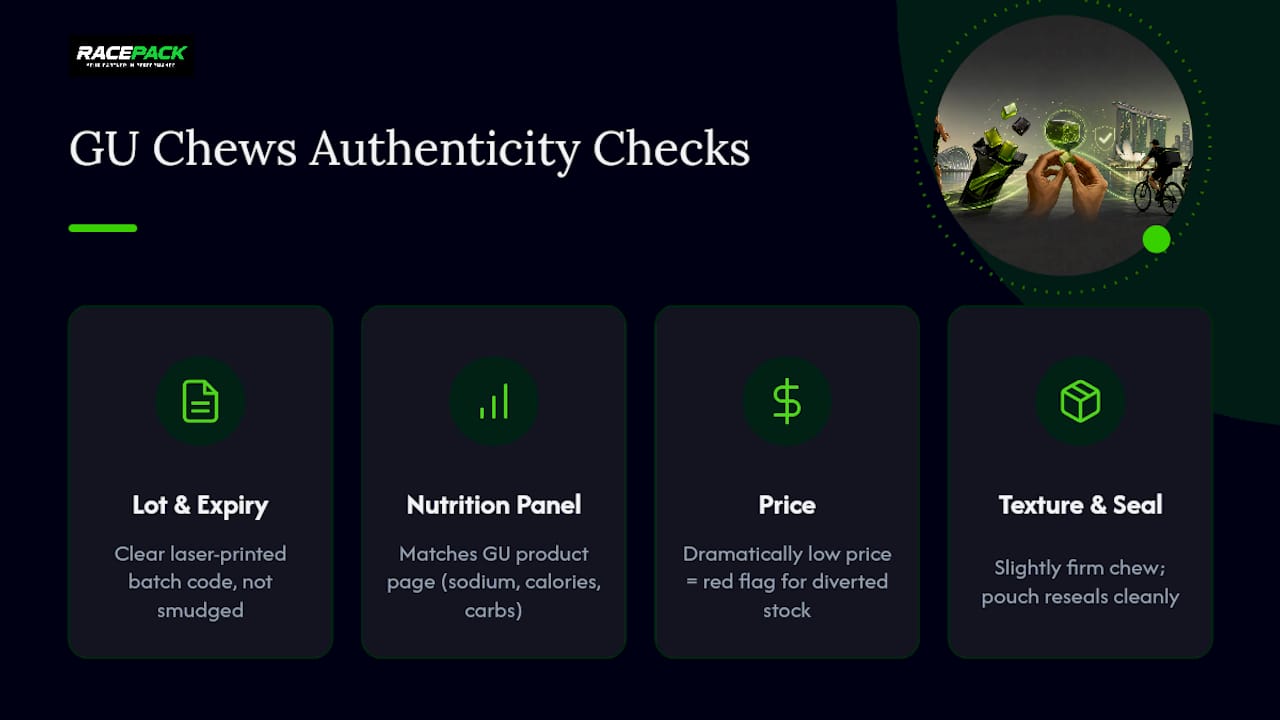
Price is often the clearest tell. A pack priced dramatically below what established retailers charge is far more likely to be old, damaged, or diverted stock than a genuine bargain. Texture and packaging quality matter too: authentic chews have a consistent, slightly firm chew and a resealable pouch that seals properly. If the wrapper feels flimsy, prints look blurry, or the seal doesn’t close cleanly, that’s a warning sign worth acting on.
Buying from a retailer that explicitly guarantees authenticity, like Racepack SG, removes most of this guesswork upfront rather than leaving you to inspect a suspicious pack after it’s already arrived.
Storage Tips for Singapore’s Heat and Humidity
Singapore’s climate is genuinely tough on sports nutrition products. High humidity and consistent heat can soften chews, encourage clumping, and, over time, degrade flavor and texture faster than in a temperate climate.
Store unopened packets in a cool, dry cupboard away from direct sunlight and away from kitchen appliances that generate heat. A bedroom drawer or a closet shelf works better than a car boot or a balcony storage box, both of which can hit high temperatures fast under the sun. If you’re prepping a race kit days in advance, an airtight container adds a layer of protection against ambient humidity seeping into the packaging seals.
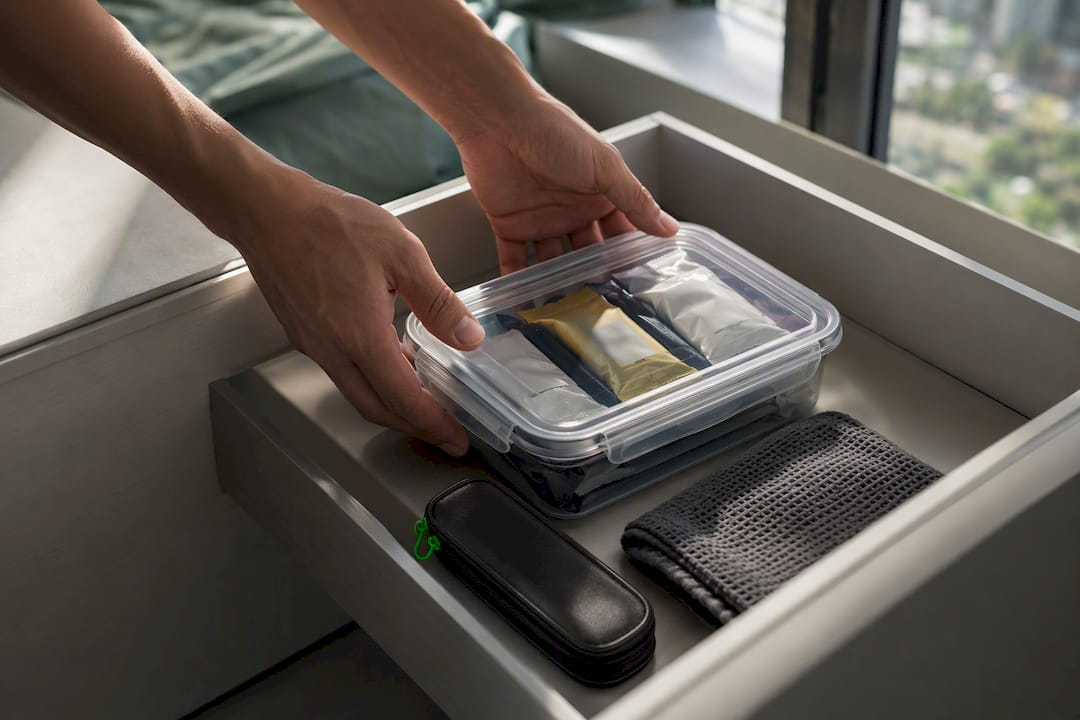
For athletes who buy in bulk, like a 12 or 24 pack, a dedicated storage solution keeps things organized and protected. A supplement storage box works well for this, keeping chews, gels, and loose vitamins separated and away from moisture rather than rattling around in a gym bag pocket. Once you’re within a day or two of a race, moving your race-day chews into a smaller, dedicated pouch also protects them from getting crushed alongside keys, phones, and other gear in your kit bag.
An Editorial Take on Fueling Smarter, Not Just Harder
Most fueling advice online treats carbohydrate intake as a single number to hit, and that’s where a lot of runners go wrong. The 30 to 90 g/h range from sports-science guidance is a target zone, not a rule you follow identically every session. What the research and product data actually support is a plan built around your specific pace, gut tolerance, and event length, tested repeatedly before race day rather than improvised on it.
The conventional advice oversimplifies chews versus gels into a binary choice. The more useful framing is that texture is a tool for managing appetite over long durations, not just a delivery mechanism for carbohydrate. If you’re only reaching for one format, you’re leaving a genuinely useful lever unused.
What should come first, before flavor preference or pack size, is verifying you’re buying real product from a retailer that can prove it. Everything else, cadence, mixing formats, hydration timing, only matters once you know what’s actually in the packet you’re eating.
— Jason John
Build Your Race Kit: GU Chews, Gels, and Hydration in One Order
Buying your race kit from a single retailer offering verified authenticity and fast delivery can streamline preparation, avoiding the hassle of assembling it from multiple marketplace sellers with uncertain stock.

A practical starter kit for most endurance events looks like this: a box of GU Energy Gels for your high-intensity segments, a pack of GU Energy Chews for the long steady stretches, an HIGH5 750ml bottle with hydration tablets to pair with your carbohydrate intake, and a MyProtein supplement storage box to keep it all organized and dry. Every item ships with the same authenticity guarantee and delivery speed.
Ready to fill out your fueling plan? Buy GU Energy Chews now and have your race kit sorted before your next long run.
Sources
FAQ
Is GU Energy Healthy to Use Regularly?
GU Energy Chews are formulated as a fast-carbohydrate fuel source for exercise, not a general health food, so “healthy” depends on context. During training or racing, the 22 to 23 g of carbohydrate and sodium per serving serve a specific performance purpose rather than everyday nutrition.
Are GU Energy Chews Good for Endurance Athletes?
Yes, they’re a solid option when used inside a planned carbohydrate strategy rather than eaten randomly. Their chewable format and roughly 22 to 23 g of carbohydrate per serving make them easy to dose against the 30 to 90 g/h guidance for events over 2.5 hours.
What Stores Sell GU Gels and Chews in Singapore?
Dedicated sports nutrition retailers like Racepack SG carry both GU gels and chews with guaranteed authenticity and next-day delivery. General marketplaces also list GU products, but batch verification and return policies vary widely by seller.
Are GU Energy Gels Any Good Compared to Chews?
Gels absorb slightly faster than chews, making them the better choice for quick energy during hard efforts, while chews suit longer, steady segments where chewing time isn’t a problem. Many endurance athletes carry both and alternate formats to manage palate fatigue and hit their hourly carbohydrate target.
How Many GU Energy Chews Should I Eat Per Hour?
It depends on your target carbohydrate rate, but two to two and a half servings per hour lands most athletes in the 45 to 60 g/h range suited to marathon-length efforts. Higher targets above 60 g/h usually work better mixed with gels or a carbohydrate drink rather than eating three or more servings of chews alone.
Do All GU Energy Chews Flavors Contain Caffeine?
No. Only select flavors, such as Strawberry, contain caffeine, at about 20 mg per serving, while other flavors in the range are caffeine-free. Check the flavor label before buying if you’re planning your caffeine intake around a race start time.
How Much Do GU Energy Chews Cost in Singapore?
Current pricing for GU Energy Chews and pack sizes is listed directly on the Racepack SG product page. Comparing cost per gram of carbohydrate, rather than price per pack, gives a clearer picture of real value across pack sizes.
How Can I Tell if GU Energy Chews Are Counterfeit?
Check the printed lot number and expiry date for a clean, laser-printed code rather than a smudged or handwritten one, and compare the nutrition panel against the official GU product page. A price far below standard retail, blurry printing, or a poorly sealing pouch are all warning signs of diverted or aging stock.
How Should I Store GU Energy Chews in Singapore’s Climate?
Keep packets in a cool, dry spot away from direct sunlight and heat sources, since Singapore’s humidity and heat can soften chews and affect texture over time. An airtight container or a dedicated supplement storage box adds extra protection for bulk packs.
Can I Mix GU Chews With Gels During the Same Race?
Yes, and sports-nutrition research supports it. Alternating chews and gels helps you hit higher carbohydrate targets while reducing the palate fatigue that comes from eating the same texture for several hours straight.
What’s the Difference Between GU Energy Chews and GU Gels Nutritionally?
Both deliver fast carbohydrate, but chews spread the same energy across a chewable format eaten over a minute or two, while gels deliver it in a single quick swallow. Nutrition profiles are broadly similar per serving, with the format choice coming down to digestion speed and personal preference rather than a major nutritional gap.
Where Can I Buy Authentic GU Energy Chews for Race Day?
Racepack SG offers GU Energy Chews with guaranteed authenticity and next-day delivery across Singapore, making it a reliable option when you’re prepping close to a race date. Verifying batch codes and buying from a retailer with a clear return policy reduces the risk of ending up with counterfeit or expired product.