

Fitness and Training Plan for Endurance Athletes
Consistency plus a balanced weekly load plus targeted nutrition produce the largest, fastest performance gains for endurance athletes. Start this week with three actions:
- Schedule three anchor sessions: one long aerobic effort (60–90 min), one interval session, and one strength session.
- Pick your race-day fueling: choose an energy gel and an electrolyte plan, then rehearse both in training.
- Record one objective metric: pace, distance, or heart rate from your first session.
The sections below give you the full framework, from weekly structure to product timing.
Table of Contents
- What does a well-rounded fitness and training plan include?
- How do you structure a weekly plan that balances intensity and recovery?
- How do dynamic warm-ups and mobility work prevent injuries?
- Why does consistency beat complex programming every time?
- What sports nutrition do endurance athletes need, and when?
- How do you measure progress and know when to adjust?
- What do sample weekly plans look like for beginners through advanced athletes?
- Key Takeaways
- What most athletes get wrong about season-long training
- RacepackSingapore has what you need to fuel every session
- FAQ
What does a well-rounded fitness and training plan include?
A well-rounded routine covers five components, and skipping any one of them tends to show up as injury or a plateau. Mayo Clinic identifies these as aerobic activity, strength training, core exercises, balance training, and flexibility/stretching.
- Aerobic work: long runs or rides at conversational pace; shorter zone-2 efforts on easy days. The Mayo Clinic recommends spreading aerobic activity throughout the week.
- Strength training: compound lower-body lifts (squats, Romanian deadlifts, single-leg press) at least twice per week. Strength-first sequencing before aerobic work preserves glycogen for resistance sessions.
- Core/stability: front plank variations, dead bugs, and anti-rotation holds — 10–15 min tacked onto strength days.
- Balance/plyometrics: single-leg balance drills, lateral bounds, or box step-ups to protect ankles and knees.
- Flexibility/mobility: 30–60 second static stretches post-run; dynamic hip openers before strength sessions.
Pro Tip: Schedule strength before your aerobic session on combined days. Your muscles use glycogen most efficiently for resistance work, so doing it first means better output from both halves of the session.
How do you structure a weekly plan that balances intensity and recovery?
The goal is to spread stress and recovery so your body adapts without breaking down. Here is a practical seven-day template:
- Monday: Strength session (45–60 min, full-body compound lifts).
- Tuesday: Interval or threshold run/ride (30–45 min quality work, zone 4–5 efforts).
- Wednesday: Easy zone-2 aerobic session (45–60 min) or active recovery.
- Thursday: Strength session (45–60 min) — keep it separate from Tuesday’s hard effort.
- Friday: Rest or light mobility circuit (20–30 min).
- Saturday: Long aerobic session (60–90+ min at easy-to-moderate pace).
- Sunday: Rest or short easy spin/walk.
For HIIT vs steady-state decisions, place high-intensity days (Tuesday) at least 48 hours from the next hard effort. Keep weekly volume increases to roughly 10% per week as a conservative ceiling. In race week, cut total volume by 30–40% but keep at least one short, sharp effort to stay sharp.

How do dynamic warm-ups and mobility work prevent injuries?
Dynamic warm-ups prime both prime movers and stabilizers, cutting acute injury risk before any session. A 3–5 minute sequence before every workout is non-negotiable.
Step-by-step dynamic warm-up:
- Leg swings (forward/lateral): 10 reps each leg
- Hip circles: 10 reps each direction
- High knees or marching: 20 meters
- Lateral sidestepping: 20 meters each way
- Heel-to-toe walking: 20 meters
- 2–3 build-up strides (before intervals only)
“A dynamic warm-up activates the stabilizers people forget about — the small muscles that protect joints under load. Skip it and you’re one bad step away from weeks off.” — Vijay Daryanani, certified trainer
“Mobility work isn’t recovery fluff. It’s the thing that keeps you training when everyone else is rehabbing.” — Ackeem Emmons, coach
For injury prevention, follow these rules: never increase weekly mileage more than 10% at a time, treat persistent joint pain (not muscle soreness) as a rest signal, and add a 20-minute mobility session once per week to address tight hips, calves, and thoracic spine.
Why does consistency beat complex programming every time?
An ACSM-focused review across more than 30,000 participants found that moving from irregular to consistent training produced greater performance improvements than adopting complex periodization. Adherence is the variable that matters most.
Tracking tools that build consistency:
- Training journals (date, session type, RPE 1–10, duration, one recovery note)
- GPS watch weekly load summaries (use for trend review, not hourly anxiety)
- Fitness tracking professionals recommend periodic subjective check-ins alongside device data
Sample log fields you can copy today:
- Date and session type
- Duration and key metric (pace, power, or HR zone)
- RPE (1–10 scale)
- Recovery note (sleep quality, soreness, energy)
- Next session intention
Set SMART-ER goals (Specific, Measurable, Achievable, Relevant, Time-bound, Evaluated, Reviewed) and attach each training week to a specific race or test date. Coaches also recommend periodic “ignore the numbers” days where you run or ride entirely by feel — this recalibrates your internal effort sense and prevents over-reliance on device data.
What sports nutrition do endurance athletes need, and when?
Targeted nutrition timing across pre/during/post windows supports both training quality and race performance. Here is how the product types map to use cases:
- Energy gels: for efforts over 60–90 minutes; take one every 30–45 min during long runs or rides.
- Isotonic hydration drinks: during sessions to maintain fluid and carbohydrate delivery simultaneously.
- Electrolytes: critical in hot or humid conditions to replace sodium and prevent cramping.
- EAA powders: intra- or post-session to support muscle protein synthesis.
- Protein/recovery powders: within 30–60 minutes post-workout for muscle repair.
| Timing Window | Product Type | Example from RacepackSingapore |
|---|---|---|
| 30–60 min pre-workout | Light carb snack + hydration | HIGH5 isotonic drink |
| Every 30–45 min during effort | Energy gel | GU Energy Gel 24-pack |
| Hot/humid sessions | Electrolyte sachet | HIGH5 ZERO+ Electrolytes |
| Within 30–60 min post-workout | EAA or protein | MyProtein EAA Powder 360g |
| Daily recovery support | Plant-based protein | MyProtein Pea Protein Isolate 2.5kg |
For athletes new to gels, start with a GU Energy Gel single pack (minimum order 8) to test flavors before committing to a GU 6/12/24 multi-pack. A MyProtein Supplement Storage Box keeps your daily supplements and race-day nutrition organized. Pair all of this with a Garmin Forerunner 165 to log fueling timing alongside pace and heart rate data.
Pro Tip: Always rehearse your race-day fueling in training. Your gut needs practice absorbing gels at race pace just as much as your legs do.
How do you measure progress and know when to adjust?
Simple, repeatable tests and trend tracking beat reacting to single-session data every time. Use these protocols:
- 5–10K time trial: every 6–8 weeks on a consistent course; track pace trend.
- FTP or threshold effort: 20-minute hard effort every 8–12 weeks for cyclists; use normalized power.
- Resting HR and HRV: check weekly; a rising resting HR over 3–5 days signals under-recovery.
- Training Stress Score (TSS): weekly TSS trend shows whether load is building, stable, or declining.
Decision rules: increase load when performance improves and recovery metrics are normal. Reduce load when pace or power drops alongside elevated resting HR or persistent fatigue. Consult a coach or sports medicine provider if performance declines for more than two consecutive weeks without a clear cause. A GPS smartwatch makes tracking all of these metrics straightforward across a full training block.
What do sample weekly plans look like for beginners through advanced athletes?
| Day | Beginner (3–4 hrs/wk) | Intermediate (6–8 hrs/wk) | Advanced (10 hrs/wk) |
|---|---|---|---|
| Monday | Rest | Strength 45 min | Strength 60 min |
| Tuesday | Easy run 30 min | Intervals 45 min | Intervals 60 min |
| Wednesday | Strength 30 min | Zone-2 run 60 min | Zone-2 ride 90 min |
| Thursday | Rest | Strength 45 min | Strength 60 min + drills |
| Friday | Easy run/walk 30 min | Mobility 30 min | Tempo run 45 min |
| Saturday | Long run 45–60 min | Long run 60–90 min | Long run 2+ hrs |
| Sunday | Rest | Rest or easy 30 min | Easy recovery ride 60 min |
Scaling and race-week rules:
- Increase weekly volume by no more than 10% per week; substitute a cross-training session (pool running, cycling) when injury risk rises.
- Race week: cut total volume 30–40%, keep one short interval session (20 min), reduce strength to bodyweight only.
- Triathlon athletes: prioritize swim technique early in the week when fatigue is lowest; run-bike brick sessions on Saturday build race-specific adaptation.
For athletes balancing a full-time job, the beginner template above fits within a standard work week without requiring early-morning doubles.
Key Takeaways
Consistent, balanced training combined with targeted nutrition timing produces the greatest performance gains for endurance athletes.
| Point | Details |
|---|---|
| Consistency drives results | An ACSM-focused review of 30,000+ participants found consistent training outperforms complex programming. |
| Five components matter | Cover aerobic, strength, core, balance, and flexibility every week to reduce injury and build performance. |
| Fuel every long effort | Use energy gels every 30–45 min for efforts over 60–90 min; add electrolytes in hot conditions. |
| Test and track trends | Run a 5–10K time trial every 6–8 weeks and act on multi-week trends, not single sessions. |
| RacepackSingapore fueling | GU Energy Gels, HIGH5 ZERO+ Electrolytes, and MyProtein EAA Powder cover every fueling window. |
What most athletes get wrong about season-long training
Most athletes treat their training plan as a fixed document rather than a living system. The plan should flex around key races, recovery weeks, and life stress — not the other way around. Sport nutrition periodization follows the same logic: your fueling needs in a base-building month look very different from the week before a marathon.
Product selection should match event distance and conditions. GU Energy Gels are a reliable marathon fueling staple. HIGH5 ZERO+ Electrolytes belong in your kit for any race in warm conditions. MyProtein Pea Protein Isolate and EAA Powder cover the recovery window that most athletes underserve. Test every product in training first — race day is not the time to discover a flavor disagreement.
RacepackSingapore’s catalog gives you authenticated, performance-grade products with next-day delivery, so you are never scrambling for supplies the week before a race. Review the product pages, build your fueling kit, and rehearse it across your next training block.
RacepackSingapore has what you need to fuel every session
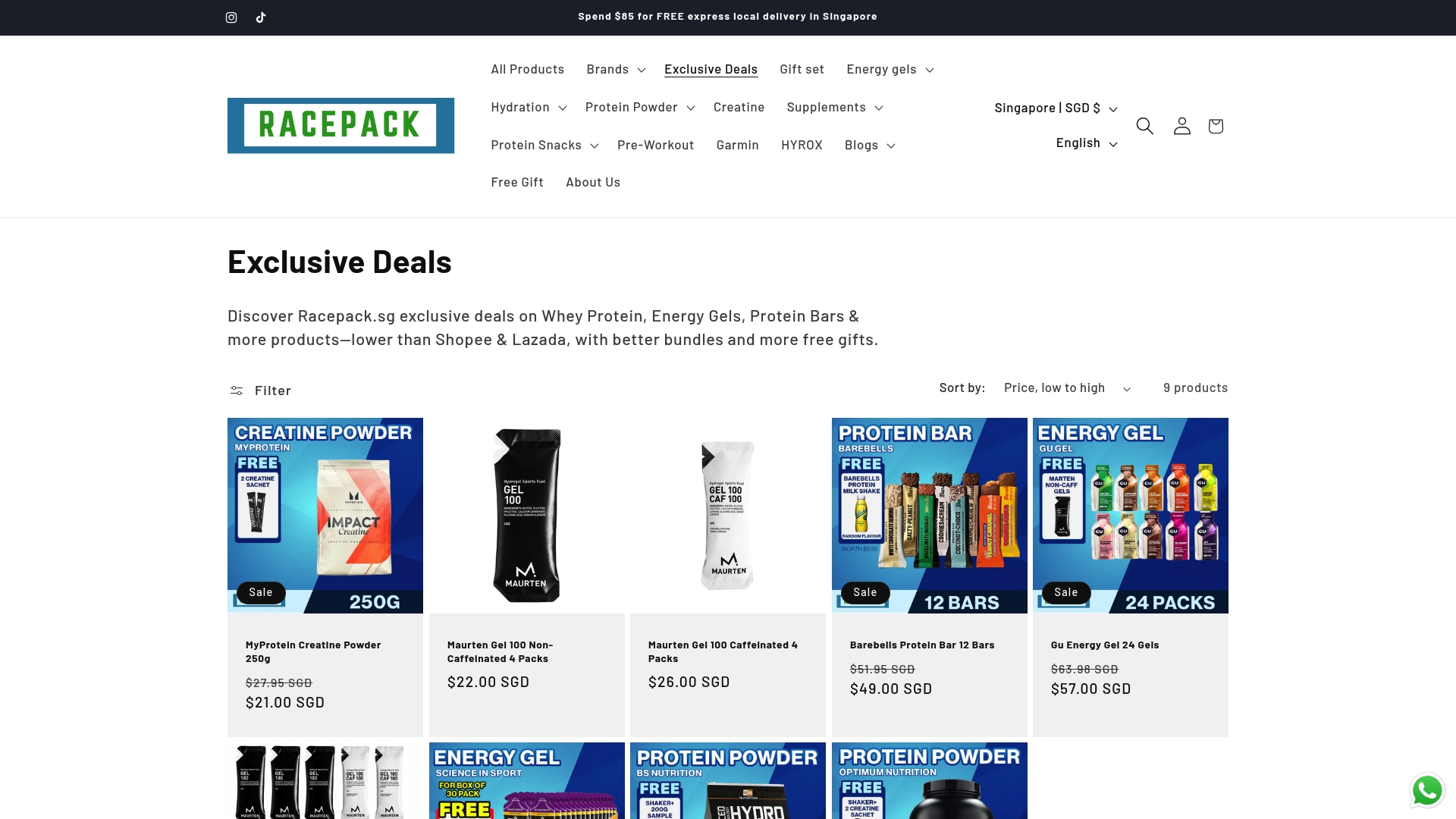
RacepackSingapore stocks the full range of endurance nutrition you need, from GU Energy Gels and HIGH5 ZERO+ Electrolytes to MyProtein EAA Powder and the Garmin Forerunner 165 GPS watch. Every product is guaranteed authentic. Every order ships with next-day delivery within Singapore. Whether you are building your first race-week fueling kit or restocking a full training block, you will find exactly what you need in one place. Check your fueling gaps, pick your products, and get your next training block sorted today.
Buy Now at RacepackSingapore
FAQ
What is the most important factor in endurance training?
Consistency is the single most statistically significant driver of results. An ACSM-focused review of more than 30,000 participants found that regular, predictable training outperforms complex programming every time.
How often should endurance athletes do strength training?
Mayo Clinic recommends strength training for all major muscle groups at least twice per week. Schedule it before aerobic sessions on combined days to preserve glycogen for resistance work.
When should I take energy gels during a race or long run?
Take one gel every 30–45 minutes during efforts lasting more than 60–90 minutes. Practice this timing in training before race day so your gut adapts to absorbing carbohydrates at race pace.
What electrolyte product works best for hot-weather training?
HIGH5 ZERO+ Multivitamins/Ultra Electrolytes sachets are designed for hot and humid sessions, replacing sodium and key micronutrients lost through sweat. RacepackSingapore carries them with next-day delivery.
How do I know when to increase or reduce my training load?
Increase load when performance improves and resting heart rate stays normal. Reduce load when pace or power drops alongside elevated resting HR or fatigue that persists for more than a few days. Use a repeatable 5–10K time trial every 6–8 weeks to track trends objectively.
Do I need a GPS watch to follow this training plan?
A GPS watch is not required, but it makes tracking pace, heart rate, and weekly load significantly easier. The Garmin Forerunner 165 is an entry-to-mid-level option that covers all the metrics in this guide.
What is the best post-workout recovery product for endurance athletes?
A serving of EAA powder or a protein shake within 30–60 minutes after training supports muscle repair. MyProtein EAA Powder (360g, 30 servings) and MyProtein Pea Protein Isolate 2.5kg are both available at RacepackSingapore.
How do I adjust my training plan for race week?
Cut total volume by 30–40%, keep one short, sharp interval session (around 20 minutes), reduce strength work to bodyweight only, and finalize your fueling and equipment checks by Thursday of race week.