

What Is Running Cadence? A Practical Guide for Runners
TL;DR:
- Running cadence, measured in steps per minute, directly influences running efficiency and injury risk.
- Most runners naturally fall between 150 and 180 SPM, but optimal cadence varies based on pace, body type, and training level.
Running cadence is defined as the total number of steps a runner takes per minute (SPM), and it directly shapes both running efficiency and injury risk. Also called stride rate, cadence is one of the most measurable and trainable variables in your running form. Most recreational runners naturally fall between 150 and 180 SPM at moderate speeds, while elite athletes often exceed that range. Understanding your cadence gives you a concrete lever to pull when you want to run faster, longer, or with less pain. This guide covers running cadence explained from the ground up, including optimal targets, how pace affects stride rate, and how to improve cadence without risking injury.
What is running cadence and why does it matter?
Running cadence is the number of individual foot strikes per minute across both feet combined. It is the foundational metric for understanding how your body moves through space while running. Cadence influences ground contact time and how your body absorbs impact forces with every step. A lower cadence typically means longer strides, more time on the ground, and greater braking forces transmitted through the joints. A higher cadence shortens that contact window, reducing the load on your knees, hips, and ankles.
The relationship between cadence and stride length is where most runners get confused. Many assume running faster requires longer strides. The reality is that elite runners primarily increase speed by turning over faster, not by reaching further forward. Overstriding, which happens when your foot lands far ahead of your center of mass, is a leading contributor to shin splints, IT band syndrome, and stress fractures.
Here is what cadence directly affects in your running mechanics:
- Ground contact time: Higher cadence reduces the milliseconds your foot stays planted, cutting braking force.
- Impact loading rate: Shorter, quicker steps distribute force more evenly across the stride cycle.
- Stride length balance: Cadence and stride length work together. Improving one without considering the other creates imbalance.
- Running economy: Efficient cadence reduces wasted vertical oscillation, keeping more energy directed forward.
Pro Tip: Count your right foot strikes for 30 seconds and multiply by four to get your current SPM. Do this at your easy pace, tempo pace, and race pace. You will likely find three different numbers, and that is completely normal.
The 180 SPM benchmark originated from 1984 Olympics data and has been misapplied as a universal target ever since. It was an observation of elite performance, not a prescription for every runner. Chasing 180 SPM when your natural cadence is 162 SPM can do more harm than good.
How cadence varies by pace, runner type, and experience level
Cadence is not a fixed number. It shifts based on your speed, fitness level, height, leg length, and fatigue state. Understanding this variability is what separates runners who use cadence intelligently from those who obsess over a single target.
Elite male ultramarathon runners average 177.6 SPM, while elite females average 188.5 SPM, with individual variation spanning 160 to 210 SPM across the field. This wide spread proves there is no single ideal running stride rate that applies to everyone. Body mechanics, training history, and race distance all shape what works for a given athlete.
The table below shows approximate cadence ranges by runner category and pace effort:
| Runner type | Easy pace (SPM) | Tempo pace (SPM) | Race pace (SPM) |
|---|---|---|---|
| Recreational beginner | 150–162 | 158–168 | 162–172 |
| Intermediate runner | 160–170 | 168–178 | 172–182 |
| Advanced/competitive | 170–180 | 178–188 | 182–192+ |
| Elite ultramarathoner | 160–177 | 175–188 | 177–210 |
Cadence naturally increases with running pace and may also fluctuate during a run due to fatigue. This means holding a fixed SPM across all training zones is counterproductive. A runner doing an easy recovery jog at 162 SPM who also runs their 5K race at 162 SPM is leaving performance on the table.
“Cadence should be optimized for each specific pace effort rather than maintaining a static cadence across all training zones.” — Nike Running
Height and leg length also play a measurable role. Taller runners with longer legs tend to have naturally lower cadences because their stride arc covers more ground per rotation. Shorter runners often turn over faster by default. This is why comparing your SPM directly to a training partner of a different build produces misleading conclusions. Focus on your own baseline and your own progress.
How increasing cadence improves performance and reduces injury risk
A targeted, gradual increase in cadence produces real biomechanical benefits. Increasing cadence by 5% to 10% effectively reduces ground contact time and impact stress, which lowers injury risk across the lower limb chain. For a runner currently at 160 SPM, a 5% increase means targeting 168 SPM. That eight-step difference per minute adds up to hundreds of fewer high-impact contacts per mile.
The performance benefits extend beyond injury prevention. A higher cadence at the same speed means your stride length stays controlled, your posture stays upright, and your energy expenditure becomes more efficient. Runners who have corrected chronic overstriding through cadence work consistently report faster race times alongside fewer soft-tissue injuries.
Key benefits of a well-calibrated cadence increase:
- Reduced knee loading: Shorter ground contact time means less compressive force through the patellofemoral joint.
- Lower braking impulse: Foot strike closer to your center of mass reduces the deceleration effect with each step.
- Improved posture: Higher turnover naturally encourages a slight forward lean, which is the correct running posture.
- Better fatigue resistance: Efficient mechanics preserve muscle glycogen and delay the form breakdown that causes late-race injuries.
The risk comes from moving too fast. Sudden large jumps to 180 SPM can overload muscles and tendons that are not conditioned for the new movement pattern, creating the very injuries you are trying to prevent. Dr. Anthony Luke recommends prioritizing consistent, comfortable cadence over forcing elite-level targets. His guidance aligns with what most sports physiotherapists observe in practice: the runner who improves cadence by 5% and holds it for eight weeks gains far more than the runner who jumps 15% in two weeks and ends up sidelined.
Pro Tip: Run your cadence improvement work during easy training days, not speed sessions. Your nervous system adapts to new movement patterns best when it is not also managing high metabolic stress.
How to measure and safely improve your running cadence
Measuring cadence accurately is the starting point. You cannot improve what you have not measured, and guessing your SPM leads to wasted effort. Here are the most reliable methods, from low-tech to high-tech:
- Manual counting: Count every right foot strike for 60 seconds during a steady run. Multiply by two for total SPM. Repeat at three different paces to build a complete picture of your cadence profile.
- GPS running watches: Garmin devices, including the Garmin Vivoactive 5, display real-time cadence data alongside pace, heart rate, and distance. This removes guesswork and lets you monitor SPM across every training run automatically.
- Running apps with cadence detection: Apps like Garmin Connect and Strava can detect cadence through your phone’s accelerometer or paired wearable. Multiple tools exist for cadence measurement, so choose the one that fits your existing training setup.
- Metronome apps: Apps like Pro Metronome or RunCadence let you set a target BPM and run to the beat. This is particularly useful for training your nervous system to recognize a new stride rate.
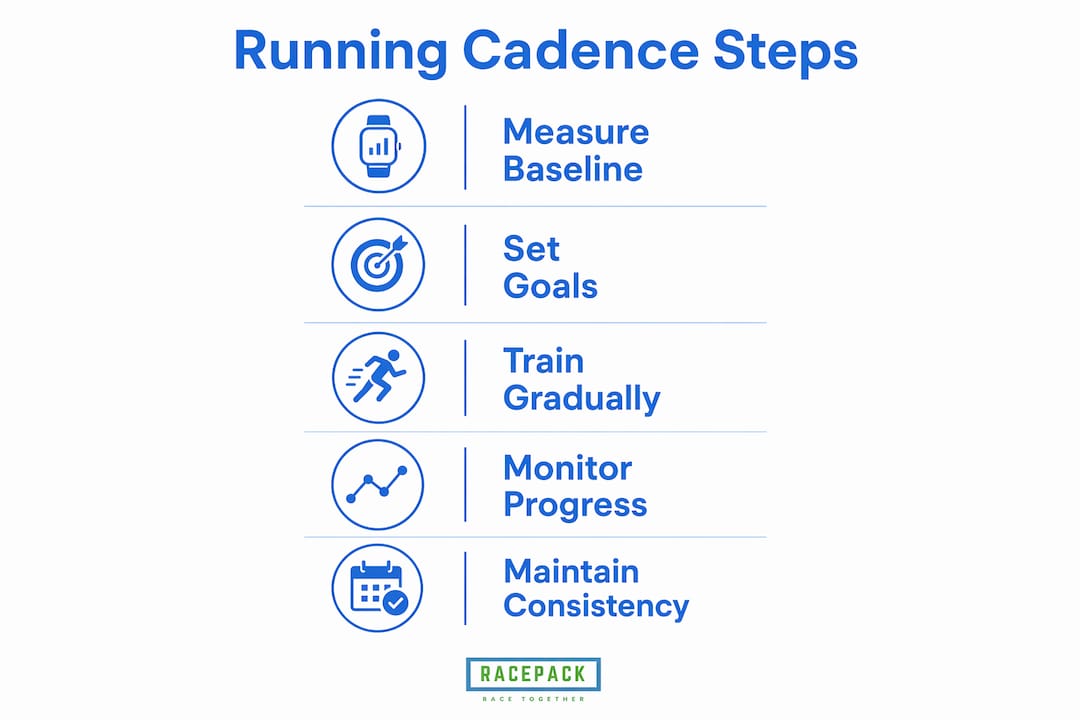
Once you have your baseline, use this progression to improve cadence safely:
- Identify your natural cadence at easy, tempo, and race pace.
- Set a target that is 5% above your easy-pace cadence. For 160 SPM, that is 168 SPM.
- Run two cadence-focused sessions per week, each lasting 20 to 30 minutes at the new target rate using a metronome.
- Hold that target for three to four weeks before increasing again.
- Add specific drills: high knees, quick-step intervals, and short downhill strides all reinforce faster turnover patterns.
Coach Jeff from Runners Connect advises testing your natural baseline cadence and using specific drills twice weekly to build the motor patterns needed for higher cadence. The key word is “build.” Cadence adaptation is a neuromuscular process. It takes weeks of consistent practice before the new pattern feels natural rather than forced. Check out the running training resources at RacepackSingapore for additional guidance on structuring your training.
Common cadence misconceptions runners should stop believing
Several persistent myths about cadence lead runners to train ineffectively or injure themselves chasing the wrong targets. Clearing these up saves you time and keeps you healthy.
- Myth: 180 SPM is the goal for every runner. The 180 SPM figure came from 1984 Olympics observations of elite distance runners. It was never intended as a universal prescription. Recreational runners at easy paces may perform optimally at 162 to 170 SPM.
- Myth: Your cadence should stay constant throughout a run. Cadence fluctuates naturally within a run as pace and fatigue change. Trying to hold a fixed SPM across a two-hour long run works against your body’s natural rhythm.
- Myth: Higher cadence always means better running. Cadence is one variable among many. A runner with excellent form at 168 SPM does not need to force 180 SPM. The goal is efficiency, not a specific number.
- Myth: Cadence improvement is quick. Neuromuscular adaptation takes time. Most runners need six to twelve weeks of consistent work before a new cadence feels natural.
- Myth: Cadence is only relevant for fast runners. Beginners benefit from cadence awareness just as much as competitive athletes. Correcting a low cadence early prevents years of overuse injuries.
Pairing cadence work with smart marathon training strategies gives you the full picture of what it takes to run efficiently over long distances.
Key takeaways
Running cadence is the single most measurable running form variable, and a 5% to 10% increase from your natural baseline produces real reductions in injury risk and improvements in efficiency without requiring any equipment beyond a watch.
| Point | Details |
|---|---|
| Cadence defined | Running cadence is steps per minute (SPM), measured across both feet combined. |
| Typical ranges vary | Recreational runners average 150 to 180 SPM; elite ultrarunners range from 160 to 210 SPM. |
| 180 SPM is not universal | The 180 SPM benchmark was an elite observation from 1984, not a target for all runners. |
| Safe improvement rate | Increase cadence by no more than 5% to 10% at a time to avoid overloading muscles and tendons. |
| Measure before you change | Use a GPS watch, manual count, or metronome app to establish your baseline at multiple paces. |
Why I think most runners overcomplicate cadence
I have worked with a wide range of endurance athletes, from first-time 10K runners to ultramarathon competitors, and the pattern I see most often is this: a runner reads about cadence, fixates on 180 SPM, and immediately tries to run every session at that number regardless of pace, fitness, or body type. Within two weeks, they have a new calf strain or knee complaint and conclude that cadence work does not work for them.
The evidence does not support chasing a fixed number. What it supports is finding your natural baseline at each pace zone and nudging it upward gradually. A runner at 158 SPM who reaches 168 SPM over eight weeks of patient work will feel a genuine difference in how their body absorbs impact. That same runner who jumps to 180 SPM in week one will feel a different kind of difference, and not a good one.
My honest advice is to treat cadence like strength training. You would not add 20 kilograms to your squat in a single session. You add small increments, let your body adapt, and build from there. The same logic applies here. Use a Garmin watch to track your data, run your cadence drills twice a week, and give the process at least six weeks before judging results. Pair that with proper nutrition and recovery, and you will see the gains compound over time. Cadence is not a shortcut. It is a skill, and skills take time to build.
— Jason John
Fuel your cadence training with the right gear and nutrition
Improving your running cadence takes consistent training, and consistent training demands consistent fueling. RacepackSingapore stocks the performance nutrition and tracking technology that endurance athletes in Singapore rely on for both training days and race day.
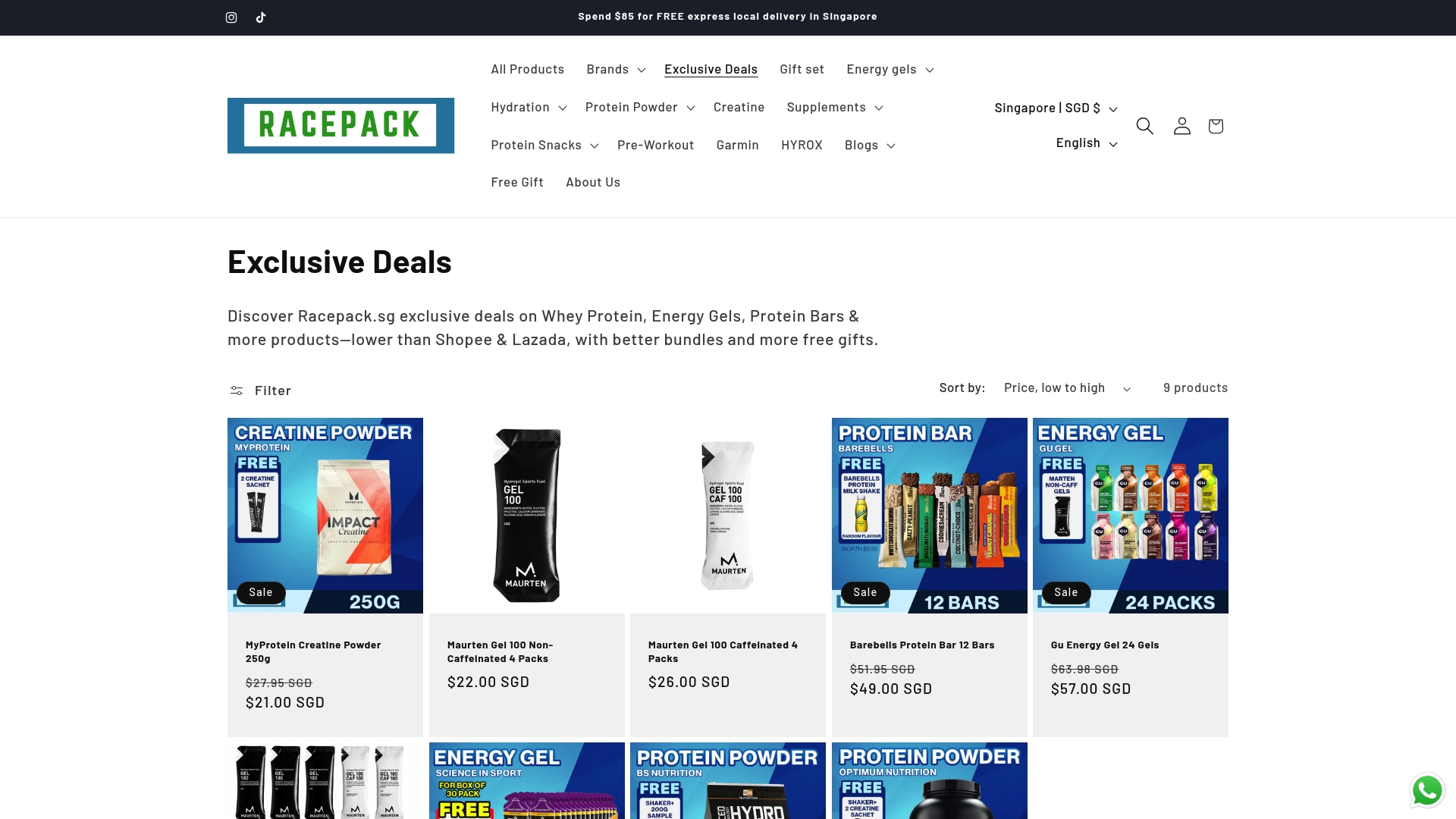
For cadence-focused training sessions, shop energy gels for race day from brands like Maurten, GU, and SiS to keep your energy stable through every interval. Pair that with SiS hydration and endurance products to support electrolyte balance during longer runs. To track your cadence accurately in real time, the Garmin smartwatch range at RacepackSingapore gives you live SPM data alongside pace, heart rate, and training load. All products come with guaranteed authenticity and next-day delivery across Singapore.
FAQ
What is running cadence in simple terms?
Running cadence is the number of steps you take per minute while running, counted across both feet. It is also called stride rate and is measured in steps per minute (SPM).
What is a good cadence for recreational runners?
Most recreational runners fall between 150 and 180 SPM at moderate speeds. The right number depends on your pace, height, and running mechanics, not a universal target.
Is 180 steps per minute the ideal running cadence?
No. The 180 SPM figure came from 1984 Olympics data on elite runners and is not a target for all athletes. Forcing an unnatural cadence significantly different from your baseline increases injury risk.
How do I measure my running cadence?
Count your right foot strikes for 60 seconds and multiply by two, or use a GPS watch like the Garmin Vivoactive 5 to track SPM automatically during every run.
How much should I increase my cadence at a time?
Increase cadence by no more than 5% to 10% at a time. Hold that new rate for three to four weeks before increasing again to allow your muscles and tendons to adapt safely.
Does cadence change with running speed?
Yes. Cadence naturally increases as pace increases. A runner’s SPM at an easy jog will be lower than their SPM at tempo or race pace, and that variation is normal and expected.
Can improving cadence prevent running injuries?
A 5% to 10% cadence increase reduces ground contact time and impact stress, which lowers injury risk in the knees, shins, and hips. Gradual improvement is key. Sudden large increases can cause new injuries.
What tools help improve running cadence?
GPS watches like those in the Garmin range, metronome apps, and structured drills like high knees and quick-step intervals are the most effective tools for building a higher cadence over time.
Does nutrition affect running cadence training?
Proper fueling supports the neuromuscular adaptations needed for cadence improvement. Adequate carbohydrate intake and electrolyte replenishment keep your muscles responsive during cadence drills. Learn more about carbohydrate loading strategies for endurance performance.
How long does it take to improve running cadence?
Most runners need six to twelve weeks of consistent cadence work before the new stride rate feels natural. Two focused sessions per week using a metronome or GPS watch produces the best results.
Should beginners focus on running cadence?
Yes. Beginners benefit from cadence awareness early because correcting a low cadence prevents overuse injuries before they develop. Start by measuring your baseline and focus on gradual improvement alongside your overall running training plan.
Where can I buy cadence tracking devices and running fuel in Singapore?
RacepackSingapore carries Garmin GPS watches for cadence tracking and a full range of endurance nutrition from Maurten, GU, and SiS. Buy now and get next-day delivery across Singapore.