

The Role of Intra Workout Carbohydrates in Performance
TL;DR:
- Intra-workout carbohydrates help maintain blood glucose and preserve muscle glycogen during exercise exceeding 60 minutes. Consuming 30 to 90 grams per hour using glucose-fructose blends optimizes performance while minimizing gastrointestinal issues. They are most beneficial for endurance athletes, prolonged sessions, and those training in hot environments.
Intra-workout carbohydrates are nutrients consumed during exercise to maintain blood glucose and preserve muscle glycogen as training intensity and duration increase. Sports nutrition scientists call this practice “intra-exercise carbohydrate supplementation,” and the evidence supporting it is clear. When you train hard for more than an hour, your glycogen stores deplete faster than your body can replace them from fat alone. Consuming carbohydrates mid-session keeps your energy substrate available, delays fatigue, and protects muscle tissue from breakdown. This guide covers the physiology, the dosing science, and the practical strategies that make intra-workout fueling work.
What is the role of intra workout carbohydrates in exercise performance?
Muscle glycogen is the primary fuel source for moderate-to-high intensity exercise. Your body stores roughly 400–500 grams of glycogen across muscle and liver tissue, but that reserve depletes rapidly during sustained effort. When glycogen falls low, your body shifts toward fat oxidation and amino acid catabolism, both of which are slower and less efficient energy pathways.

Carbohydrate ingestion during exercise maintains blood glucose concentration. This matters because your working muscles and central nervous system both draw from blood glucose when glycogen runs short. Carbohydrate ingestion during prolonged exercise preserves muscle glycogen and spares amino acids, reducing the rate of muscle tissue breakdown during long, high-intensity sessions.
The central nervous system fatigue piece is often overlooked. Low blood glucose impairs motor unit recruitment and perceived effort, meaning you feel harder work at the same output. Keeping glucose stable through intra-workout nutrition delays that perception shift and lets you maintain training quality deeper into a session.
Carbohydrate-electrolyte supplementation during moderate-to-high intensity exercise significantly increases time to exhaustion, with a standardized mean difference of 0.60 in controlled research. That is a meaningful effect size. It translates to more reps, more distance, and more quality work completed before you hit the wall.
How do intra-workout carbs affect fatigue and training volume?
The performance benefits of mid-session carbohydrate intake show up most clearly in two areas: total training volume and time to exhaustion.
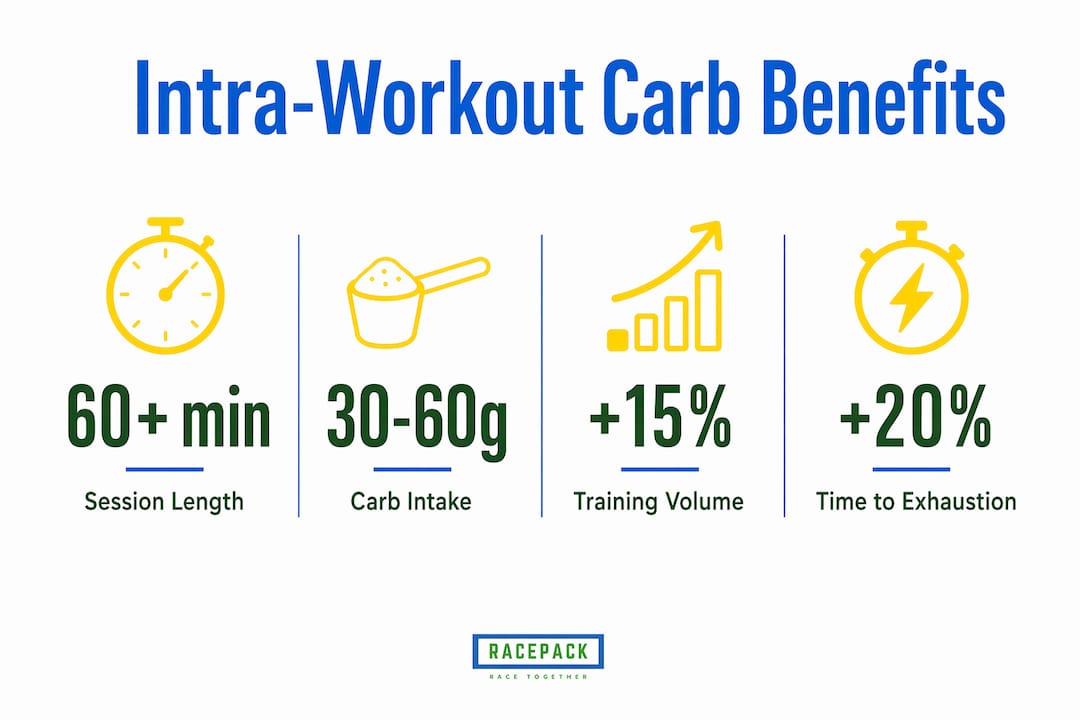
For resistance training specifically, acute carbohydrate ingestion during sessions longer than 45 minutes produces a statistically significant improvement in total training volume, with a standardized mean difference of 0.38. That is a small but real gain. Over weeks and months of training, that extra volume compounds into measurable strength and hypertrophy adaptation.
For endurance athletes, the effect grows with session length. Carbohydrate benefits become pronounced after the first hour and increase markedly between 120 and 180 minutes. The longer your session, the more your performance depends on mid-session fueling rather than pre-workout nutrition alone.
Key mechanisms driving these benefits include:
- Glycogen sparing: Exogenous carbohydrates reduce the rate at which muscle glycogen is oxidized, extending the time before depletion.
- Blood glucose maintenance: Steady glucose supply prevents the drop that triggers central fatigue and reduces power output.
- Muscle protein sparing: Adequate carbohydrate availability reduces reliance on amino acid oxidation for fuel, protecting muscle tissue.
- Reduced perceived effort: Stable blood glucose keeps the brain’s effort perception lower, allowing harder work at the same subjective intensity.
Pro Tip: If you track your session RPE (rate of perceived exertion), try adding 30g of carbohydrates per hour during your next long session. A lower RPE at the same pace or load is a direct signal that your fueling is working.
What are the best carbs for workouts: types, amounts, and timing?
Carbohydrate type matters as much as quantity. Glucose is the primary fuel, but the intestinal transporter that absorbs it (SGLT1) saturates at approximately 60 grams per hour. Consuming more glucose than that does not increase absorption. It just increases the risk of gastrointestinal distress.
The solution is multiple transportable carbohydrates. Fructose uses a separate intestinal transporter (GLUT5), so combining glucose and fructose in a roughly 2:1 ratio allows total absorption of up to 90 grams per hour with less GI distress. This is the science behind glucose-fructose blends used in high-end sports nutrition products.
Standard dosing guidelines from sports nutrition research are straightforward:
- Sessions of 1–2.5 hours: Target 30–60g of carbohydrates per hour using glucose-based sources such as energy gels, chews, or sports drinks.
- Sessions over 2.5 hours: Increase to up to 90g per hour using a glucose-fructose blend to maximize absorption and minimize gut issues.
- Resistance training over 45 minutes: 30–45g per hour is sufficient to support training volume without overloading the gut.
- Timing within the session: Start consuming carbohydrates 30–45 minutes into the session, not at the start. Your pre-workout glycogen handles the early demand.
For athletes who want to understand how energy gel absorption works at a mechanistic level, the transporter saturation concept explains why gel timing and spacing matter more than most athletes realize.
Pro Tip: Gut training is not optional for athletes targeting 60–90g of carbohydrates per hour. Gradually build up your carbohydrate intake in training over several weeks. Your gut adapts, absorption improves, and race-day GI distress drops significantly.
When and for whom are intra-workout carbs most beneficial?
Not every athlete needs carbohydrates mid-session. The benefit depends on session length, intensity, training state, and individual context.
Athletes who benefit most from intra-workout carbohydrate intake:
- Endurance athletes training over 60–75 minutes at moderate-to-high intensity. This is the clearest use case. Glycogen depletion is real and measurable at this duration.
- Athletes doing multiple sessions per day. Athletes training multiple sessions per day or those who train fasted can benefit from intra-workout carbs even in shorter sessions because glycogen stores are already compromised before the session starts.
- Athletes in extreme heat or humidity. High environmental temperature accelerates glycogen use and increases fluid and electrolyte loss, making combined carbohydrate-electrolyte intake more critical.
- Competitive athletes in prolonged events. The fueling strategies used by elite marathon runners demonstrate how precisely timed carbohydrate intake at high doses can sustain race pace for extended periods.
| Session type | Duration | Carb benefit |
|---|---|---|
| Low-intensity steady state | Under 60 min | Minimal to none |
| Moderate endurance | 60–90 min | Moderate, 30–45g/hr |
| High-intensity endurance | 90–180 min | High, 45–60g/hr |
| Ultra-endurance or multi-sport | Over 180 min | Critical, up to 90g/hr |
| Resistance training | Under 45 min | Minimal to none |
| Resistance training | Over 45 min | Small but significant |
For carbohydrate timing strategies specific to HYROX and hybrid events, the principles above apply directly. Those sessions combine strength and endurance demands, making mid-session fueling particularly valuable.
If you want to understand the full picture of glycogen and how it functions during running, the role of glycogen in running covers the physiology in detail.
Common myths about intra-workout carbohydrates
Several misconceptions keep athletes from using intra-workout carbohydrates effectively.
Myth 1: Intra-workout carbs cause fat gain. Adequate carbs during exercise support higher training intensity and better metabolic adaptation without driving fat gain when total daily calories remain balanced. Carbohydrates consumed during exercise are oxidized for fuel, not stored as fat. The concern about fat gain applies to total daily caloric surplus, not to mid-session fueling.
Myth 2: Carbs help in any workout length. Intra-workout carbs provide negligible benefit in sessions under 60–75 minutes. Digestive and absorption lag means the carbohydrates you consume at minute 20 of a 45-minute session are still being processed when you finish. Pre-workout nutrition is the priority for short sessions.
Myth 3: BCAAs are as effective as carbohydrates mid-session. BCAAs added intra-workout provide minimal performance benefit compared to carbohydrates. Carbohydrates remain the primary ergogenic nutrient for sustained training performance. BCAAs have a role in recovery, but they do not replace glucose as an energy substrate during exercise.
“For typical strength training sessions under 60 minutes, pre-workout nutrition is more important than intra-workout carbs. Carbohydrates consumed mid-session in short workouts deliver no meaningful performance benefit because the body simply cannot absorb and oxidize them fast enough to matter.”
Avoiding digestive issues comes down to three practices: start with lower doses, use glucose-fructose blends for higher intake rates, and practice your fueling strategy in training before relying on it in competition. Pair your carbohydrates with adequate fluid intake to support absorption and maintain hydration simultaneously.
Key Takeaways
Intra-workout carbohydrates deliver measurable performance benefits for sessions exceeding 60 minutes, with the greatest gains in endurance events lasting 90 minutes or more.
| Point | Details |
|---|---|
| Session length threshold | Carb benefits are negligible under 60 minutes; significant gains appear after 60–75 minutes. |
| Dosing range | Target 30–60g per hour for most sessions; up to 90g per hour with glucose-fructose blends. |
| Muscle protection | Intra-workout carbs spare amino acids and reduce muscle tissue breakdown during long efforts. |
| Gut training required | Gradually increase carb intake in training to improve absorption and reduce GI distress. |
| Short sessions | Prioritize pre-workout nutrition for sessions under 45–60 minutes rather than mid-session carbs. |
My take on fueling strategy: when carbs earn their place
I have worked with athletes across endurance and strength disciplines, and the most common fueling mistake I see is binary thinking. Athletes either consume carbohydrates for every session regardless of length, or they avoid them entirely out of fear of excess calories. Neither approach is correct.
Intra-workout carbohydrates earn their place when the session demands exceed what pre-workout nutrition can sustain. A 40-minute strength session with adequate pre-workout carbohydrates does not need mid-session fueling. A 90-minute tempo run or a two-hour HYROX training block absolutely does. The decision should be based on session length, intensity, and your glycogen status going in.
The athletes I have seen benefit most are those who combine carbohydrate intake with electrolyte replenishment. Carbohydrates without sodium and fluid support lead to suboptimal absorption and missed hydration. The two work together. Products that combine both in one serving simplify execution and reduce the cognitive load of managing multiple supplements mid-session.
My strongest advice is to practice your fueling strategy in training, not just in competition. Your gut needs to adapt to higher carbohydrate intake rates. Athletes who train their gut consistently perform better on race day because the fueling becomes automatic. If you want a structured approach to nutrition coaching that integrates intra-workout fueling with your overall training plan, working with a qualified sports dietitian accelerates that process significantly.
— Jason John
RacepackSingapore’s picks for intra-workout fueling
Athletes training hard in Singapore’s heat need carbohydrates and electrolytes working together mid-session.
The MyProtein HYROX Electrofuel Electrolyte Powder delivers electrolyte replenishment alongside carbohydrate support, designed specifically for high-intensity and extended training sessions. For athletes who prefer a ready-to-mix drink format, the MyProtein HYROX Electro Drink Mix combines carbohydrates and electrolytes in a single serving, making mid-session fueling straightforward. After your session, the SiS Beta Fuel Recovery Powder supports glycogen replenishment and muscle repair to complete your nutrition strategy. RacepackSingapore ships all three with next-day delivery across Singapore, with guaranteed product authenticity on every order.
FAQ
What is the role of intra-workout carbohydrates?
Intra-workout carbohydrates maintain blood glucose and preserve muscle glycogen during exercise, delaying fatigue and supporting sustained performance in sessions lasting over 60 minutes.
How many carbs should I consume during a workout?
Sports nutrition guidelines recommend 30–60g of carbohydrates per hour for sessions of 1–2.5 hours, and up to 90g per hour for ultra-endurance efforts using glucose-fructose blends.
Do intra-workout carbs help with short gym sessions?
No. Carbohydrates consumed mid-session provide negligible benefit for workouts under 60–75 minutes because absorption lag prevents the fuel from reaching working muscles before the session ends.
What is the best carbohydrate source during exercise?
Glucose-fructose blends are the most effective for sessions requiring over 60g per hour, as they use separate intestinal transporters to maximize absorption and reduce gastrointestinal distress.
Can intra-workout carbs cause fat gain?
No. Carbohydrates consumed during exercise are oxidized for fuel. Fat gain results from total daily caloric surplus, not from mid-session carbohydrate intake.
Do I need carbs during resistance training?
For resistance training sessions exceeding 45 minutes, research shows a small but statistically significant improvement in total training volume with intra-workout carbohydrate intake.
Should I combine carbohydrates with electrolytes during exercise?
Yes. Carbohydrate-electrolyte combinations improve absorption and maintain hydration simultaneously, producing greater performance benefits than carbohydrates alone during prolonged or hot-weather sessions.
What happens if I train fasted without intra-workout carbs?
Athletes training fasted or doing multiple sessions per day have reduced glycogen stores before the session starts. Intra-workout carbohydrates become beneficial even in shorter sessions under these conditions.
How do I avoid stomach issues with intra-workout carbs?
Gut training is the solution. Gradually increase your carbohydrate intake rate over several weeks of training. Your intestinal transporters adapt, absorption improves, and GI distress decreases significantly.
What is the difference between pre-workout and intra-workout carbohydrates?
Pre-workout carbohydrates top up glycogen stores before exercise begins. Intra-workout carbohydrates provide exogenous glucose during the session to supplement depleting glycogen and maintain blood glucose levels throughout.
Are glucose-fructose blends better than glucose alone?
Yes, for intake rates above 60g per hour. Glucose alone saturates its intestinal transporter at approximately 60g per hour. Adding fructose uses a separate transporter, enabling up to 90g per hour of total carbohydrate absorption.
Where can I buy intra-workout carbohydrate supplements in Singapore?
RacepackSingapore stocks the MyProtein HYROX Electrofuel Electrolyte Powder and the MyProtein HYROX Electro Drink Mix, both available with next-day delivery and guaranteed authenticity. Buy now and fuel your next session right.