

Sport Nutrition Timing: Your 2026 Performance Guide
TL;DR:
- Sport nutrition timing involves strategically consuming nutrients around exercise to maximize performance and recovery. It emphasizes proper timing of carbs and protein during pre, intra, and post-workout windows, layered on a consistent daily diet. Personalization based on sport, training, and individual response enhances effectiveness and GI comfort.
Sport nutrition timing is the deliberate scheduling of nutrient intake around physical activity to maximize athletic performance and recovery. Known formally as nutrient timing, this practice goes beyond simply eating well. It specifies when you eat, what you eat, and how much you eat relative to your training sessions. The International Society of Sports Nutrition (ISSN) recognizes nutrient timing as a validated strategy that, when layered on top of solid daily nutrition, accelerates glycogen replenishment, supports muscle protein synthesis, and delays fatigue. For athletes and fitness enthusiasts training in Singapore’s heat and humidity, getting this right is a genuine performance edge.
What is sport nutrition timing and why does it matter?
Sport nutrition timing is defined as the strategic consumption of specific macronutrients at specific intervals before, during, and after exercise. The core idea is simple: your body uses nutrients differently depending on when you supply them relative to physical stress. Feed it at the right moment, and you amplify adaptation. Miss the window, and you leave recovery gains on the table.
The ISSN’s position stand on nutrient timing confirms that total daily macronutrient intake and consistent protein distribution every three hours are more influential on long-term outcomes than any single post-workout meal. That finding reframes the entire conversation. Timing is a multiplier, not a foundation. Build your daily intake first, then use timing to sharpen results.
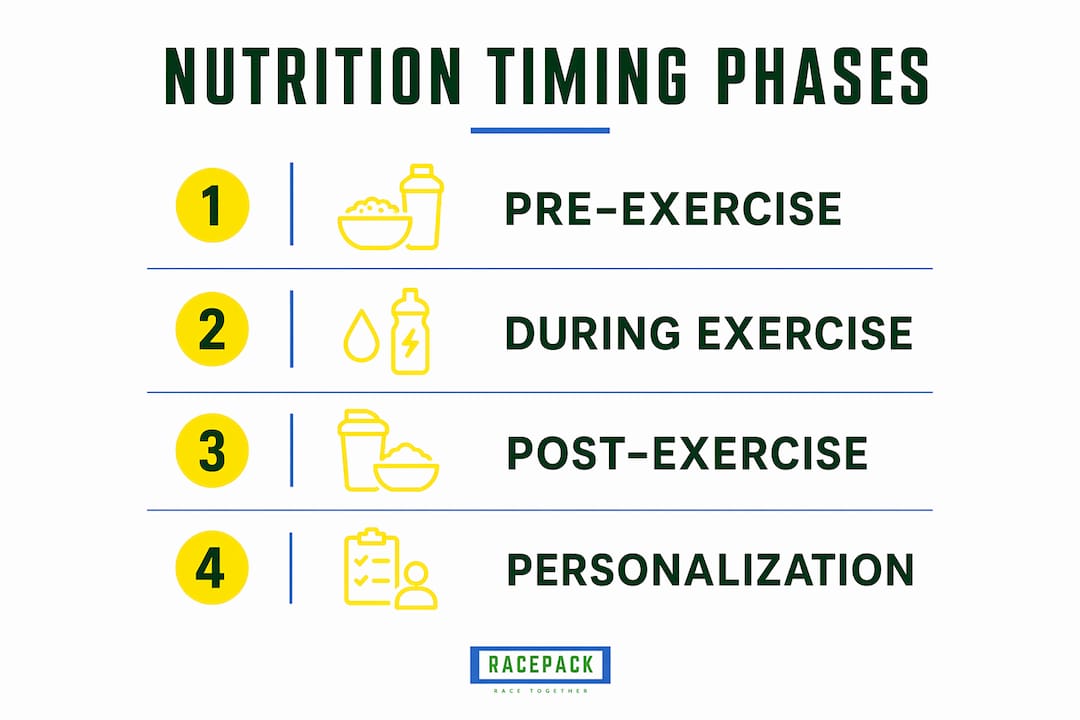
Three phases structure every athlete’s timing plan: pre-exercise, during exercise, and post-exercise. Each phase has distinct nutrient priorities, dose ranges, and timing windows backed by research. Understanding all three gives you a complete sports nutrition strategy rather than a collection of disconnected habits.
What should you eat before a workout, and when?
Pre-exercise nutrition sets the energy baseline for your session. Pre-exercise meals should be consumed 2–4 hours before activity, emphasizing a balanced combination of carbohydrates and moderate protein. That window gives your digestive system time to process the meal and top off glycogen stores without causing discomfort during training.

If you are training early in the morning or have less than two hours before your session, a smaller, carbohydrate-rich snack 30–60 minutes before works well. Think 30–60 grams of fast-digesting carbohydrates: a banana, a rice cake with honey, or an energy gel. The goal is immediate fuel availability, not a full glycogen reload.
Key principles for pre-workout meal timing:
- 2–4 hours out: Balanced meal with rice, oats, or pasta, lean protein like chicken or eggs, and minimal fat or fiber to reduce GI risk.
- 30–60 minutes out: Small, high-carb snack with low fat and low fiber. Keep it simple and familiar.
- Hydration: Start every session already hydrated. Drink 400–600 ml of water in the two hours before training.
- Avoid new foods: Never test unfamiliar foods before a key session or race. Stick to what your gut knows.
Pro Tip: Test your pre-workout meal during lower-stakes training sessions first. What works for a 45-minute run may not work before a two-hour ride. Individual digestive tolerance varies significantly, so build your protocol through trial, not assumption.
For athletes doing longer endurance blocks, carbohydrate loading in the days before a race extends this pre-exercise strategy across an entire week.
How much should you eat during exercise to maintain energy?
Intra-workout nutrition becomes critical once your session exceeds 45–60 minutes. During workouts lasting 45–60 minutes to 2.5 hours, 30–60 grams of carbohydrates per hour maintains blood glucose and delays fatigue. For ultra-endurance events exceeding 2.5 hours, that target rises to 90 grams per hour. That is a meaningful jump, and it requires using multiple carbohydrate sources (glucose plus fructose) to hit it without GI distress.
| Exercise duration | Carbohydrate target per hour | Notes |
|---|---|---|
| Under 45 minutes | 0–15 g (mouth rinse acceptable) | Glycogen stores sufficient |
| 45–90 minutes | 30–60 g | Single carb source works |
| 90 minutes to 2.5 hours | 60–90 g | Mix glucose and fructose sources |
| Over 2.5 hours | Up to 90 g | Requires trained gut; test in training |
Distribute your intake in small, frequent doses rather than large boluses. Taking 20 grams every 20 minutes is easier on your gut than 60 grams at the one-hour mark. Pair carbohydrates with fluids and electrolytes to support absorption and replace sweat losses. Sodium, in particular, drives fluid retention and prevents hyponatremia during long events.
Electrolyte replenishment is not optional for athletes training in Singapore’s climate. Sweat rates here are high, and sodium losses can be significant within a single session. Hydration drinks that combine carbohydrates and electrolytes address both fuel and fluid needs simultaneously, which is why many endurance athletes prefer them over water alone during long efforts.
Pro Tip: Trial your race-day nutrition plan during training, not on race day itself. Your gut adapts to absorbing carbohydrates at high rates, but that adaptation takes weeks of consistent practice. Introduce new gels, chews, or drinks during long training sessions first.
For sport-specific guidance on fueling during long rides, the cycling nutrition guide at RacepackSingapore covers intra-ride fueling in detail.
What is the best post-workout nutrition timing for recovery?
Post-exercise nutrition is where most athletes either win or lose their recovery. Recovery nutrition should prioritize intake within 30–45 minutes after finishing, combining 1.0–1.5 g/kg bodyweight of carbohydrates with 15–25 g of high-quality protein. That combination restores glycogen and triggers muscle protein synthesis simultaneously.
When recovery time between sessions is under eight hours, feeding frequency at 15–30 minute intervals with nutrient-dense foods maximizes glycogen storage and muscle repair. This matters most for athletes training twice a day or competing in multi-event formats. The faster you refuel, the faster you are ready to perform again.
Practical post-workout options that hit both targets:
- Recovery shake: 25 g whey protein plus 50–75 g fast carbohydrates (banana, maltodextrin, or a dedicated recovery powder).
- Chocolate milk: A well-researched option delivering carbohydrates and protein in a convenient ratio.
- Rice and chicken: A whole-food option for athletes who prefer solid meals and have 60+ minutes before their next session.
- Recovery powder: Products like SiS Beta Fuel Recovery deliver a calibrated carbohydrate-to-protein ratio designed specifically for the post-exercise window.
The ISSN clarifies that total daily protein intake of 1.4–2.0 g/kg bodyweight must be met consistently. Timing fine-tunes gains, but it cannot compensate for a daily protein deficit. Hit your daily targets first, then use the post-workout window to accelerate recovery.
For a deeper look at how protein drives repair, the whey protein guide and the protein synthesis explainer at RacepackSingapore are worth reading alongside this article.
How do you personalize nutrition timing for your sport?
No single timing protocol fits every athlete. Personalizing nutrition timing requires accounting for sport type, training volume, sweat rate, and individual metabolic response. The 4Ps framework, Personalise, Periodise, Prefuel, and Prepare, gives athletes a practical structure for building a timing plan that actually fits their life and training demands.
Chrono-nutrition adds another layer. Aligning nutrient intake to biological rhythms supports metabolic stability, improves sleep quality, and enhances long-term recovery beyond what acute timing windows alone can deliver. Eating at consistent times each day, not just around workouts, trains your body’s internal clock to support performance.
Endurance athletes and strength athletes have different timing priorities:
| Athlete type | Pre-exercise focus | During exercise | Post-exercise priority |
|---|---|---|---|
| Endurance (runners, cyclists) | High carbohydrate load | 30–90 g carbs/hour | Carbs first, then protein |
| Strength and power | Moderate carbs, higher protein | Minimal unless session exceeds 60 min | Protein first (20–25 g), then carbs |
| Team sport athletes | Balanced carbs and protein | Carbs for halftime top-up | Combined carbs and protein |
Advanced nutritional periodization takes this further by manipulating carbohydrate availability across training cycles. Training low (reduced carbohydrate availability) on easy days can enhance fat oxidation, while training high on key sessions preserves performance quality. Elite athletes use this deliberately. Recreational athletes can apply a simplified version by saving higher carbohydrate intake for hard training days.
Gastrointestinal tolerance is the most overlooked variable in timing personalization. Many athletes follow a textbook protocol and suffer GI distress on race day because they never tested it under real conditions. Your timing plan must be trained, not just planned.
Key Takeaways
Sport nutrition timing works best when it layers onto consistent daily intake, not when it replaces it.
| Point | Details |
|---|---|
| Pre-exercise window | Eat a balanced meal 2–4 hours out, or a small carb snack 30–60 minutes before training. |
| Intra-workout fueling | Consume 30–60 g of carbohydrates per hour for sessions over 45 minutes; scale up to 90 g for ultra-endurance. |
| Post-exercise recovery | Take 1.0–1.5 g/kg carbohydrates plus 15–25 g protein within 30–45 minutes of finishing. |
| Daily intake comes first | The ISSN confirms total daily protein (1.4–2.0 g/kg) matters more than any single timing window. |
| Personalize with the 4Ps | Use Personalise, Periodise, Prefuel, and Prepare to build a timing plan that fits your sport and body. |
Why I think most athletes overcomplicate nutrient timing
After working with athletes across endurance and strength sports, the pattern I see most often is this: athletes obsess over the 30-minute post-workout window while eating poorly for the other 23 hours. That is the wrong priority order. The ISSN’s own position stand says it clearly. Total daily intake and consistent protein distribution every three hours drive adaptation. Timing refines it.
My honest advice is to start with two anchors: your pre-workout meal and your post-workout recovery. Get those two habits locked in before you think about intra-workout fueling or chrono-nutrition. Once those feel automatic, layer in the next level. Incremental implementation beats an overnight overhaul every time.
The other mistake I see regularly is athletes testing new nutrition products on race day. Your gut is not a lab. Trial your fueling strategy during training, specifically during sessions that mirror race intensity and duration. If a gel causes cramping at kilometer 15 of a training run, it will do the same at kilometer 15 of your race. Respect your GI system. It will tell you what works if you listen during training.
Nutrient timing is a performance edge, not a rigid rulebook. Use it as a tool, adjust it as your training evolves, and always let your body’s signals guide the fine-tuning.
— Jason John
RacepackSingapore products built for your timing protocol
Knowing your timing windows is only half the equation. Having the right products ready at the right moment makes execution consistent.
RacepackSingapore stocks the products that fit every phase of your timing plan. For post-workout recovery, SiS Beta Fuel Recovery Powder delivers a calibrated blend of carbohydrates and protein designed for the 30–45 minute recovery window. It is one of the most practical recovery tools for athletes who train hard and need to be ready again quickly. Browse the full range of protein supplements, energy gels, and hydration drinks from brands like Maurten, SIS, GU, and Optimum Nutrition, all available with next-day delivery across Singapore. Authentic products, no guesswork on sourcing.
Buy Now at RacepackSingapore →
FAQ
What is sport nutrition timing?
Sport nutrition timing is the practice of consuming specific nutrients at strategic intervals before, during, and after exercise to enhance performance and recovery. It is formally recognized by the International Society of Sports Nutrition as a complement to consistent daily macronutrient intake.
When should I eat before a workout?
Eat a balanced carbohydrate and protein meal 2–4 hours before training. If you have less time, a small carbohydrate-rich snack 30–60 minutes before provides immediate energy without GI discomfort.
How many carbohydrates do I need during exercise?
Athletes need 30–60 grams of carbohydrates per hour for sessions lasting 45 minutes to 2.5 hours. Ultra-endurance events exceeding 2.5 hours require up to 90 grams per hour, best delivered through a mix of glucose and fructose sources.
What is the post-workout nutrition window?
The post-workout window is the 30–45 minutes after exercise when your body most efficiently absorbs carbohydrates and protein. Consuming 1.0–1.5 g/kg bodyweight of carbohydrates plus 15–25 g of high-quality protein during this period accelerates glycogen replenishment and muscle repair.
Does nutrient timing replace a good daily diet?
No. The ISSN confirms that total daily protein intake of 1.4–2.0 g/kg bodyweight and consistent macronutrient distribution are more foundational than any single timing window. Nutrient timing amplifies a solid daily diet. It does not substitute for one.
What is chrono-nutrition for athletes?
Chrono-nutrition is the practice of aligning meal timing with your body’s biological rhythms. Research from the Gatorade Sports Science Institute shows it supports metabolic stability, improves sleep quality, and enhances long-term recovery beyond what acute post-workout timing alone delivers.
What is the 4Ps framework in sports nutrition?
The 4Ps framework stands for Personalise, Periodise, Prefuel, and Prepare. It is a practical structure for building a nutrient timing plan tailored to your sport type, training volume, metabolic response, and competition schedule.
How do endurance and strength athletes differ in timing needs?
Endurance athletes prioritize carbohydrate loading before and during exercise, with carbohydrates leading post-workout recovery. Strength athletes prioritize 20–25 g of protein immediately after training, with carbohydrates supporting glycogen restoration afterward.
Should I test my race-day nutrition during training?
Yes, always. Gastrointestinal tolerance varies between athletes, and products that cause discomfort during training will cause the same issues on race day. Test every gel, drink, and recovery product under conditions that mirror your competition intensity and duration.
What products support nutrient timing at RacepackSingapore?
RacepackSingapore carries energy gels from Maurten and GU, hydration drinks with electrolytes, and recovery powders including SiS Beta Fuel Recovery, all suited to pre, during, and post-exercise timing protocols. Next-day delivery is available across Singapore.