

Train Smarter With Garmin Training Readiness: Build a 2 Week Baseline
Garmin Training Readiness is a daily score that estimates how well your body can handle training stress that morning, based on sleep, HRV status, recovery time, and recent training load. A high score means green light for your planned hard session; a moderate score calls for a modified effort; a low or poor score means switch to easy movement or full recovery. Treat the number as a starting point, not a verdict, and confirm it with a short warm-up before you commit to your workout.
TL;DR:
- Consistent overnight wear for at least two weeks is necessary to establish a stable and trustworthy baseline for your training readiness score.
- A score above 85 indicates high performance capacity, making it suitable for intense workouts, while below 50 suggests the need to reduce effort or rest.
- External factors such as illness, travel, inadequate sleep, loose device fit, or recent diving can temporarily skew the score and should be accounted for.
- Reacting to a single low or moderate score is less effective than observing weekly trends and comparing them with actual session performance.
- Using a compatible Garmin watch like the Forerunner 165 or 265, combined with proper habits, optimizes data accuracy and training decision-making.
Table of Contents
- What Is Garmin Training Readiness and What Drives the Score?
- Your Morning Checklist: Turning the Score Into a Training Decision
- Why Your Score Looks Wrong and How to Fix It
- Reading Readiness Trends Instead of Single Days
- Where Racepack SG Fits Into Your Readiness Routine
- Where Training Readiness Falls Short
- The Real Skill Isn’t Reading the Score. It’s Knowing When to Ignore It
- Compatible Garmin Watches for Reliable Training Readiness Data
- Sources
- FAQ
What Is Garmin Training Readiness and What Drives the Score?
Training Readiness pulls together six inputs every morning to produce that single number: last night’s sleep score, your sleep history from the past three nights, HRV status, recovery time, acute training load, and stress history from the past three days. Garmin built the feature specifically to combine overnight physiological signals with your recent training load, so you’re not just guessing whether today is a build day or a back off day, according to Garmin’s own technology documentation.
Sleep score reflects last night specifically, while sleep history smooths that out across three nights so one bad night doesn’t tank your score unfairly. HRV status compares your current heart rate variability to your personal baseline, not to some universal number, which is why two athletes can post wildly different raw HRV readings and still both show “balanced” status. Recovery time counts down the hours your watch estimates you need before your next hard effort, and acute load reflects the training stress you’ve piled up recently relative to what your body has adapted to.
Some devices layer in extra inputs. Dive-capable Garmin watches factor in dive history, and a qualifying dive can suppress the score entirely for a day, which we’ll get into below.
The color zones break down like this, per Garmin’s official manual:
- Prime (85 to 100): Your body is primed for a hard session. Go after intervals, tempo work, or a race simulation.
- High (70 to 84): Solid readiness. Planned hard work is generally safe to proceed with as written.
- Moderate (50 to 69): Middle ground. Fine for steady aerobic work, but reconsider stacking two hard days back to back.
- Low (25 to 49): Your body is signaling accumulated fatigue. Scale volume or intensity down significantly.
- Poor (1 to 24): Recovery day territory. Easy movement or full rest, not a compromise session.
Your Morning Checklist: Turning the Score Into a Training Decision
A number on your wrist means nothing until you turn it into a decision. Here’s the workflow worth building into your routine before you lace up:
- Check the score first thing. Open the widget on your watch or Garmin Connect before you start second-guessing based on how you feel.
- Tap into the contributor breakdown. The app shows which factor is dragging the score down (poor sleep vs. high acute load vs. depressed HRV), and that detail changes what you do next.
- Compare against your planned session. A speed workout scheduled on a Poor day is a different problem than an easy run on a Poor day.
- Warm up before deciding anything final. Run 10 to 15 minutes easy and see how your legs and breathing actually respond.
- Commit or modify. If the warm-up feels normal despite a Moderate score, you can often proceed as planned. If it feels heavy, scale back regardless of what the number said.
Score-to-session adjustments generally look like this: on a Prime or High morning, intervals and tempo runs stay as written, and long runs can include planned surges. On Moderate, keep the long run but drop tempo pace by a notch, or trade intervals for a steady aerobic session. On Low, shrink volume significantly and drop intensity altogether. On Poor, strength work becomes mobility work, and running becomes walking or a rest day.
The rule of thumb for moving versus scaling a key session: if it’s Poor and the session is your single most important workout of the week (a race-pace long run, a key interval session), move it rather than force it through. If it’s Moderate, scale it in place instead of rescheduling, because rescheduling every Moderate day creates a training plan that never actually happens.
Pro Tip: Don’t trust the score in isolation. T3’s breakdown of the feature makes the same point experienced coaches have argued for years: treat Training Readiness as a guide, confirm with a warm-up, and let how your body actually responds in the first ten minutes override a borderline number.
Why Your Score Looks Wrong and How to Fix It
A Training Readiness score that never seems to match how you feel usually traces back to a handful of fixable habits, not a broken feature.
Building a reliable baseline takes time. Most athletes see scores stabilize after two to three weeks of consistent wear, and behavior gets genuinely predictable closer to a month in, according to analysis from Should I Train. If you only wear your watch during workouts and charge it every night, your HRV baseline never fully forms, and the score stays noisy indefinitely.
Common culprits behind a persistently off score include:
- Inconsistent night wear. Skipping overnight wear even a few nights a week starves the algorithm of sleep and HRV data.
- Charging at bedtime. Charge during the day instead, ideally during a shower or a desk-bound stretch of work.
- Noisy HRV readings. Loose strap fit, cold wrists, or alcohol the night before all distort HRV status independent of actual recovery.
- Illness or travel. Both spike stress history and depress the score temporarily, which is the algorithm working correctly, not malfunctioning.
- Outdated firmware. Garmin periodically refines the readiness algorithm, so an unsynced watch may be running a stale model.
- Dive suppression. Devices built for diving suppress Training Readiness for 24 hours after any dive deeper than 4.6 meters or longer than three minutes, since decompression physiology mimics acute stress signals.
If none of that explains a stubborn mismatch, re-establish your baseline by wearing the watch continuously, snug on the wrist, for at least two full weeks before trusting the number again.
Reading Readiness Trends Instead of Single Days
One morning’s score is genuinely noisy. A late dinner, a stressful email, or a poor strap fit can knock ten points off a reading that has nothing to do with actual recovery capacity. The number becomes far more useful once you stop reacting to it daily and start reading it as a trend across a training block, a pattern Qbit backs up with its own weekly-review recommendation.
Cross-check readiness against three other signals before drawing conclusions:
- Training load trend. Is acute load climbing faster than your recovery time is dropping?
- Body Battery. Does your daytime energy pattern match what the morning score predicted?
- Sleep trend and session outcomes. Are your actual workout performances tracking with what the score forecast, or diverging from it?
Review your week every seven days, and reassess before starting any new training block by asking: is my average readiness trending up, flat, or down compared to last month? If your score and your actual performance keep disagreeing, that mismatch is data too. It usually points to something the watch can’t see, like heat stress, under fueling, or sport-specific fatigue that HRV alone doesn’t capture.
Where Racepack SG Fits Into Your Readiness Routine
We built Racepack SG around one idea: performance data only matters if you act on it well. Jason John, who covers training technology for our editorial team, has spent years watching athletes over-index on a single morning number instead of the pattern behind it, and that gap between promise and practice shapes everything we write here.
Readiness scores don’t fuel your sessions. What you eat before, during, and after does. A few practical pairings worth building around your readiness routine:
- On Prime or High mornings before a hard session, fuel properly beforehand using our fuel during training runs guide.
- On Low or Poor mornings, lean on our recovery and wellness guidance rather than pushing through on empty.
- If your recovery drink habits need a rethink, sugar-free options covered in Aboocha’s guide to recovery drinks are worth a look.
Treat readiness as one input among several, then test how it actually maps to your own performance over a full training block.
Where Training Readiness Falls Short
Training Readiness is genuinely useful, but it isn’t a lab test, and it has blind spots worth knowing before you lean on it too heavily.
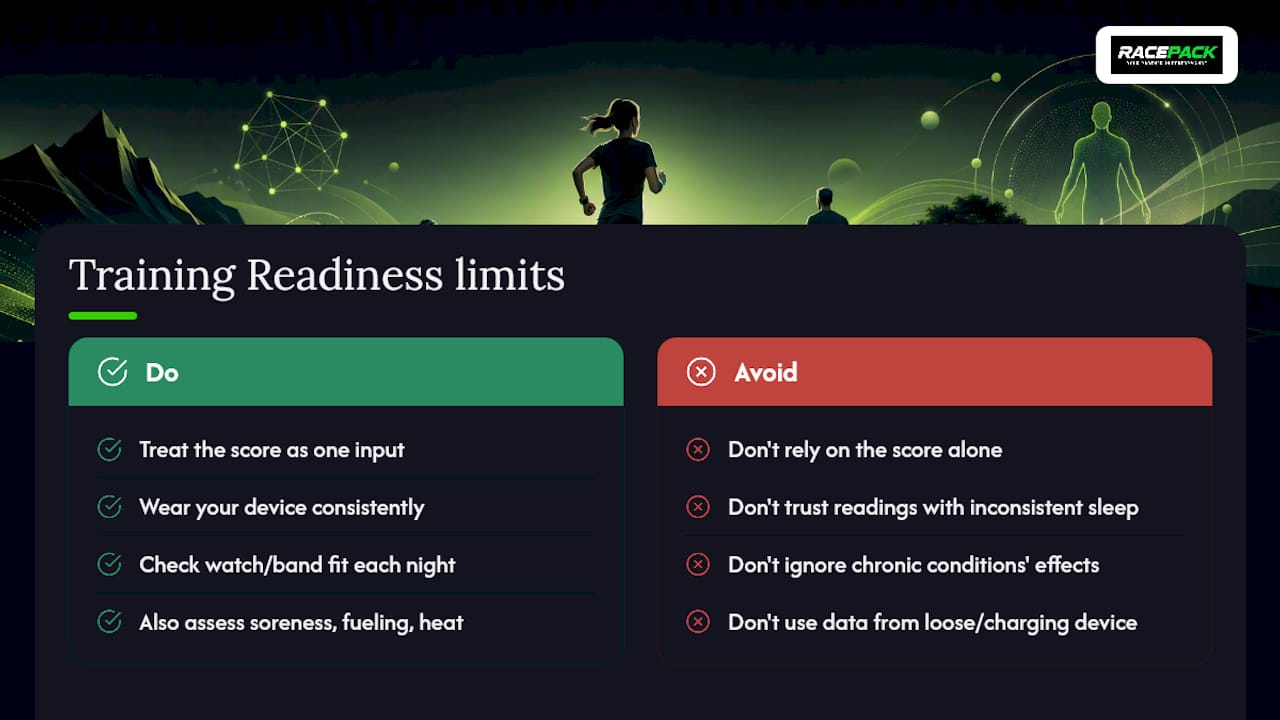
The score is built from population-level algorithms applied to your personal baseline, which means athletes with irregular sleep schedules (shift workers, parents of infants, frequent international travelers) tend to see noisier, less trustworthy readings simply because their baseline data is inconsistent by nature. Masters athletes and anyone managing a chronic condition may also see HRV patterns that don’t map cleanly onto the same thresholds younger or healthier athletes use, since Garmin’s model wasn’t tuned to any specific medical population.
The metric also can’t see everything relevant to training decisions. It has no visibility into muscular soreness from strength work, joint pain, heat acclimation status, or fueling quality, all of which affect how a session will actually go regardless of what your HRV looked like at 4 a.m. Sport-specific fatigue is another blind spot. A cyclist’s legs can be cooked in a way that overnight HRV never registers, because the stress that matters most for tomorrow’s ride happened in the muscles, not the nervous system.
Finally, accuracy depends entirely on wear consistency and device fit. A loose band, a cold night, or a watch left charging overnight during a critical baseline-building period will produce numbers that look precise but mean very little. Use the score as one voice in the room, not the only one.
The Real Skill Isn’t Reading the Score. It’s Knowing When to Ignore It
Most guidance on Training Readiness treats the number like an oracle: check it, obey it, repeat. That framing is backwards. The score is a snapshot built from a handful of physiological proxies, and proxies are approximations, not ground truth.
Where conventional advice falls short is in treating every reading as equally meaningful. A Moderate score after a genuinely hard training week tells you something real. A Moderate score after one bad night’s sleep before an otherwise fresh block tells you almost nothing, and reacting to it by scrapping a key session is overcorrection dressed up as discipline.
What actually matters is the weekly shape of your readiness data, cross-checked against how your sessions actually felt and performed. Athletes who build a two-week baseline, review trends instead of daily blips, and use warm-ups as the tiebreaker get far more value from this feature than athletes who let one low morning derail a training block. The watch is a good advisor. It’s a poor dictator.
— Jason John
Compatible Garmin Watches for Reliable Training Readiness Data
Training Readiness lives or dies on the quality of the overnight data feeding it, which means the watch on your wrist matters as much as the habits around it. Continuous overnight HRV tracking and consistent sleep monitoring require a device built for exactly that job, not a basic step counter wearing a fitness label.
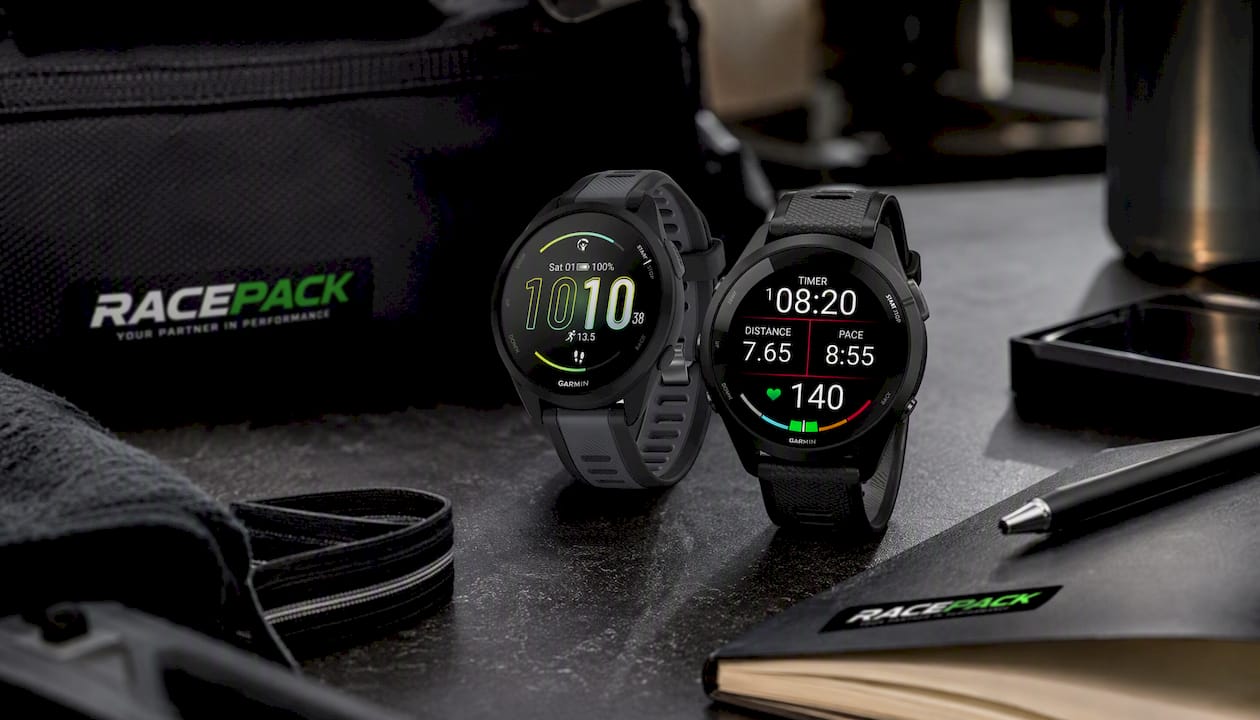
The Garmin Forerunner 165 is a strong entry point if you’re building your first reliable baseline. It handles overnight HRV, sleep tracking, and recovery time cleanly, without unnecessary complexity slowing down your morning check.

The Garmin Forerunner 265 suits athletes running structured training blocks who want deeper contributor detail behind the score, alongside the AMOLED display that makes checking your morning number easier in bright daylight.
Both watches are available with warranty coverage and delivery options. Before you buy, browse our full Garmin smartwatch collection to compare features against your training goals. Once you’ve picked your model, wear it overnight for at least two weeks before judging its accuracy, since that’s how long a stable baseline takes to form. Ready to get started? Buy Now on the Garmin Forerunner 265 or the Garmin Forerunner 165 and start building your baseline this week.
Sources
- Forerunner 965 Watch Owner’s Manual - Training Readiness
- Training Readiness | Garmin Technology
- How Garmin Training Readiness feature explained | T3
FAQ
What Is Training Readiness on a Garmin Watch?
It’s a daily 0 to 99 score, generated each morning, that combines sleep score, sleep history, HRV status, recovery time, acute training load, and stress history to estimate how ready your body is for training stress that day.
How Do I Get Garmin Training Readiness?
You need a compatible Garmin watch such as the Forerunner 165 or Forerunner 265, worn consistently overnight for two to three weeks so the algorithm can establish your personal HRV and sleep baseline.
Is Garmin Training Readiness Worth It?
For athletes who train with structure, yes: it condenses several recovery signals into one actionable number, provided you treat it as a guide and confirm borderline readings with a short warm-up rather than following it blindly.
Why Does My Garmin Say My Training Readiness Is Low?
Low scores usually trace back to poor sleep, elevated stress history, high acute training load, or inconsistent HRV readings caused by loose strap fit, illness, travel, or alcohol the night before.
How Often Does Training Readiness Update?
It recalculates each morning based on the previous night’s data, and it can shift slightly during the day as your watch gathers more recent stress and activity readings.
Can I Trust a Single Day’s Training Readiness Score?
Not entirely. Single-day readings are noisy, so weekly trends compared against your actual training outcomes give a far more reliable picture than any one morning’s number.
Does Diving Affect My Training Readiness Score?
Yes. Dive-capable Garmin watches suppress the score for 24 hours after any dive deeper than 4.6 meters or longer than three minutes, since decompression physiology can mimic acute stress signals.
How Long Does It Take to Establish an Accurate Baseline?
Most athletes see more stable, trustworthy scores after two to three weeks of consistent overnight wear, with behavior becoming genuinely predictable closer to a month.
Should I Skip a Workout if My Score Is Poor?
For your most important sessions, yes, move them rather than force them through on a Poor day. For easier sessions, scaling down volume and intensity is usually enough without a full rest day.
Which Garmin Watches Support Training Readiness?
Most modern Garmin fitness and running watches, including the Forerunner 165 and Forerunner 265, support Training Readiness, though exact contributing metrics can vary by model and firmware version.
Where Can I See My Training Readiness History?
Historical scores and trend graphs live in the Garmin Connect app and on the watch’s glance widget, letting you compare recent readings against several weeks of data at once.