

12-Week Half Marathon Training Plan for Beginners
TL;DR:
- A 12-week half marathon training plan helps beginners gradually build endurance through consistent running, cross-training, and rest days. It emphasizes slow mileage increases, effective pacing, run-walk strategies, and proper tapering to prevent injury and ensure race readiness. Proper nutrition and mental preparation are crucial for completing the race confidently.
The ultimate 12-week half marathon training plan for beginners is a structured, week-by-week schedule that takes you from casual jogger to confident half marathon finisher. This plan suits runners who can already jog or walk continuously for 20–30 minutes. It builds your endurance gradually, protects you from injury, and prepares you mentally and physically for 13.1 miles. You do not need to be fast. You need to be consistent, patient, and willing to follow the process.
How is a 12-week half marathon training plan structured for beginners?
A well-structured weekly schedule includes 3–4 running days, 1–2 cross-training days, and 2 rest days. That balance gives your body enough stimulus to adapt and enough time to recover. Skipping rest days is one of the most common mistakes beginners make.
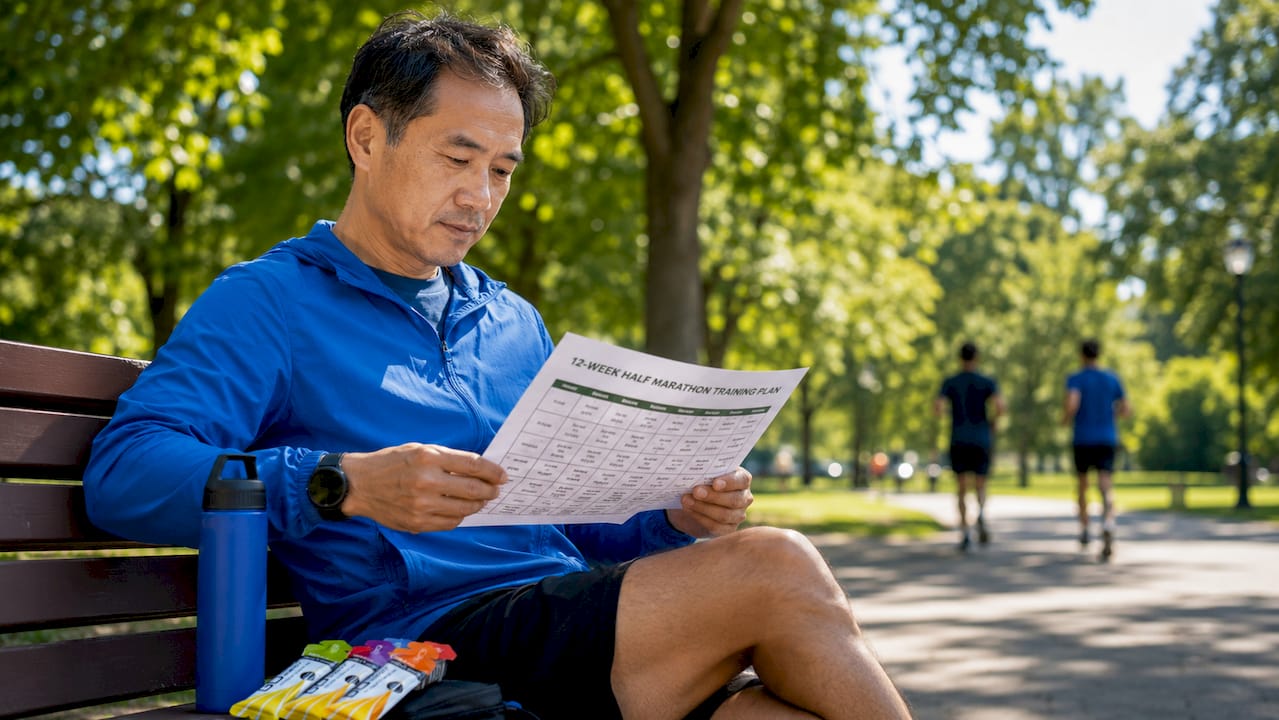
Here is a sample weekly breakdown:
| Day | Activity | Purpose |
|---|---|---|
| Monday | Rest | Full recovery after weekend long run |
| Tuesday | Easy run (30–40 min) | Aerobic base building |
| Wednesday | Cross-training (cycling, yoga) | Active recovery, low impact |
| Thursday | Easy or tempo run (30–45 min) | Build endurance and pace awareness |
| Friday | Rest | Recovery before long run |
| Saturday | Long run | Primary endurance session |
| Sunday | Easy walk or light stretch | Active recovery |
Cross-training options like swimming, cycling, and yoga reduce impact stress while keeping your cardiovascular fitness moving forward. They also prevent the mental fatigue that comes from running every single day. Two full rest days per week are not optional. Rest is a core training component, not a reward for hard work.
What are the key phases and weekly mileage progressions?
The 12-week plan divides into four clear phases. Each phase has a specific purpose, and skipping ahead defeats the whole structure.
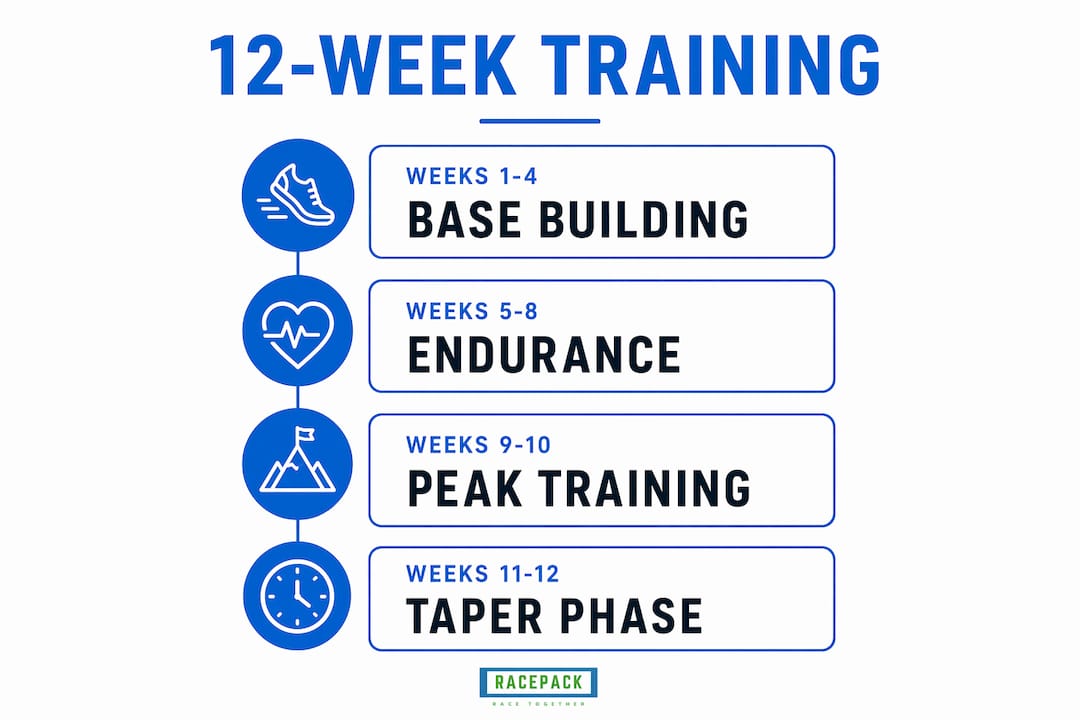
Weeks 1–4: Base building
The first four weeks focus entirely on consistency. Your long run starts at 4–5 miles and grows slowly. Beginners should prioritize consistency over speed during this phase. Running at a conversational pace, sometimes called “gossip pace,” builds your aerobic engine without burning you out. Total weekly mileage stays low, typically 12–18 miles.
Weeks 5–8: Endurance building
This phase introduces slightly longer midweek runs and pushes your long run toward 7–9 miles. You may add one tempo effort per week, meaning a run that feels comfortably hard. The 10% weekly mileage increase rule applies here strictly. Increasing total weekly mileage by more than 10% from the previous week raises your injury risk significantly, particularly for shin splints and IT band syndrome.
Weeks 9–10: Peak training
Your long runs reach their highest point. Peak long runs top out at 10–12 miles two to three weeks before race day. You do not need to run the full 13.1 miles in training. Race-day adrenaline and the taper effect carry you through the final distance.
Weeks 11–12: Taper
Tapering reduces training volume by 30–40% in the final two weeks. Your last long run of 5–6 miles should fall about seven days before race day. Tapering feels uncomfortable for many runners. Your legs may feel heavy or restless. That is normal. Your body is storing energy and repairing tissue.
| Week | Long Run Distance | Total Weekly Mileage |
|---|---|---|
| 1 | 4 miles | 12 miles |
| 3 | 5 miles | 15 miles |
| 5 | 7 miles | 18 miles |
| 7 | 9 miles | 22 miles |
| 9 | 11 miles | 26 miles |
| 11 | 6 miles (taper) | 18 miles |
| 12 | 3 miles (taper) | 10 miles |
How to implement effective pacing and run-walk strategies?
Conversational pace is the single most important concept in beginner half marathon training. If you cannot hold a short conversation while running, you are going too fast. Running too hard in the early weeks leads to burnout and injury, not fitness gains.
Run-walk strategies are effective for beginners to complete the distance sustainably. A common approach is running for 3–4 minutes, then walking for 1 minute. This method reduces cumulative fatigue and improves race completion rates. Many experienced runners use this technique on race day without any stigma attached.
Pacing tips for beginner runners:
- Run your easy days truly easy. If it feels too slow, it is probably right.
- Use the talk test: speak a full sentence without gasping.
- Never run two hard efforts on back-to-back days.
- Start your long run slower than you think you need to.
- Walk through water stations on race day to drink safely.
Common pacing mistakes to avoid:
- Starting race day too fast because of crowd energy.
- Skipping easy runs and replacing them with harder efforts.
- Ignoring pace data and running by feel alone on long runs.
- Comparing your pace to other runners in your training group.
Pro Tip: Use a GPS watch or a free running app to track your pace in real time. Knowing your pace per mile removes guesswork and keeps you honest on easy days. A running cadence guide can also help you run more efficiently at any pace.
What are the best cross-training activities and recovery tips?
Low-impact cross-training protects your joints while building fitness. Swimming, cycling, and yoga are the three most effective options for beginner runners. Swimming builds lung capacity and upper body strength without any impact stress. Cycling maintains cardiovascular fitness on days when your legs need a break from pavement. Yoga improves flexibility and reduces muscle tightness, particularly in the hips and hamstrings.
Ignoring rest leads to burnout and injury cycles that can end your training entirely. Moderate, consistent effort yields better results than aggressive training followed by forced rest. Think of rest days as part of your training, not a break from it.
Cross-training and recovery best practices:
- Swim or cycle on cross-training days at a light to moderate effort.
- Practice yoga or foam rolling after every run to reduce soreness.
- Sleep 7–9 hours per night. Sleep is when your muscles actually repair.
- Drink water consistently throughout the day, not just during runs.
- Eat a meal with carbohydrates and protein within 45 minutes of finishing a long run.
Nutrition plays a direct role in recovery. Glycogen replenishment after long runs restores the fuel your muscles burned. Protein supports muscle repair. Both matter more as your weekly mileage increases. For a deeper look at how protein supports your training, the protein guide for runners from RacepackSingapore covers the essentials clearly.
Pro Tip: Pay attention to unusual fatigue, persistent soreness, or mood changes. These are early signs of overtraining. Reduce your mileage by 20–30% for one week before resuming your plan.
How to prepare mentally and physically for race day?
The final two weeks of your training plan are about preparation, not fitness gains. Your fitness is already built. The taper period lets your body absorb all the work you have done. Many beginners feel anxious during taper weeks because they are running less. Trust the process.
Carb loading in the days before your race tops up your glycogen stores and gives you maximum fuel for race morning. Focus on familiar foods. Race week is not the time to experiment with new meals or supplements.
Race-day preparation checklist:
- Lay out your gear the night before: shoes, socks, race bib, and nutrition.
- Eat a familiar, carbohydrate-rich breakfast 2–3 hours before the start.
- Arrive at the race venue early to warm up and find your starting corral.
- Carry or plan to use energy gels at miles 4–5 and again at miles 8–9.
- Start at the back of your pace group and resist the urge to go out fast.
- Know the course water station locations before you start.
Mental preparation matters as much as physical readiness. Visualize crossing the finish line during your taper runs. Break the race into thirds mentally: the first third is easy, the middle third is steady, and the final third is where your training pays off. You have done the work. Race day is the celebration.
Key Takeaways
A successful first half marathon requires a structured 12-week plan that builds mileage gradually, prioritizes recovery, and uses smart pacing from the very first week.
| Point | Details |
|---|---|
| Start with a fitness base | You need to jog or walk for 20–30 minutes before beginning the 12-week plan. |
| Follow the 10% rule | Never increase total weekly mileage by more than 10% from the previous week. |
| Peak at 10–12 miles | Your longest training run reaches 10–12 miles; race-day adrenaline covers the rest. |
| Taper in weeks 11–12 | Reduce volume by 30–40% to let your body absorb training and arrive fresh. |
| Use run-walk freely | Run-walk intervals are a proven strategy, not a sign of weakness, for beginner runners. |
What I have learned coaching beginner runners through their first half marathon
Most beginner runners come to their first half marathon training plan with the same fear: they think they are not fast enough. Speed is irrelevant at this stage. The runners who finish their first half marathon are the ones who showed up consistently, ran their easy days easy, and respected their rest days.
The biggest mistake I see is running too hard on easy days. Runners feel good in weeks 3 and 4, so they push the pace. Then they hit week 7 exhausted and injured. The conversational pace rule exists for a reason. If you can sing a verse of a song while running, you are at the right effort level.
Run-walk strategies deserve more credit than they get. Walking during a race is not failure. It is a tool. Some of the most experienced ultramarathon runners in the world use walk intervals strategically. For a beginner, walking for one minute every four minutes can be the difference between finishing strong and hitting the wall at mile 10.
Celebrate every long run you complete. Each one is proof that your body is adapting. The half marathon distance feels impossible in week 1 and completely achievable by week 10. That shift in confidence is the real training outcome.
— Jason John
Fuel your training with the right race nutrition
Every long run in your 12-week schedule is a chance to practice your race-day nutrition. What you eat and drink during training runs directly affects how you perform on race day.
RacepackSingapore stocks the energy gels trusted by endurance runners across Singapore. SiS GO Isotonic Energy Gels deliver clean, low-sugar energy without needing water to absorb them, making them ideal for runs where water stations are limited. For longer efforts, SiS Beta Fuel Gels combine carbohydrates with nootropics to support both physical output and mental focus in the final miles. GU Energy Gels are a proven choice for sustained energy across extended endurance activity. Practice with your chosen gel on every long run above 7 miles so your stomach is fully adapted before race day.
FAQ
What fitness level do I need to start a 12-week half marathon plan?
You need to jog or walk continuously for 20–30 minutes before starting. Runners with lower fitness should build a walking base first, or consider a 16-week plan.
How many days per week should a beginner run during half marathon training?
The optimal weekly schedule includes 3–4 running days, 1–2 cross-training days, and 2 full rest days. This balance supports adaptation and prevents overuse injuries.
Do I need to run 13.1 miles before race day?
No. Peak long runs reach 10–12 miles in training. Race-day adrenaline and the taper effect carry you through the final distance.
Is it okay to walk during a half marathon?
Yes. Run-walk intervals are a proven strategy for beginner runners. Walking during a race reduces fatigue and improves your chances of finishing strong.
When should I start taking energy gels during the race?
Take your first gel at miles 4–5, before you feel tired, and a second gel at miles 8–9. Practice this exact timing on your long training runs to confirm your stomach tolerates your chosen gel.
How do I avoid injury during half marathon training?
Follow the 10% weekly mileage rule and never skip rest days. Most beginner injuries come from increasing mileage too fast or running too hard on easy days.
What should I eat the week before my half marathon?
Focus on carbohydrate-rich meals in the final three days before race day to top up glycogen stores. Stick to familiar foods and avoid anything new or high in fiber.
What energy gels work best for a beginner half marathoner?
SiS GO Isotonic Energy Gels, SiS Beta Fuel Gels, and GU Energy Gels are all well-suited for half marathon distances. Choose one, practice with it on long runs, and buy your race nutrition well before race week so you are never scrambling last minute.
How does tapering help my performance?
Tapering reduces training volume by 30–40% in the final two weeks. This lets your muscles repair, glycogen stores refill, and your body arrive at the start line fresh rather than fatigued.
Can I follow this plan if I have never run a race before?
Yes. This plan is built specifically for first-time racers. Pair it with a beginner marathon guide from RacepackSingapore for additional context on race-day logistics and long-distance preparation.